Act II: Why I Came Back in Coveralls
I had not planned to return to Atlantic Naval Command Academy.
Some places are too deeply fused to the bones to revisit without cost. The academy was one of mine. It taught me celestial navigation, operational command, and the exact flavor of loneliness that comes from being the first person in a room no one had imagined needing to make space for.
At nineteen, I learned to survive there.
At thirty-eight, I came back to decide whether it deserved to survive itself.
The orders arrived on a Tuesday night in Norfolk while I was still in engine-room coveralls from a training review aboard the Halsey. The Secretary wanted a new command structure installed before the autumn intake. Officially, it was a leadership transition.
Unofficially, it was an intervention.
Complaints had been building for months.
Racialized hazing hidden under “tradition.” Women in tactical tracks routed away from key assignments. Anonymous reports of humiliation rituals in hallways, maintenance bays, and late-night drills. Nothing spectacular enough to make headlines. That was the design. Institutions prefer their abuse procedural.
My name appeared because I had two things the academy board needed and feared.
A record they could not publicly discredit.
And a memory long enough to recognize their old tricks in new uniforms.
I knew Nolan Pike before I ever met him.
Not personally.
By type.
Golden boy. Third-generation naval family. Excellent evaluations from the sort of commanders who confuse confidence with leadership. Noted for presence, discipline, and “strong corridor control,” which is the kind of phrase people write when they are too lazy or complicit to name intimidation for what it is.
Three anonymous complaints mentioned him directly.
One called him “the man who turns hallways into little courts.”
Another said, “He humiliates people before he corrects them because the audience is the point.”
The third, written by someone who had probably deleted and retyped the sentence six times before submitting it, said simply: “He always chooses the person least likely to hit back.”
That last line stayed with me.
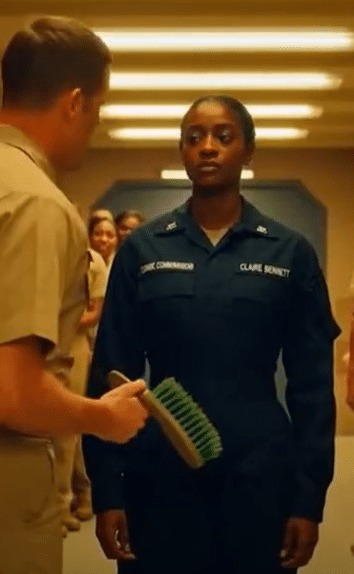
So when the academy arranged a formal command welcome with dress whites, photos, speeches, and a donor luncheon I did not want, I changed the terms. I told them I would arrive early, inspect quietly, and enter the building as I pleased.
Hence the coveralls.
Hence the hallway.
Hence Nolan Pike, standing above a scrub brush he had dropped for me in front of cadets who needed to learn exactly what this building had been rewarding while no one senior was looking.
The red light above the elevator was part of the old command protocol system. It only flashed for high-level arrival overrides or emergency access. Most cadets had never seen it used outside drills. That was why the corridor shifted before the doors even opened.
The laughter died first.