A Waitress, A Starving Father, And The Dimes That Changed A Town

Part 2
I thought that was the end of it.
I thought Marcus would disappear into the Ohio night with his little girl on his hip, his stomach full, his pride still standing, and his dimes resting beside my register like a sacred offering.
But I was wrong.
Because some people don’t walk into your life by accident.
Some people arrive like a quiet test.
And by morning, that test had spread through our entire town.
I didn’t know that yet, though.
All I knew was that I stood by the diner window long after Marcus’s old pickup disappeared beyond the blinking yellow light at the intersection.
His daughter’s laughter still seemed to hang in the air.
So did the smell of pancakes.
Sal came out from the kitchen wiping his hands on a towel.
“You did good, Bren,” he said.
I didn’t turn around.
“I lied,” I whispered.
Sal gave a low grunt. “Best lie I heard all week.”
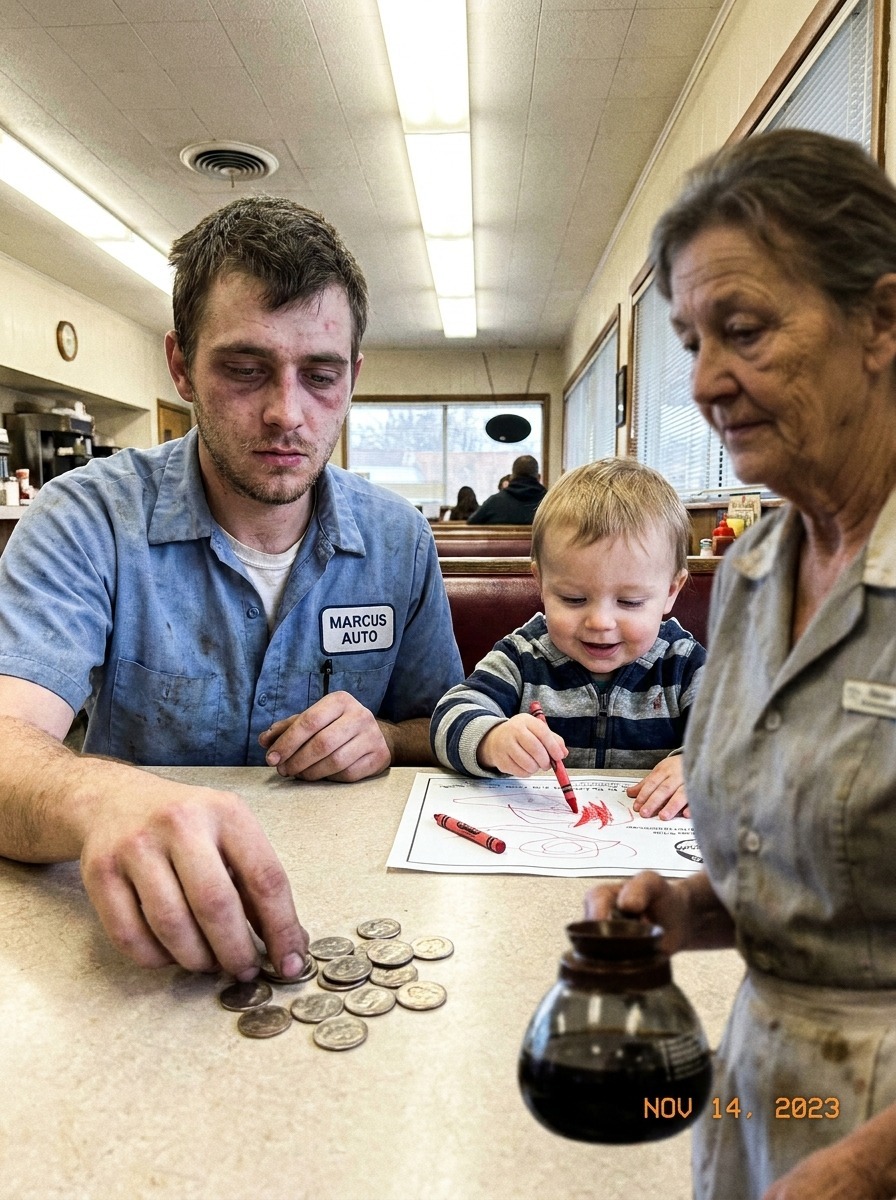
I looked down at the little pile of dimes Marcus had left on the counter.
Two dollars and fifty cents.
Every coin dull.
Every coin heavy.
I picked them up one by one and dropped them into an empty coffee mug beneath the register.
“What are you doing?” Sal asked.
“Saving them.”
“For what?”
I didn’t know yet.
So I just said, “For something.”
Sal didn’t press me.
That was one of the reasons I liked him.
He acted like he didn’t care about anything, but his heart was bigger than the griddle he stood behind every night.
The rest of my shift dragged by.
Two truckers came in for coffee.
A young couple split a piece of pie.
An old widower named Mr. Hanley sat at the counter and pretended to read the paper even though I knew he just came in so he wouldn’t have to eat toast alone at home.
Normal things.
Small-town things.
But nothing felt normal anymore.
Because every time the door opened, I looked up hoping it was Marcus again.
It wasn’t.
At two in the morning, I wiped down the counters.
At three, I refilled the sugar shakers.
At four, I counted my tips.
Twenty-seven dollars and eighteen cents.
And one coffee mug full of dimes I refused to touch.
When my shift ended, I took the mug home with me.
I set it on my kitchen table beside a stack of bills and a framed photo of my son in his graduation gown.
Then I sat there in the gray light before dawn and cried harder than I had cried in years.
Not because I was sad.
Not exactly.
I cried because I remembered what hunger does to a parent.
It doesn’t just empty your belly.
It hollows out your voice.
It teaches you how to smile while breaking.
It makes every cashier’s glance feel like judgment.
It makes every coin sound too loud.