The vet was kind.
Honest, but kind.
She listened to his heart.
Checked his teeth.
Pressed along his spine.
Amos tolerated it with the exhausted patience of someone who had been through too much to be dramatic.
“He’s old,” she said gently.
“I know.”
“He has arthritis. His kidneys are not perfect. His hearing is probably poor. His vision is limited.”
“I know.”
She looked at me carefully.
“He may need extra care.”
I nodded.
Then she said the sentence everyone seemed to be thinking.
“You understand this may not be a long adoption.”
I looked at Amos.
He was sitting on the metal table with his folded ear crooked sideways, staring at the wall like he had better places to be.
“No,” I said. “But it’s still a real one.”
The vet smiled then.
Not a pity smile.
A real one.
“That’s the best answer,” she said.
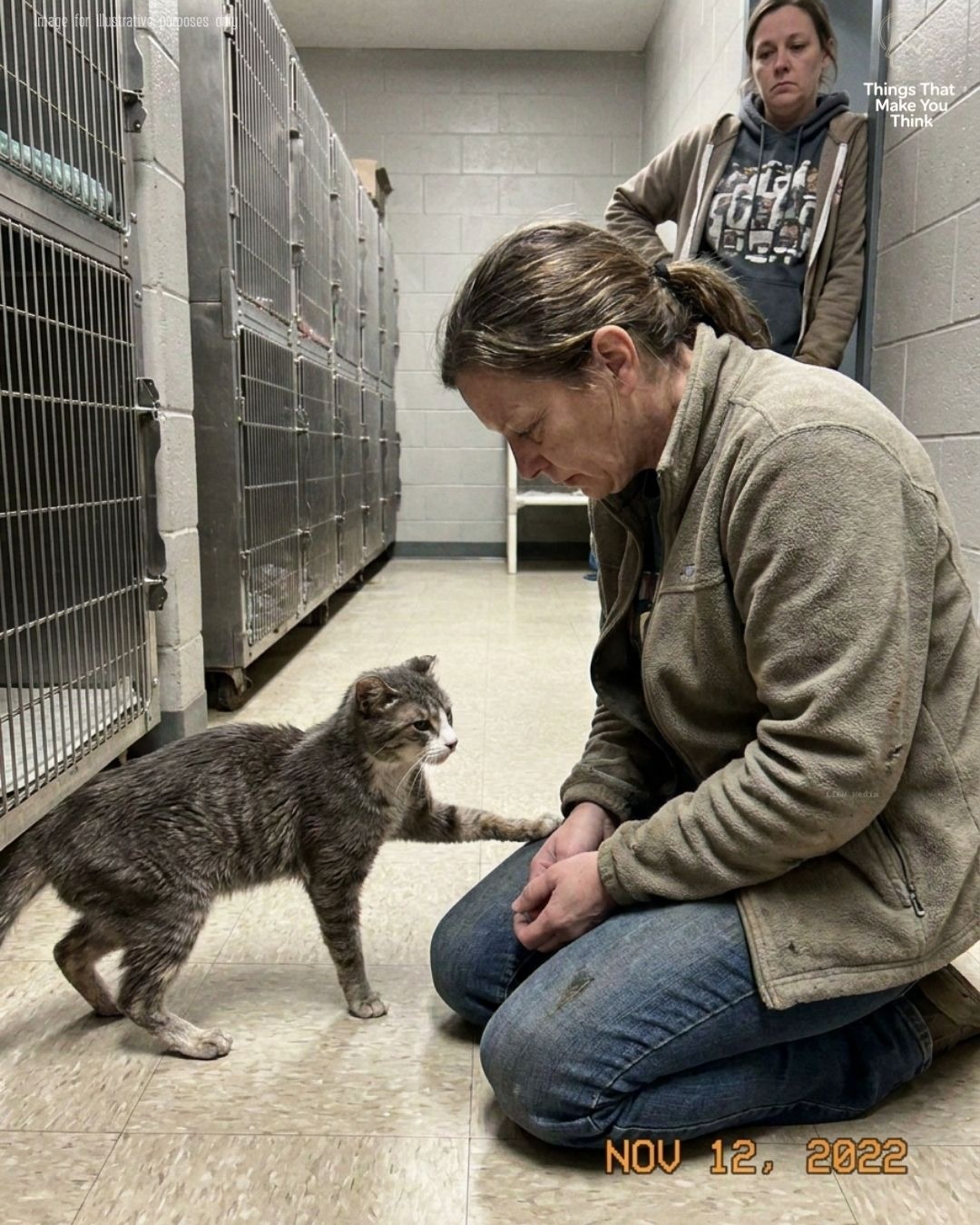
On the way home, I stopped at the shelter.
I had brought back the carrier blanket they had loaned me.
Marnie was at the desk again.
Same sweatshirt.
Same tired eyes.
Same cat hair.
But when she saw Amos in the carrier, her whole face opened.
“Well, look at you,” she said.
Amos blinked slowly at her.
Marnie put one hand over her heart.
“He looks different.”
“He sleeps in my bed now,” I said.
Marnie laughed under her breath.
“I figured he would.”
Then I asked the question I had been avoiding.
“Do people ever come back for the old ones?”
Marnie’s smile faded.
“Sometimes.”
That one word said enough.
Behind her, a family was filling out papers for a kitten.
Two children were arguing over names.
One wanted Pumpkin.
The other wanted Rocket.
Their parents looked tired and happy.
I watched them and felt no resentment.
Kittens deserve homes too.
Every living thing deserves to be wanted at the beginning.
But something about the old ones at the end haunted me.
“How many senior cats are here right now?” I asked.
Marnie looked toward the back hallway.
“Too many.”
She did not say it like a statistic.
She said it like a prayer that had gone unanswered.
That night, I took a picture of Amos.
Not a cute one.
Not a polished one.
He was lying on my old blue blanket with one paw stretched toward my hand.
His eyes were half closed.
His whiskers bent in different directions.
A little bit of food was stuck on his chin.
I almost wiped it off before taking the photo.
Then I didn’t.
That was Amos.
Old.
Messy.
Here.
I posted the picture with a few words.
This is Amos. He is eighteen. He spent eleven months in a shelter because people thought his best years were gone. Tonight he is asleep on my bed. Please don’t forget the old ones.
I expected maybe twelve likes.
Mostly from women I knew from church, work, and the neighborhood.
By morning, there were hundreds of comments.
By lunch, there were thousands.
Some made me cry.
Some made me angry.
Some made me sit very still at the kitchen table while Amos ate breakfast like none of it concerned him.
“My senior cat gave me the best six months of my life.”
“I adopted an old dog and he passed after three weeks. I would do it again.”
“My mother is in assisted living and says the same thing: people stop visiting when you get old.”
Then came the other kind.
“Why spend money on an animal that old?”
“That’s just setting yourself up for heartbreak.”
“Shelters should focus on animals with more years left.”