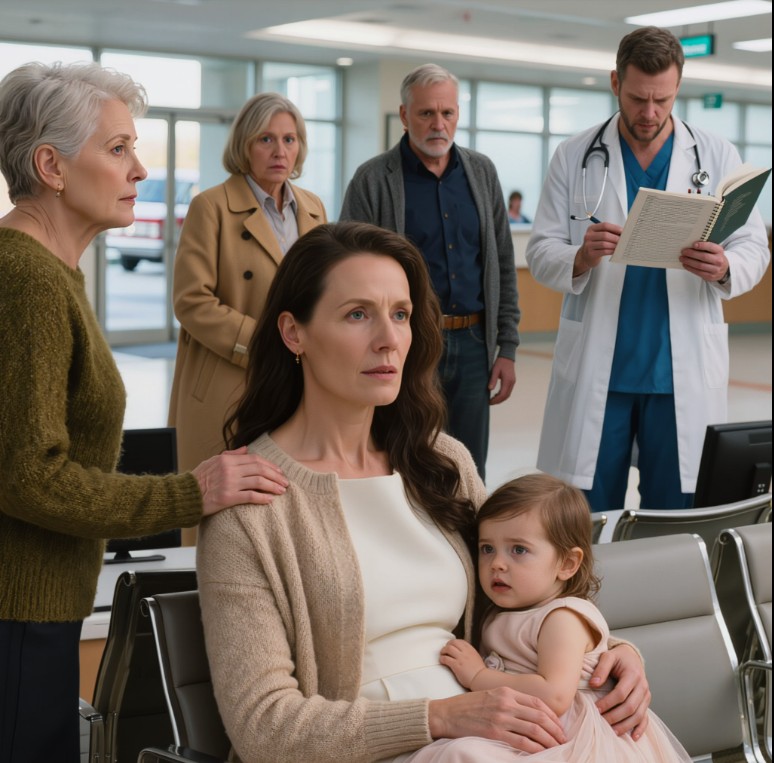
“Sarah, please. We’re going to lose our apartment. We can’t afford it without your help. Just give us a few more months to figure things out.”
“You had eight years to figure things out. I’m done subsidizing your life while you treat me like I don’t exist.”
“But where will we go? What will we do?”
“I don’t know, Mom. Maybe Marcus can help. He’s the successful one, right? The one who takes such good care of you.”
I pulled my arm free and followed the nurse down the hallway.
Behind me, I could hear my mother’s voice rising, calling my name.
I didn’t look back.
Dr. Chin’s examination room was quiet and calm. He checked my incisions, reviewed my test results, and smiled.
“You’re healing beautifully. Your heart rhythm is perfect. Whatever you’re doing, keep doing it.”
“I cut toxic people out of my life,” I said. “Turns out that’s good for cardiac health.”
He laughed.
“Best medicine there is.”
When we finished, Patricia was waiting in the hall with Emma.
But there was someone else with them.
Dr. Morrison, the ER physician who had been on duty the night I came in.
“Sarah,” he said warmly. “Good to see you up and walking. How are you feeling?”
“Much better, thank you. You saved my life that night.”
“We all did our jobs. But listen, I wanted to talk to you about something. I was just in the waiting room, and I couldn’t help but overhear your conversation with those people. Are they your parents?”
My stomach dropped.
“Yes. I’m sorry if they caused a scene.”
“No, nothing like that.”
But he hesitated.
“Sarah, I need to tell you something. The night you came in, when your condition was unstable, I asked who your emergency contact was. You said your parents. I called them while you were in surgery.”
The world tilted.
“You what?”
“I called the number you gave me. Your mother answered. I identified myself as an ER physician at County General and told her you were in critical condition, undergoing emergency cardiac surgery, and that she should come to the hospital immediately.”
“What did she say?”
Dr. Morrison’s expression turned grim.
“She asked if you were going to make it through the next two hours. I said I didn’t know, but that your condition was serious and unstable. She said, and I’m quoting from what I documented, ‘If she’s still stable in two hours, I’ll think about coming by tomorrow. We have plans tonight.’ Then she hung up.”
The room spun.
I sat down hard on a bench in the hallway.
“I documented the call in your chart,” Dr. Morrison continued. “I’ve been a physician for twenty-three years, and I have never had a family member respond that way to a life-threatening emergency. I wanted you to know because I heard them in the waiting room saying they didn’t know it was serious. They knew, Sarah. They absolutely knew, and they chose not to come.”
Patricia’s hand was on my shoulder, steadying me. Emma was in her arms, playing with her necklace, oblivious.
“Why are you telling me this?” I whispered.
“Because you looked like you might be wavering. Like maybe you were second-guessing your decision to cut them off. And I wanted you to know that your decision was the right one. Parents who respond that way to their child’s medical emergency…”
He shook his head.
“You deserve better. That little girl deserves better.”
“Thank you,” I managed. “Thank you for telling me.”
He nodded and walked away.
I sat there for a long moment, processing.
They had known the whole time.
They had known how serious it was, and they had gone to the concert anyway.
And now they were out in that waiting room, rewriting history, pretending they had been victims of my poor communication.
Patricia sat down beside me.
“You okay, honey?”
“Yeah,” I said slowly. “Yeah, I think I actually am.”
We stood to leave, heading toward the exit.
As we passed the waiting room, my parents were still there talking to the receptionist, probably trying to find out when my next appointment was.
My father saw me and started to stand.
I met his eyes and shook my head once.