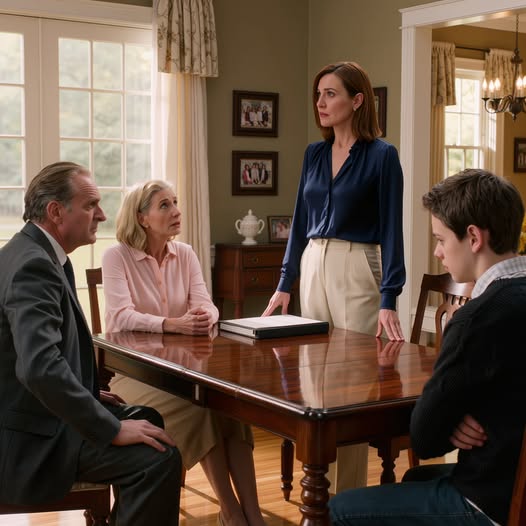
If I asked my dad to look at a drawing, he would mutter that he was busy checking Carter’s college fund. If I asked my mom to come to a parent-teacher conference, she would sigh and complain that it conflicted with Carter’s tutoring schedule.
I learned to swallow my words. I learned to stop sharing my joys because having them ignored hurt a thousand times worse than keeping them to myself.
But a child can only shrink herself down so much before she starts to suffocate. The real breaking point, the day I stopped trying to exist in their world entirely, happened when I turned sixteen.
If there is one birthday American culture tells you is supposed to be magical, it is your sixteenth. You watch the movies, you see the shows, you see your friends at school getting cars with giant red bows or surprise parties, or at the very least, a nice dinner with a cake.
I did not expect a car. I was not delusional. But I had dropped hints for months.
I had circled things in catalogs. I had casually mentioned restaurants I wanted to try. I just wanted one day, twenty-four hours, where the focus was on me.
The morning of my birthday, I woke up an hour before my alarm. I lay in bed, my heart actually fluttering with this stupid, stubborn hope.
I put on my favorite outfit, fixed my hair, and walked downstairs to the kitchen. I expected a balloon, maybe a card on the counter, maybe just my mom turning around from the stove and saying, “Happy birthday, sweetie.”
I walked in.
My dad, Craig, was sitting at the island, fiercely typing on his laptop, completely absorbed in some bank report. My mom, Brenda, was standing in front of Carter.
Carter was nineteen at the time, home from his freshman year of college, and he was getting ready for an interview for a highly competitive, prestigious pre-law summer internship.
Brenda was frantically adjusting his tie and smoothing his shoulders, her voice a high-pitched buzz of nervous energy.
“You remember what we practiced?” she was saying to him. “Firm handshake. Look them right in the eye. Mention your dad’s connections if you have to.”
I stood in the doorway for a full minute. Neither of them looked up.
Finally, I walked over to the fridge to get a glass of orange juice. My mom stepped back, admired Carter, and clapped her hands.
“Perfect,” she said. “Craig, get the keys. We can’t be late.”
My dad snapped his laptop shut. “Right. Let’s go, son. Big day.”
They bustled toward the garage door. I stood there holding my glass of juice.
“Have a good interview,” I said quietly.
Carter threw a thumbs-up over his shoulder. My parents did not even acknowledge I had spoken.
The door slammed shut, and the house fell into that heavy, oppressive silence. They were gone. They had completely, entirely forgotten my birthday.
I went to school. I did not tell anyone it was my birthday because the thought of someone pitying me was worse than the neglect.
When I got home that afternoon, the house was empty. They were still out, probably taking Carter to a celebratory late lunch. I went up to my room and sat on the edge of my bed.
I did not turn on the lights. I just sat there as the sun went down, watching the shadows stretch across my floor.
Around 8:00 p.m., I heard the garage door open, laughter echoing up the stairs, and the clinking of glasses. They were in a great mood.
I went downstairs. They were in the kitchen eating leftover pizza they had picked up on the way home.
My mom looked at me, completely unbothered.
“There’s cold pizza in the box if you’re hungry, Blair,” she said.
That was it. That was the entirety of my sixteenth birthday. Eating a cold slice of pepperoni pizza in the glow of the open refrigerator door while my family celebrated my brother’s internship in the next room.
I did not scream. I did not throw a tantrum.
I realized, with a chilling clarity no one should have at sixteen, that I was profoundly and entirely alone. I was a tenant in their house, not a daughter.
That night, lying in the dark, something inside me snapped. The desperate need for their validation, the endless, exhausting cycle of trying to impress them, just died.
It burned out completely. I decided right then and there that I was going to build a life so big, so undeniably successful, that their opinion of me would not matter.
I just needed a way out.
My escape route presented itself at the beginning of my junior year of high school. I needed an elective credit, and the easiest one to fit into my schedule was a multimedia and video production class.
I walked into that room expecting an easy A, just a place to sit quietly in the back and zone out. But then I met Mrs. Diane Higgins.
Mrs. Higgins was a tornado of a woman. She had wild curly hair, paint on her jeans, and an intensity that made you sit up straight.
On the first day of class, she did not hand out a syllabus. She held up an old, bulky digital camera like it was a weapon.
“This,” she told us, “is how you control the narrative. The world is a messy, chaotic, unfair place. But through this lens, you get to decide what matters.”
“You get to frame the story. You get to cut out the garbage and highlight the beauty.”
For a kid whose entire existence felt out of control, whose own family had written her out of their narrative, those words hit me like a physical blow.
I checked out a camera that afternoon and did not put it down for two years.
I started filming everything. Not people at first. People disappointed you.
I filmed the way rain hit the pavement outside my bedroom window. I filmed the abandoned train tracks on the edge of town. I filmed the harsh flickering neon sign of the diner down the street.
I would take hours of useless footage and bring it back to the school’s clunky desktop computers. That was where the real magic happened: the editing room.
The first time I opened the editing software, it looked like an airplane dashboard. It was terrifying and complex, but I was obsessed.
I spent every lunch period, every free hour, and every day after school sitting in that dark, air-conditioned lab. While Carter was out partying with fraternity friends and my parents were agonizing over his law school prospects, I was learning how to color grade.
I was learning how to cut a scene perfectly to the beat of an instrumental track. I was learning how to shape emotion through sound and light.
When you edit a video, you command time. You can make a painful moment disappear with a single keystroke. You can stretch a beautiful second into an eternity.
It was the ultimate antidote to my real life. In my videos, I was never ignored. I was the invisible hand guiding the viewer exactly where I wanted them to go.
Mrs. Higgins noticed my obsession. She did not treat me like a weird loner. She treated me like a professional.
She gave me advanced tutorials, introduced me to complex framing techniques, and pushed me harder than anyone ever had. She looked at my work, really looked at it, and told me I had a gift.
Not a hobby. A gift.
By the time I was a senior, I was not just slapping clips together. I was telling stories.
I was making short, atmospheric documentaries about the loneliness of our suburban town. I poured every ounce of my isolation, my anger, and my hidden hope into those digital files.
My family thought I was just wasting time playing on the computer. They never asked to see a single video. They never asked what I was working on.
But for the first time in my life, I did not care. I did not want their eyes on my work. My art was mine.
It was the only thing in the world that belonged entirely to me, untainted by their neglect, and I was getting incredibly good at it.
Toward the end of my senior year, Mrs. Higgins pulled me aside and handed me a crumpled flyer. It was for a regional student film festival hosted in downtown Madison.
The prize was a $500 grant and a trophy, but more importantly, it was public recognition.
“You’re entering this, Blair,” she said.