“Are you reading the reports they send you?”
“A few.”
“Florence.”
It was the first time he said her name like that—plainly, directly, as someone speaking to a person rather than a title.
She looked up.
“The chair is not the solution,” he told her. “It’s a break from the problem.”
Her jaw tightened. “You don’t understand what it’s like to go back. You don’t understand that house. That office. Everywhere I look, there’s something missing.”
“I know I don’t understand that specific pain,” Richard said. “But I understand running.”
She went still.
“You’ve been running for five weeks,” he said, “and the pain is still exactly where you left it.”
His voice stayed gentle, but steady.
“Stopping doesn’t make it real. It’s already real. It was real the moment it happened. You don’t need to escape your life, Florence. You need to learn how to live in it again.”
The road was quiet. Somewhere nearby a child laughed.
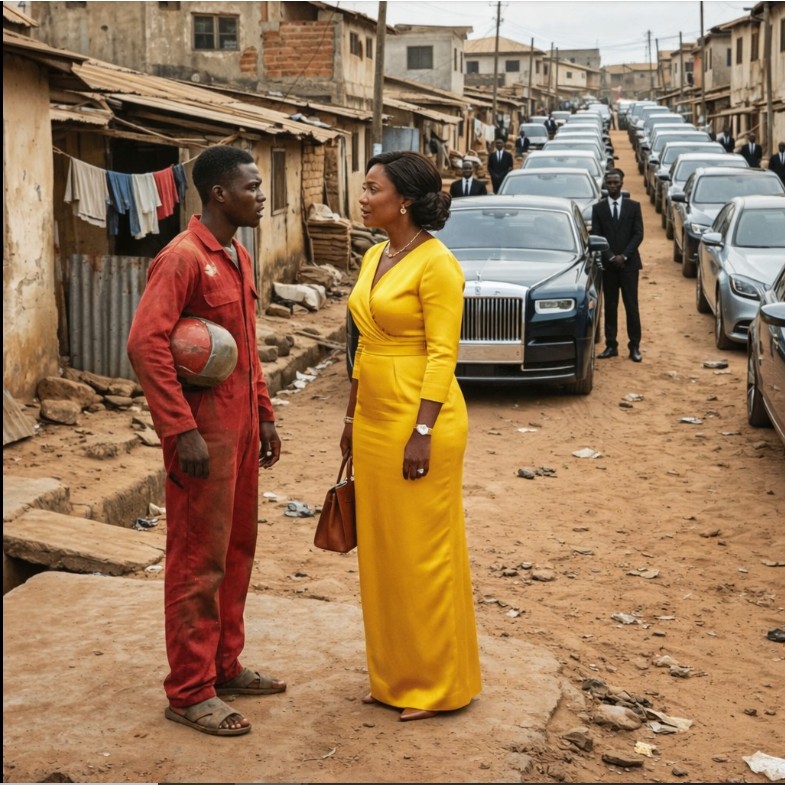
Florence stood in her expensive casual clothes on his broken street with tears swelling in her eyes. Then, for the first time since the police told her about the crash, she let herself break.
Not dramatically. Not in the loud, cinematic way. Quietly—like old wood giving under patient weight.
Richard did not touch her. He did not rush forward. He simply stayed close enough for her not to be alone and still enough not to steal the moment from her.
When the tears passed, she wiped her face.
“I hate that you’re right,” she said.
“I know.”
She left that evening differently. Her back was straighter—not armored, just decided.
At the car, she turned to him. “I don’t know if I can do it.”
“I know,” Richard said. “But you can try.”
And she did.