She continued.
“You will judge someone too quickly again. So will Chloe. So will I. We’re human. We get tired. We get scared. We protect ourselves by making simple stories out of complicated people.”
She reached for the blanket over her knees.
“The goal is not to become a person who never misjudges. That’s pride wearing better clothes.”
Her eyes met mine.
“The goal is to become a person who corrects course faster.”
I sat there, humbled by a woman whose body was failing but whose wisdom was standing upright.
When I left, Chloe walked me to the door.
On the porch, she said, “She liked you.”
“She has a strange way of showing it.”
“She was gentle.”
I laughed softly.
“I’d hate to see firm.”
Chloe smiled.
Then she grew serious.
“Thank you for not giving up when it got messy.”
I looked out at the quiet street.
“Thank you for coming back.”
She hugged her arms against the chill.
“I almost didn’t.”
“I know.”
“No,” she said. “I really almost didn’t. I stood outside the store that first morning and thought, if one person looks at me with pity, I’m leaving.”
“What made you stay?”
She looked at me.
“You gave me a different badge.”
I smiled.
“That badge nearly got me fired.”
“Was it worth it?”
I thought of Tanya.
Calvin.
Terrence.
Rosa.
Dave.
Marcus.
Elaine’s sister.
Mary in the chair by the window.
A whole store learning to ask one more question before closing the book on someone.
“Yes,” I said. “It was worth it.”
Six months later, Harvest Lane Market was not perfect.
No workplace is.
People still called out.
Customers still complained.
Schedules still broke.
Calvin still annoyed Chloe by reorganizing displays without telling her.
Chloe still annoyed Calvin by asking how people felt before asking what they finished.
Tanya still rolled her eyes at both of them and somehow kept the front end alive.
Elaine still sent emails with bullet points sharp enough to draw blood.
But something had changed.
Not dramatically.
Not like in movies.
Quietly.
The way real change usually arrives.
A cashier who looked exhausted was no longer automatically lazy.
A stock clerk who snapped was no longer automatically disrespectful.
A manager who enforced a rule was no longer automatically heartless.
People started asking the second question.
At first because policy required it.
Then because it worked.
Then because they could no longer imagine not asking.
One evening, I was closing the store when I saw Chloe at register three.
A new cashier named Lily stood beside her, crying quietly.
She was seventeen.
Her drawer had come up short.
Not by much.
Enough to scare her.
I watched from a distance as Chloe handed her a tissue.
Then Chloe said the words.
Softly.
Clearly.
“Is there anything going on that I need to understand before I make this decision?”
Lily broke down.
Her parents had separated that week.
She had been moving between two houses with a backpack and no sleep.
She had counted change wrong because her hands wouldn’t stop shaking.
The shortage still mattered.
Chloe documented it.
They reviewed cash handling.
Lily received a warning.
And a schedule adjustment for three days.
Accountability.
With mercy.
The two things I once thought could not stand in the same room.
After Lily left, Chloe saw me watching.
She walked over.
“You heard?”
“I did.”
“Did I handle it right?”
I looked at register three.
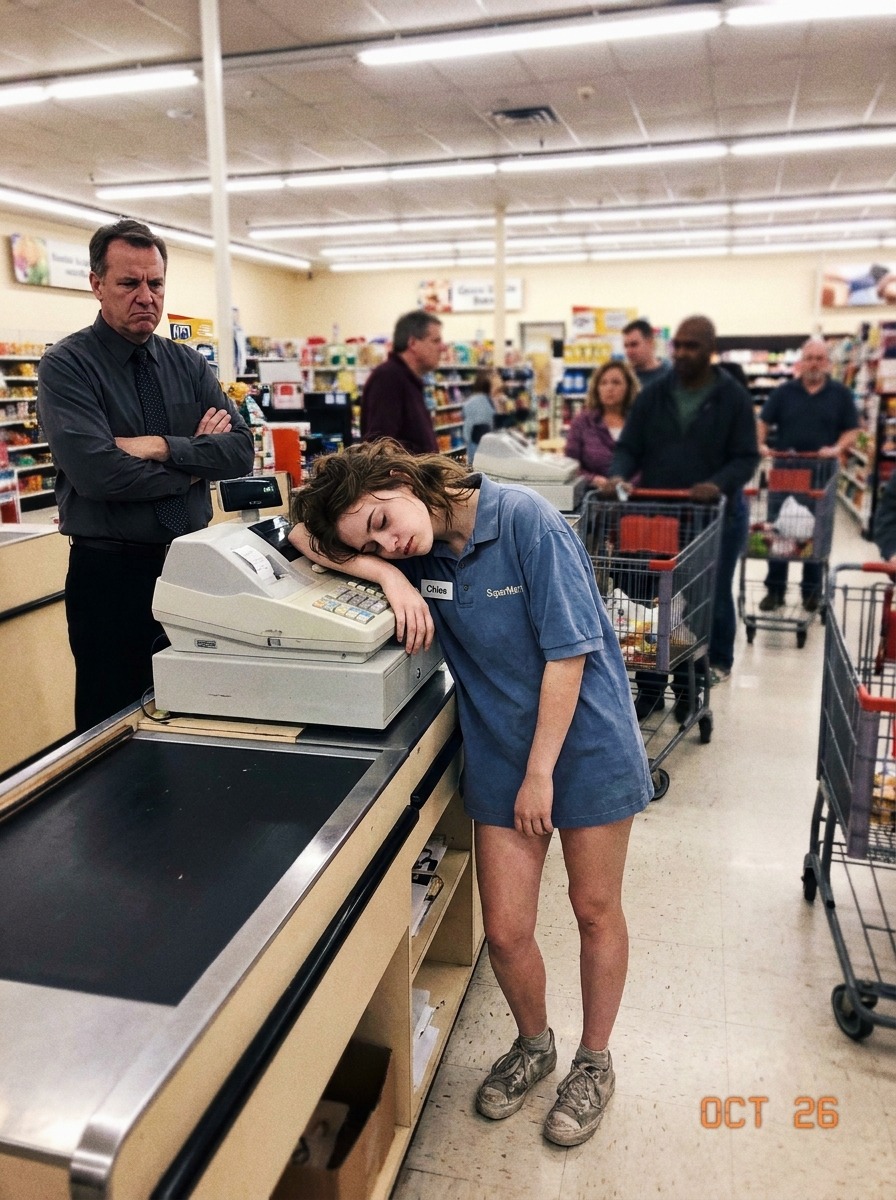
The same register where I had once found Chloe asleep.
The same place where I had mistaken collapse for character.
The same place where a new girl had just been seen before being judged.
“Yes,” I said. “You handled it right.”
Chloe looked down, blinking quickly.
“Sometimes I still feel like that girl in your office.”
“I know.”
“Like one mistake could take everything.”
I nodded.
“That feeling may take a long time to leave.”