Her face crumpled.
Mark stepped closer, voice low.
“Deputy… what happens on these visits?”
Hale hesitated.
“I can’t speak for them,” he said. “But they’ll ask questions. Check the home. Make sure he’s safe. Make sure there’s food. Make sure… you know.”
He didn’t say the word.
But we all heard it anyway.
Competent.
Like being old meant you had to prove your mind every day like a license.
Jessica swallowed.
“What do we do?” she asked, and suddenly she didn’t sound like a furious daughter—she sounded like a frightened one.
Hale looked at me.
His voice softened.
“You keep being you,” he said. “Just… maybe be ready to explain it again.”
I nodded.
“I’ve explained grief my whole life,” I said. “People just don’t like listening.”
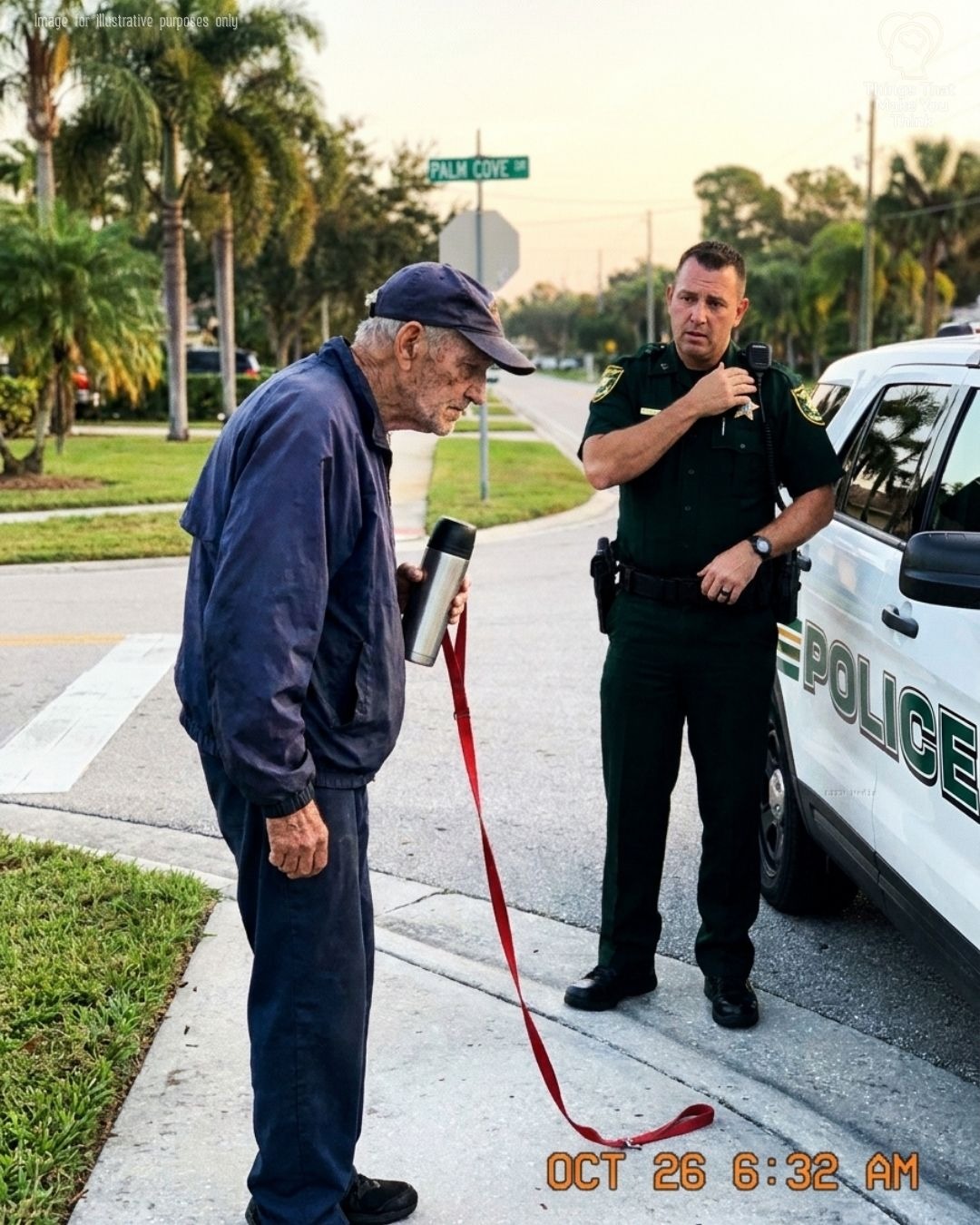
Hale’s eyes flicked to the leash on the hook.
He swallowed hard.
“My dad died last year,” he said quietly. “And my mom still sets his plate at dinner sometimes. Not every night. But… sometimes.”
Jessica’s shoulders sagged a little.
Hale looked at her.
“Ma’am,” he said, gentle. “I don’t think your dad is lost.”
Jessica didn’t answer.
But her eyes shimmered.
Hale tipped his cap to me.
“I’ll be around,” he said. “If you need a witness to your own sanity.”
Then he turned and walked back down the driveway.
I watched him go and thought about how strange it was—how the person in a uniform was the one treating my grief like something human.
The caseworker arrived at 7:12 P.M.
Not a uniform.
No badge flashed in my face.
Just a woman in a plain blouse, holding a folder, hair pulled back, eyes tired but kind.
She introduced herself as Ms. Alvarez.
“Mr. Henderson,” she said. “Thank you for letting me in.”
Jessica hovered behind her like a guard dog.
Mark stood to the side, hands clasped.
I let Ms. Alvarez into my living room.
She glanced around in that subtle way people do when they’re assessing whether you’re a person or a situation.
Photos on the mantle.
A throw blanket folded too neatly—Sarah’s habit.
A recliner that looked like it had held a man in place for months.
She sat across from me, opened her folder.
“I’m required to ask some questions,” she said gently. “This isn’t an accusation. It’s a check-in.”
I nodded.
“Ask.”
She asked about my medications.
My meals.
Whether I drove.
Whether I paid my bills.
Whether I had friends.
Jessica shifted like she wanted to answer for me, but I held up a hand.
I answered myself.
Yes, I ate. Not as much as I should, but enough.
Yes, I took my heart pills.
No, I didn’t drive at night anymore.
Yes, I knew what day it was.
Yes, I knew where I lived.
When she asked about the leash, Jessica leaned forward like she’d been waiting for this.
“Tell her,” she said. “Tell her what you’re doing.”
I looked at Ms. Alvarez.
Then I stood up.
Slowly.
I went to the hook.
Unclipped the leash.
Held it in my hands like it was sacred.
“My wife carried this after our dog died,” I said. “And now I carry it after she died.”
Ms. Alvarez watched my face carefully.
Not judging.
Listening.
I continued, “It looks strange if you don’t know the story.”
Jessica let out a laugh that sounded like a sob.
“It looks unsafe,” she said. “People think he’s—”
Ms. Alvarez raised a hand gently.
“Jessica,” she said, soft but firm. “Let him finish.”
Jessica’s mouth snapped shut.
I appreciated that more than I could say.
“I don’t wander,” I said. “I walk the same route. Same time. Same bench. I come home.”
Ms. Alvarez nodded.
“And you talk to her?” she asked.
I held her gaze.
“Yes,” I said. “Because silence is worse.”
Ms. Alvarez looked down at her notes, then back up.
“There’s a difference,” she said carefully, “between talking to someone you miss… and believing something that puts you in danger.”
“I’m not in danger,” I said.
Jessica’s voice rose.