I stared at her.
“My family is busy,” I said.
Karen didn’t flinch. “We’ve already contacted the numbers you have listed. Your son responded.”
My stomach dropped.
“My son?”
“Yes. He’d like to meet tomorrow. He said he can do a video call if necessary.”
A video call.
A digital hug.
A convenient conscience.
Marcus shifted in the chair like he suddenly felt guilty for existing in the middle of my shame.
I wasn’t mad at him.
I was mad at the whole ridiculous system we’ve built where a stranger can become your lifeline and your own blood becomes a calendar problem.
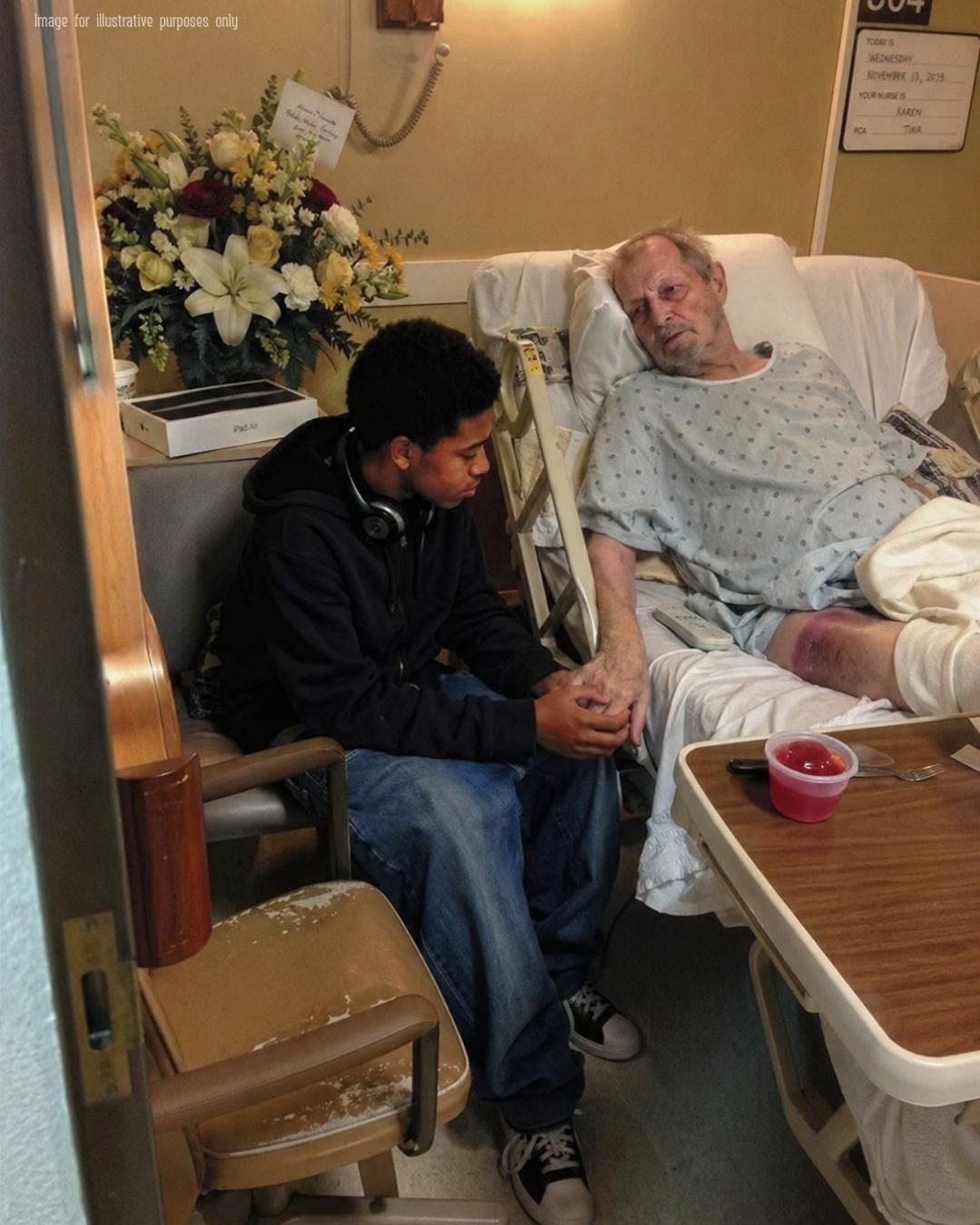
After Karen left, Marcus didn’t speak for a while. He just stared at the floor like the linoleum had answers.
“You okay?” I asked.
He nodded too fast. “Yeah.”
There it was again.
That “yeah” that meant no.
“You don’t have to come tomorrow,” I said.
He looked up quick, eyes sharp. “Why?”
“Because it might get… awkward.”
He snorted. “I can handle awkward.”
I didn’t say it, but what I meant was:
It might get ugly.
The next day, at 7:04 PM—four minutes into visiting hours—my son walked into Room 304 like a man entering a meeting he didn’t want.
Tom is 46. Tall. Good posture. The kind of face that has never had to ask a stranger for directions.
He smelled like expensive soap and airport air.
Behind him came my daughter, Claire.
Claire looked like me around the eyes. Same stubborn brow. Same “don’t you dare” stare.
She held a paper gift bag like a shield.
And behind them, pushing a stroller even though there was no baby in it—just coats and a purse—was my daughter-in-law, Megan.
They did the hug thing. The quick lean-in, careful not to touch the broken parts. The kind of hug you give a relative at a funeral reception.
“How are you feeling, Dad?” Tom asked, like he was reading a script.
“Fine,” I said.
Claire’s eyes went straight to the chair.
It wasn’t empty.
Marcus stood up when they came in, hands visible, polite. He looked like a kid trying to prove he belonged in the wrong neighborhood.
Tom froze for half a beat.
Claire froze longer.
Then Tom recovered first, because he’s practiced at recovering.
He extended a hand. “Hi. I’m Tom. Frank’s son.”
Marcus shook it. “Marcus.”
Claire didn’t offer her hand.
Her eyes flicked to Marcus’s hoodie. To his shoes. To his backpack on the floor.
Then to my face.
And something hard formed in her mouth.
“Who is this?” she asked me.
Not Who are you? to Marcus.
Who is this? like he was an object.
I felt something in me go cold.
“He’s my friend,” I said.
Claire’s eyebrows shot up. “Your friend.”
Tom jumped in, still smiling. “Dad, the nurse said he might be your grandson?”
Marcus’s jaw tightened.
I said, “She asked. He answered.”
Megan tilted her head. “That’s… sweet.”
But the tone wasn’t sweet.
It was the tone people use when they’re watching a dog they don’t trust near their purse.
Marcus took one step back toward the door.
“I can go,” he muttered.
“No,” I snapped, sharper than I meant. “You can sit.”
Tom looked at me like I’d just cussed in church.
“Dad,” he said quietly, “we need to talk about your discharge plan.”
“Then talk,” I said. “He can hear. He’s heard worse in this building.”
Claire’s voice went tight. “This is a family discussion.”
And there it was.
The sacred American phrase people use to excuse cruelty:
This is family.
As if that word automatically equals love.
As if that word cancels neglect.
As if family is only family when it’s convenient.
I looked at Marcus.
He looked at me.
And for a second I saw him doing the math in his head—I don’t want to cause trouble. I don’t want to be the reason he loses what little he has.
So I did the only thing I could do.
I claimed him.
“Marcus,” I said, “sit down. You’re family.”
Claire let out a laugh that wasn’t laughter. “Dad, don’t be ridiculous.”
Tom rubbed his forehead like he was already exhausted. “Okay. Okay. Let’s keep this calm.”
Calm.
That word people use when they’re about to blame you for being hurt.
Karen the social worker came in a minute later and her eyes widened like she’d walked into a reality show reunion.
She introduced herself. She started talking about home safety, physical therapy, follow-up care, support systems.
Support systems.