Then she looked embarrassed for saying it.
“But it’s okay,” she added quickly. “I have a job.”
That sentence.
I have a job.
I had heard my father say it a thousand times.
As if gratitude and exhaustion were supposed to cancel each other out.
I thanked her and walked away, but her answer followed me.
Every day.
By noon, the meeting request hit my inbox.
“Foundation Alignment Conversation.”
Three words.
Beautifully sanitized.
It was scheduled for Friday.
Present: Grant Ellison, two administrators, the dean, myself, and one board representative.
I knew what it really was.
A warning.
That afternoon, Preston came to my office.
Yes.
That Preston.
The same man who had laughed at my father in the front row.
Life has a strange sense of humor.
Preston had become a surgeon.
A good one.
Not warm, exactly.
But careful.
Disciplined.
The kind of doctor who triple-checked a chart and pretended it was not kindness.
Over the years, we had become professional allies.
Not friends.
Not quite.
There are some moments people can apologize for and still never fully erase.
He stood in my doorway holding two paper cups of coffee.
“Peace offering,” he said.
I took one.
“Do I need one?”
He stepped inside.
“I heard about Ellison.”
Of course he had.
In hospitals, rumors travel faster than lab results.
Preston looked at the photograph.
For a long moment, he said nothing.
Then he exhaled.
“He wants it gone?”
“Yes.”
“And you told him no?”
“Yes.”
He nodded slowly.
“Good.”
I looked at him.
That surprised me.
He gave a humorless laugh.
“I know. I don’t have much moral authority on this subject.”
I said nothing.
He looked down at his coffee.
“I think about that day more than you probably want to know.”
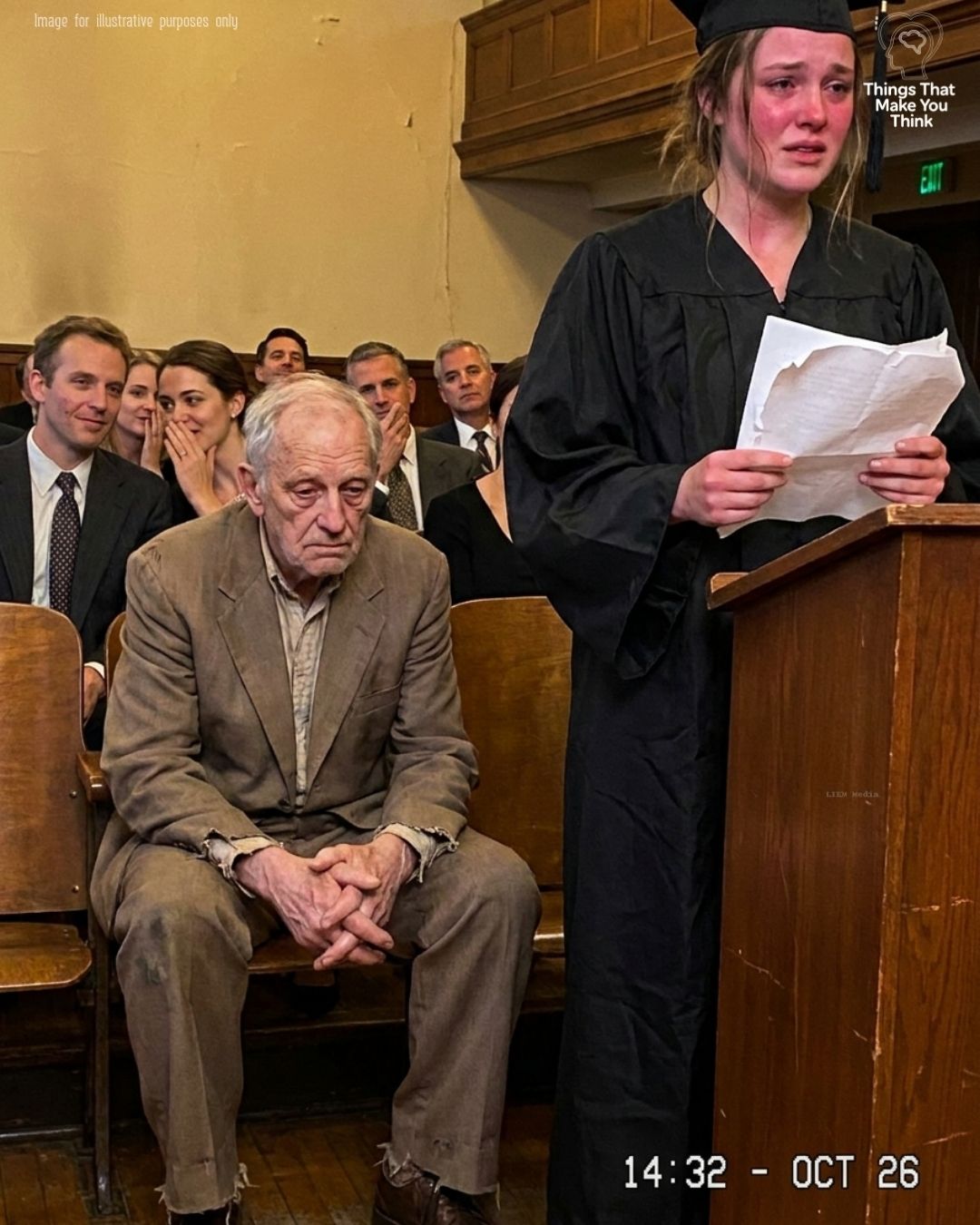
Graduation day.
My father.
The laugh.
The smirk that started the speech that changed my life.
“I was an idiot,” he said.
“You were cruel.”
He flinched.
But he nodded.
“Yes.”
There was no defense.
No polished excuse about being young.
No softening.
Just yes.
“I grew up thinking hospitals belonged to people like my family,” he said. “Doctors. Donors. Department chairs. People with plaques. I never thought about who cleaned the room after we walked out.”
He looked at the photo again.
“Your father made me ashamed in the best possible way.”
I wanted to stay angry at him.
A part of me always had.
But age does something complicated to anger.
It does not erase it.
It adds furniture.
You learn that people can be guilty and changed.
You learn that one ugly moment can be true, and so can the years after it.
Preston sat down.
“Ellison is dangerous,” he said.
“Because he has money?”
“Because he thinks money is morality.”
That line stayed with me too.
He leaned forward.
“The board wants the wing. The hospital needs the wing. The residents need the simulation rooms. Patients need the outpatient expansion. If he walks, people will blame you.”
“I know.”
“Do you?”
His voice sharpened.
“Because this won’t be framed as dignity. It will be framed as ego. They’ll say you chose a photograph over patient care.”
There it was again.