Grief respects patience.
The next morning, the retired vet came before breakfast.
His name was Dr. Harlan Briggs, but everyone just called him Doc Briggs.
He drove a faded brown pickup with a cracked dashboard, a glove box full of peppermint candies, and a back seat that smelled permanently of hay and antiseptic.
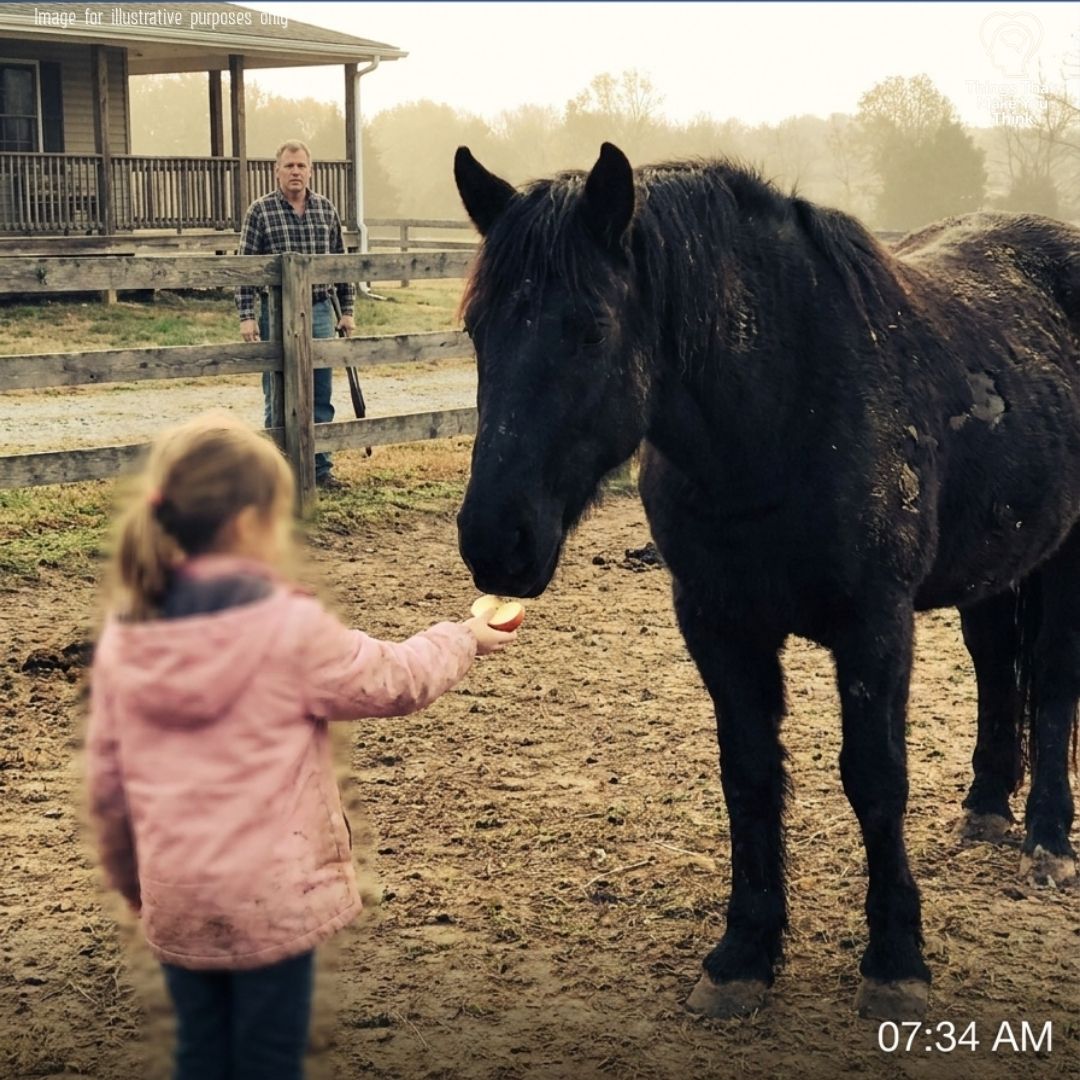
He examined Buster in the pasture while Lily held the lead rope.
Buster tolerated the stethoscope.
He tolerated the light in his eyes.
He even tolerated Doc lifting each hoof, though he leaned heavily toward Lily as if borrowing courage from her small body.
Doc wrote everything down on a yellow legal pad.
Weight loss.
Old scars.
Overgrown hooves.
Stress response.
No aggression observed when handled calmly.
Strong attachment behavior.
Possible trauma from abandonment and forced removal.
He tore the page off and handed it to me.
“Take that to the hearing,” he said.
“Will it be enough?”
Doc rubbed his gray beard.
“No.”
I stared at him.
He didn’t soften it.
“Truth usually ain’t enough when folks are scared.”
Lily looked up.
“What is enough?”
Doc’s eyes flicked to her.
He heard the miracle too.
But like me, he respected it by not grabbing at it.
“Patterns,” he said. “People trust patterns. One good moment sounds like luck. Ten good moments sound like evidence.”
“We have two days,” I said.
“Then make two days count.”
So we did.
For the next forty-eight hours, our farm became part home, part sanctuary, part courtroom preparation.
Doc called a horse behavior specialist from three towns over.
Her name was Mara Ellison.
She arrived in a dusty green truck pulling no trailer, carrying no whip, wearing no polished boots.
She was in her late thirties, plain-faced, sunburned, with one front tooth slightly crooked and eyes that missed nothing.
She spent the first twenty minutes doing absolutely nothing.
She stood outside the paddock and watched Buster breathe.
At first, I thought she was wasting time.
Then she said, “He doesn’t want to hurt anyone.”
I felt my shoulders drop.
“But he absolutely will if people corner him.”
My shoulders tightened again.
Mara nodded toward the east fence.
“That rail is too low.”
“I know.”
“That gate latch is bad.”
“I know.”
“That back tree line gives him too much room to bolt and circle.”
“I know.”
She looked at me.
“Knowing won’t matter at the hearing. Fixing will.”
“I can’t rebuild a whole farm in two days.”
“No,” she said. “But you can show them you understand the risk.”
That sentence stayed with me.
Because that was the line I had to walk.
If I told the board Buster was harmless, I would be lying.
He wasn’t harmless.
Neither was I, on certain nights, when a slammed cabinet sent my heart into war.
Neither was Lily’s grief, when it turned her into a ghost sitting at the kitchen table.
Pain doesn’t become safe just because it deserves sympathy.