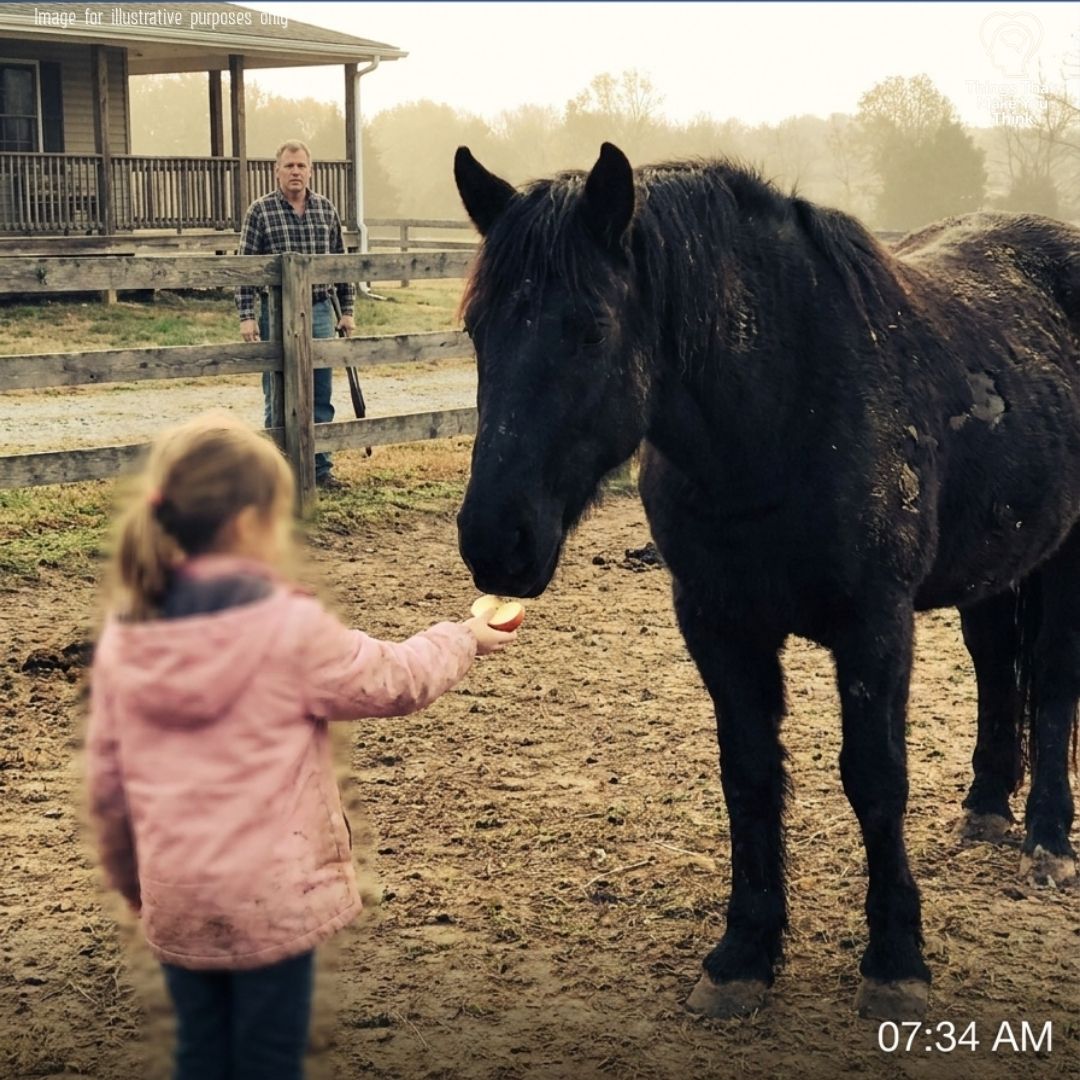
Standing near the fence instead of firing from the porch.
Letting the wounded thing lower its head.
Letting the silent child speak when she was ready.
Not every story ends with everyone agreeing.
Daniel still never stepped inside the paddock.
Arthur’s son still struggled to look Buster in the eye.
Some neighbors still crossed to the far side of the road when passing our farm.
And maybe that was honest.
Healing did not require the whole town to applaud.
It required enough people to stop throwing stones.
It required fences strong enough to hold fear safely.
It required apologies without demands.
It required mercy with rules.
That winter, the first snow fell early.
Large soft flakes covered the pasture, the barn roof, and the porch where I had once aimed a rifle at a horse I did not understand.
Lily ran outside in boots too big for her and a coat zipped crooked.
Buster trotted through the snow, tossing his head like a colt.
He looked ridiculous.
Majestic and ridiculous.
Lily laughed so hard she bent over.
“Dad, look at him!”
“I’m looking.”
Buster stopped near the fence.
Snow gathered in his mane.
He lowered his head.
Lily pressed both gloved hands to his face.
“I told you,” she said.
“Told me what?”
She looked back at me, cheeks pink from cold, eyes bright in a way I had once feared I would never see again.
“He’s a good boy.”
This time, I didn’t hear it as a miracle.
I heard it as a fact.
I walked down from the porch and stood beside my daughter.
Together, we watched the black horse breathe clouds into the winter air.
The valley was quiet.
Not empty.
Quiet.
The kind of quiet that doesn’t mean grief has won.
The kind that means something wounded finally feels safe enough to rest.