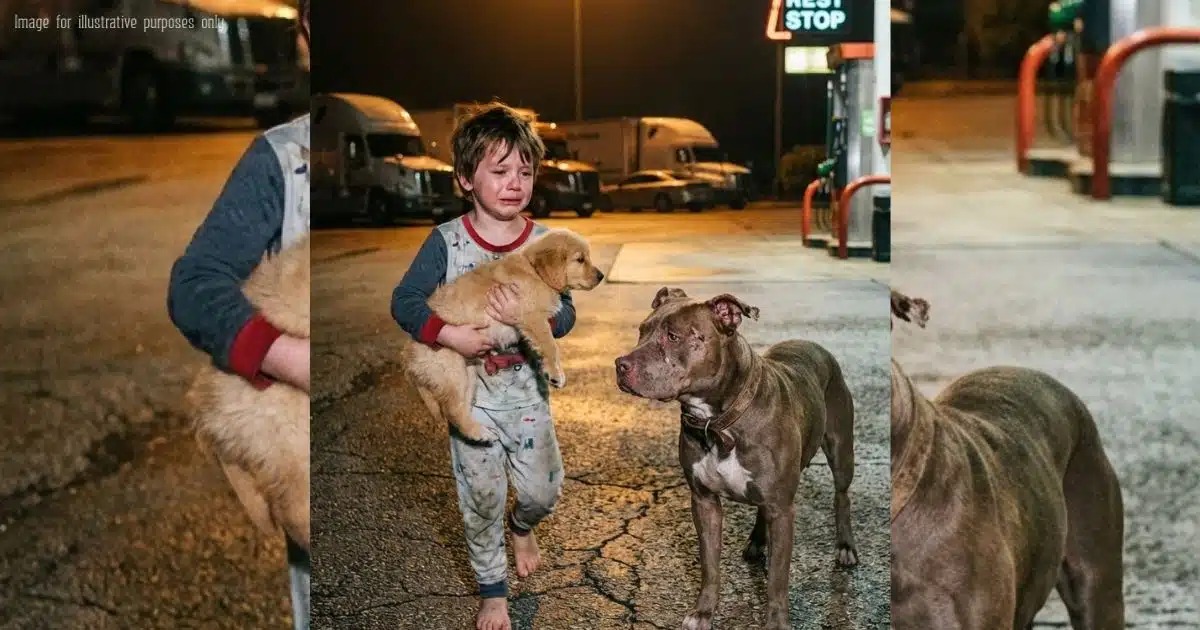
“Because fifteen years ago, a little boy made it to safety at midnight only because his mother knew the dog mattered too.”
Now people were crying openly.
Not all of them.
Just the good kind.
Micah’s face hardened again.
“And if anybody thinks that means I forgive the man who caused that night, hear me clearly: I do not. This isn’t mercy for him. This is survival for them.”
He pointed toward the kennels.
Toward Ledger.
Toward the recovering hounds.
Toward the barn with the torn roof.
Toward the puppies asleep in a volunteer’s lap.
“Some people will say I sold out. Maybe they’re not entirely wrong. Some people will say money is money. They’re not entirely right either. The truth is uglier than both. But I did not build this sanctuary to keep my hands clean. I built it to keep doors open.”
Nobody clapped at first.
That was how I knew it was real.
A good truth usually lands before it earns applause.
Then Lena stood.
Just stood.
No theatrics.
No announcement.
She walked to the front and faced the board.
“I’m the mother from that story,” she said.
The whole pavilion went still again.
“I’ve listened to strangers debate what healing should look like for my family. Let me make something plain.”
Her voice did not shake.
“You do not honor survivors by asking them to stay pure while the innocent pay the cost.”
That line hit like a bell.
Lena folded her hands.
“My son is not accepting that money because he was bought. He is accepting it because pain does not get to become policy at this sanctuary. Not while there are animals who need a way out.”
She glanced toward Evelyn.
Then back to the board.
“And as for the neighbors afraid of motorcycles, tattoos, and dogs with square heads—I’d trust every man standing in that lot before I trusted a polished lie in a pressed shirt. Appearances almost got us killed once already.”
That one did earn applause.
Even Tank wiped at one eye and pretended dust had blown into it.
Then something happened I will never forget.
Evelyn walked to the front.
No microphone.
No dramatic pause.
Just a woman walking straight into a room that had every right to hate her name.
She held a single envelope.
“This is a signed transfer,” she said. “It lists no donor family in perpetuity. The funds will be administered under the sanctuary’s terms. If they ever decide the money compromises the mission, they can redirect the remainder to unrelated rescue work. I will have no authority over any part of it.”
She looked at Micah.
Then at Lena.
Then at Hope.
“My father hurt people and animals because he believed control was the same thing as strength. I won’t repeat him by trying to control what happens next.”
She set the envelope on the table and stepped back.
No applause then.
Something better.
Respect.
Even from people who still disagreed.
The county board recessed for twenty minutes.
Those were the longest twenty minutes I’d lived through since the rest stop.
Cedar Trace people huddled and whispered.
Volunteers refreshed the donations page and cried when small-dollar gifts kept coming in faster than they could read the names.
Ten bucks from a bus mechanic.
Twenty from a waitress.
Five from a kid who wrote for Hope in the note line.
Tank paced.
Deacon sat with his elbows on his knees looking like he hated half of life and wasn’t sure which half.
I sat beside him.
“You still against it?” I asked.
He stared at the gravel.
“I’m against what made it possible.”
“That wasn’t the question.”
He exhaled.
“No. I’m not against feeding dogs.”
That was about as close to surrender as Deacon ever gave.
When the board came back, the chairwoman adjusted her glasses and read the decision.
Permit upheld.
Youth program protected.
Intake expansion approved contingent on the barn rebuild and transport plan.
Parking guidelines revised, but no restrictions on volunteer demographics, motorcycle presence, or breed categories beyond standard safety protocol.
Cedar Trace got their noise review.
We got our future.
The place exploded.
Volunteers hugging.
Kids crying.
Tank lifting Marlene clear off the ground.
Even Deacon smiled, which on his face looked like an old scar reopening.
Hope barked once.
Just once.
Ledger, from his run, answered with a sound so low it barely counted as a bark at all.
More like a decision.
That should have been the ending.
A tidy one, anyway.
But real life hates tidy endings.
Half an hour after the hearing, the smaller rescue director called.
One of the shelters slated to take Willow Run’s remaining dogs had backed out.
No room.
No foster line.
No backup.
Six adults and four puppies were still waiting in temporary holding.
Could Brutus & Hope take them by midnight?
Micah didn’t even glance at the transfer envelope.
He just looked at me.
At Tank.
At the bikes.
And grinned with the kind of exhausted insanity I have always loved in him.
“Midnight Run starts now,” he said.
So that’s how we did it.
Not with a ribbon cutting.
Not with a magazine feature.
With headlights.
With coffee in paper cups.
With a convoy rolling into darkness because there were still ten lives sitting in limbo and now, finally, there was room to stop pretending room was impossible.
Evelyn came too.
Not in front.
Not like a heroine.
She loaded crates.
Carried blankets.
Listened more than she spoke.
When one of the puppies fouled itself from terror, she cleaned it without making a face.
That mattered more to me than any transfer amount.
By the time we reached temporary holding, the moon was high and the air had gone cold enough to sting.
Micah unloaded first.
Hope stayed in the sidecar, wrapped in a blanket, old eyes bright.
And when they brought out the last of the waiting dogs—an elderly black mutt who could barely stand, plus a pair of bonded sisters shaking so hard their tags jingled—Hope let out this low, tender whine that made every human there move gentler.
I watched Evelyn kneel in the dirt so one of the sisters could sniff her hand.
No press.
No audience.
No legacy management.
Just dirt.
Just trembling.
Just the long, humiliating work of proving you came to help and not to own.
On the ride back, Micah pulled alongside me at a stoplight.
Helmet visor up.
Wind in his hair.
“You think Brutus would’ve approved?” he shouted over the engines.
I laughed.
“Of the money or the dog count?”
“Both.”
I looked ahead at Hope in the sidecar.
At the transport van behind us.
At Tank thundering up the shoulder because patience had never been a spiritual gift he possessed.
Then I looked back at Micah.
“Brutus would’ve approved of open gates,” I yelled.
Micah grinned.
That was enough.
The next few months were the busiest in sanctuary history.
Not glamorous busy.
Real busy.
The kind where your back hurts in places you forgot existed.
The new barn went up board by board.
The medical wing got its repairs.
The Midnight Run program launched with a network of volunteer fosters, discreet drivers, after-hours vet partners, and emergency pet supply kits stacked in a locked storage room labeled with nothing more than a moon decal and a number.
No speeches.
No self-congratulations.
Just systems.
That’s what mercy looks like once it grows up.
Ledger took the longest.