After that, I stopped reading most of the arguments.
People could debate whether pets were family.
They could debate whether adult children owed more.
They could debate grief and boundaries and loneliness and responsibility.
But I knew what I had seen.
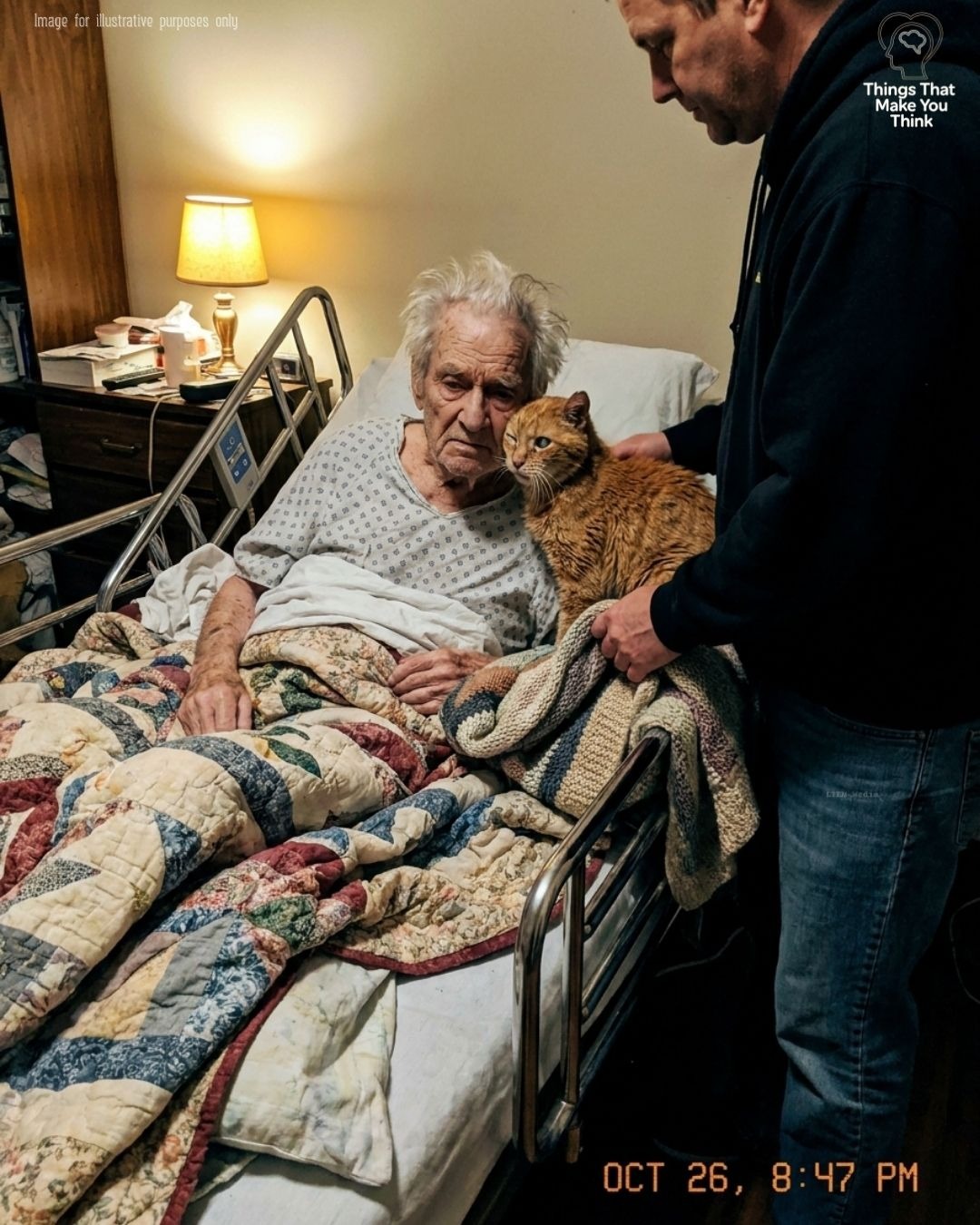
I had seen an old man breathe easier when his cat touched his cheek.
I had seen a dying hand calm under orange fur.
I had seen an old cat use the last of his strength to keep a promise no human had asked him to make.
Nobody in a comment section could edit that.
Nobody could reduce it.
Nobody could make it silly.
On the first warm day of spring, Rachel brought her kids to Dad’s house.
We opened the windows.
Dust moved in the light.
Caleb ran straight to Copper’s stone.
He had brought a toy mouse.
A new one.
Bright gray.
He set it beside the rock.
Rachel said, “That’s sweet.”
Caleb shrugged.
“He might need it.”
His older sister rolled her eyes.
“He’s not actually playing, Caleb.”
Caleb looked at her.
“Maybe not. But Grandpa will know we remembered.”
That shut her up.
Rachel looked at me over his head.
There it was again.
Children carrying matches.
We spent the afternoon going through Dad’s garage.
Not everything was sacred.
Some of it was junk.
Bent nails.
Paint cans.
A toaster from 1987.
Three broken radios he had sworn he would fix.
Rachel held up a box of tangled cords.
“Do we honor these too?”
“No,” I said. “Those can go to the great beyond.”
She laughed.
It felt good.
Not because grief was gone.
Because laughter had found a crack to come through.
In the back corner, behind a stack of old lawn chairs, I found a wooden sign.
Dad had made it by hand.
The letters were uneven.
Painted in blue.
SIT A WHILE
I remembered it then.
Mom had hung it on the porch years ago.
After she died, Dad took it down.
Maybe it hurt too much.
I carried it outside.
Rachel saw it and stopped.
“Oh.”
“Should we put it back?”
She nodded.
We found the old hooks.
They were still there above the porch rail.
I climbed on a chair and hung the sign.
It looked weathered.
Imperfect.
Right.
That evening, we sat under it.
Rachel.
Mark.
The kids.
Me.
No phones for a while.
Not because we were noble.
Because Rachel made a basket and said everyone had to drop theirs in.
Her children complained like she had outlawed breathing.
Then, after ten minutes, they survived.
We ordered pizza from a local place.
We drank lemonade.
We told stories about Dad.
Mark admitted he had been afraid of Copper.
“Everyone was afraid of Copper,” I said.
Caleb said, “I wasn’t.”
“You only knew old Copper.”
“He still looked like a pirate.”
“He was a pirate.”
The kids laughed.
Rachel looked toward Copper’s stone.
Then toward Dad’s empty recliner visible through the window.
“I wish he could see this,” she said.
I looked up at the sign.
SIT A WHILE
“Maybe this is what he wanted.”
“What?”
“For us to stop rushing through rooms where people are waiting.”
She nodded.
The sky turned pink.
The porch light clicked on.
For the first time since Dad died, the house did not feel abandoned.
It felt like it was exhaling.
Later, when everyone left, I stayed behind to lock up.
I stood in the living room one last time.
The recliner was still there.
We had decided to keep it.
Not forever maybe.
But for now.
Some people would call that unhealthy.
Some would say move on.
Some would say furniture is furniture.
Let them.
I had learned that people who rush you through grief are usually trying to escape their own.