No one moved.
Then I heard a sound from the back.
The older man with the hat had covered his face.
His shoulders were shaking.
I folded the letter.
“I know some people will hear this and think, ‘It was just a cat.’”
I looked around the chapel.
“I used to think that too.”
I took a breath.
“But I don’t anymore.”
Rachel slipped her hand into mine.
I held it.
“Because sometimes the creature who saves a person is not the one with the right words. Sometimes it is the one who stays when words are gone.”
The room was silent.
Not empty silent.
Full silent.
“There are people in this room who called my father. There are people who visited. There are people who cared. I’m not here to blame anyone.”
I swallowed hard.
“I’m here to say we need to stop believing people every time they say they’re fine.”
A woman in the third row started crying.
“We need to check twice.”
A man nodded.
“We need to sit longer.”
Mrs. Hanley pressed a tissue to her mouth.
“We need to remember that loneliness does not always look like sadness. Sometimes it looks like a clean shirt, a mowed lawn, and a man who says, ‘Don’t fuss over me.’”
Rachel squeezed my hand.
“And we need to stop mocking the small comforts that keep people here.”
That was the line.
I did not know it would be.
But I felt it land.
Some people leaned forward.
Some looked away.
Some looked guilty.
Maybe I did too.
“Call it a pet. Call it family. Call it whatever makes you comfortable. But if an old orange cat helped my father survive his quietest years, then I will honor that cat in this room.”
I looked at Dad’s casket.
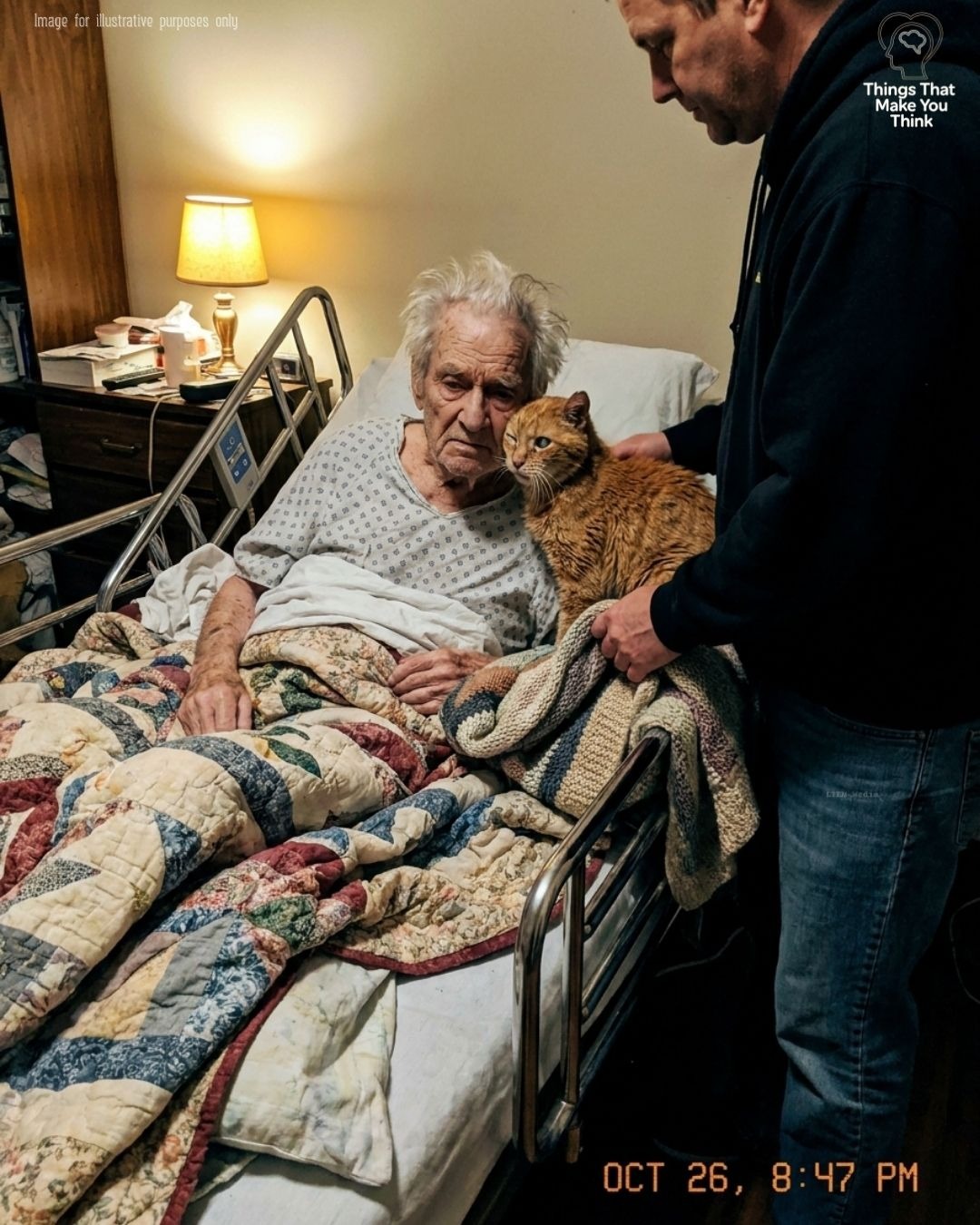
“Dad, Copper stayed.”
My voice broke.
“And we’re sorry we didn’t always understand what that meant.”
I could not say more.
Rachel wrapped her arm around mine and walked me back to the pew.
No one clapped.
Thank God.
Some moments do not need applause.
They need silence to do their work.
After the service, people came up to us.
Not all at once.
Slowly.
Like confession had formed a line.
Mrs. Hanley told us Dad used to leave Copper’s food bowl on the porch even during storms.
“He’d stand there in his slippers,” she said, “holding an umbrella over that cat like a fool.”
Rachel laughed through tears.
A retired mail carrier told me Copper used to follow Dad to the mailbox and swat at fallen leaves.
A woman from Mom’s quilting group said she had seen Dad at the grocery store buying tiny cans of cat food and pretending they were “for a neighbor.”
Then the older man with the hat came up.
He was tall but bent.
His eyes were red.
He shook my hand with both of his.
“My wife died two years ago,” he said.
“I’m sorry.”
He nodded.
“I got a little dog.”
He looked embarrassed saying it.
“A ridiculous thing. No teeth. Sleeps under my chair.”
I smiled.
He looked toward Dad’s photo.
“People laugh.”
My smile faded.
He swallowed.
“Your father would have understood.”
“Yes,” I said. “He would have.”
The man nodded once, put his hat back on, and walked out into the rain.
That moment alone would have been enough.
But grief was not done teaching us.
At the cemetery, the rain had stopped.
The ground was soft.
The air smelled like wet leaves and cold stone.
The funeral director approached us before the burial.
He held Copper’s collar in a small cloth pouch.
He looked at Rachel.
“You wanted to place it?”
Rachel looked at me.
I shook my head.
“No. You do it.”
Her lips trembled.
“Ethan.”
“He was your father too.”
She took the pouch.
For a second, she looked like a little girl holding something breakable.
The funeral director opened the casket just enough for the family.
No one else saw.
Rachel leaned in.
I stood beside her.
Dad looked peaceful in a way I didn’t trust.
People say that, but death does not look like sleep when you have sat beside it.
Still, his face was calm.
Rachel placed Copper’s collar beside Dad’s hand.
The copper tag rested against his sleeve.
She touched Dad’s fingers.
“I’m sorry,” she whispered.
Then she added, “He was not just a cat.”
I looked away.
Not because I didn’t want to hear it.
Because I did.
Too much.
When we stepped back, Rachel looked lighter.
Not healed.
Just lighter.
Sometimes doing the right small thing removes one stone from your pocket.
Not the whole weight.
Just one.
After the burial, family gathered at Dad’s house.
There was coffee.
Casseroles.
Soft voices.
The usual parade of people holding paper plates and not knowing where to stand.
Someone had brought a ham.
Someone else brought rolls.
Nobody wanted to eat, so everyone ate.
That is how grief works in America.
We feed the shocked because chewing gives the body something simple to do.
Rachel’s youngest son, Caleb, wandered into the living room.
He was eight.
He had red hair and a serious face.
He stood by the recliner.
“Where’s Copper’s blanket?” he asked.
Rachel froze.
I answered.
“On the chair.”
Caleb touched it.
“Can I keep it?”
Rachel looked at me.
I looked at her.
She knelt beside him.
“Why, honey?”
Caleb shrugged.
“Because Grandpa smelled like it.”
Rachel closed her eyes.
Then she nodded.
“Yes. You can keep it.”
Caleb picked up the blanket and pressed it to his face.
Then he said something that ended every adult conversation in the room.
“Grandpa wasn’t alone, right?”
Nobody moved.
Rachel pulled him close.
“No,” she whispered. “He wasn’t alone.”
Caleb nodded.
“Good.”
Then he walked away with the blanket dragging behind him.
Children can carry truth through a room like a lit match.