Some people would call that unhealthy.
Some would say move on.
Some would say furniture is furniture.
Let them.
I had learned that people who rush you through grief are usually trying to escape their own.
I placed Dad’s notebook on the side table.
Beside it, I placed the photo of him and Copper.
Then I sat in the recliner.
Just once.
It creaked under me.
The cushion sank into Dad’s shape.
For a moment, I felt like I was sitting inside his absence.
I looked toward the window where Copper used to wait.
The glass reflected the room back at me.
A middle-aged man in his father’s chair.
Tired eyes.
Unshaven face.
Holding a grief that had nowhere useful to go.
I thought about all the times I had said, “I’ll call tomorrow.”
I thought about all the people sitting in houses across the country, saying they were fine.
I thought about old dogs at apartment doors.
Cats in windows.
Birds in cages.
Neighbors behind curtains.
Fathers in recliners.
Mothers at kitchen tables.
People who do not need saving in a dramatic way.
Just noticing.
Just someone to say, “I’m coming by.”
Just someone to sit a while.
I touched the arm of Dad’s chair.
“I’m sorry,” I said.
Not loudly.
Not for performance.
Just into the room.
Then I added, “I’m learning.”
Outside, the porch was quiet.
Copper’s stone sat in the last blue light of evening.
The blanket Rachel had left on the porch chair moved slightly in the breeze.
For half a second, my heart did what hearts do.
It hoped for the impossible.
An orange tail.
A torn ear.
A tiny meow.
Nothing came.
But the ache that followed was not empty.
It was full of everything that had been there.
Dad.
Mom.
Copper.
Rachel’s hand in mine.
Caleb’s question.
The old man with the toothless dog.
Mrs. Hanley at the door.
A thousand strangers promising to call someone.
Maybe that is what staying means after death.
Not the body.
Not the breath.
The proof.
The pressure love leaves behind.
The way it changes what you do next.
I locked the door.
Then I stopped.
I turned around, opened it again, and went back inside.
On the kitchen counter, I found Dad’s grocery pad.
The same one I had used for Copper’s note.
I tore off a page and wrote in big letters.
CHECK TWICE. SIT LONGER. DON’T MOCK WHAT KEEPS SOMEONE GOING.
I taped it to the inside of the front door.
Maybe it was for me.
Maybe for Rachel.
Maybe for whoever came into that house next.
Then I turned off the light.
This time, when I locked the door, I did not feel like I was leaving Dad behind.
I felt like I was carrying instructions.
And I have tried to follow them.
Not perfectly.
I still get busy.
I still miss calls.
I still say “we should get together soon” and then let soon become a month.
But I am different now.
When someone says they are fine, I listen to the space after it.
When an older neighbor waves from a porch, I wave back and sometimes walk over.
When Rachel calls, I answer if I can.
When I cannot, I call back.
Not two weeks later.
Not when life slows down.
Life does not slow down unless something stops it.
And when someone tells me their pet is “all they have,” I do not smile politely anymore.
I believe them.
Because I knew an old orange cat named Copper.
Cloudy-eyed.
Bad-hipped.
Torn-eared.
Half-wild until love made him brave.
He could not speak.
He could not fix grief.
He could not make my father young again.
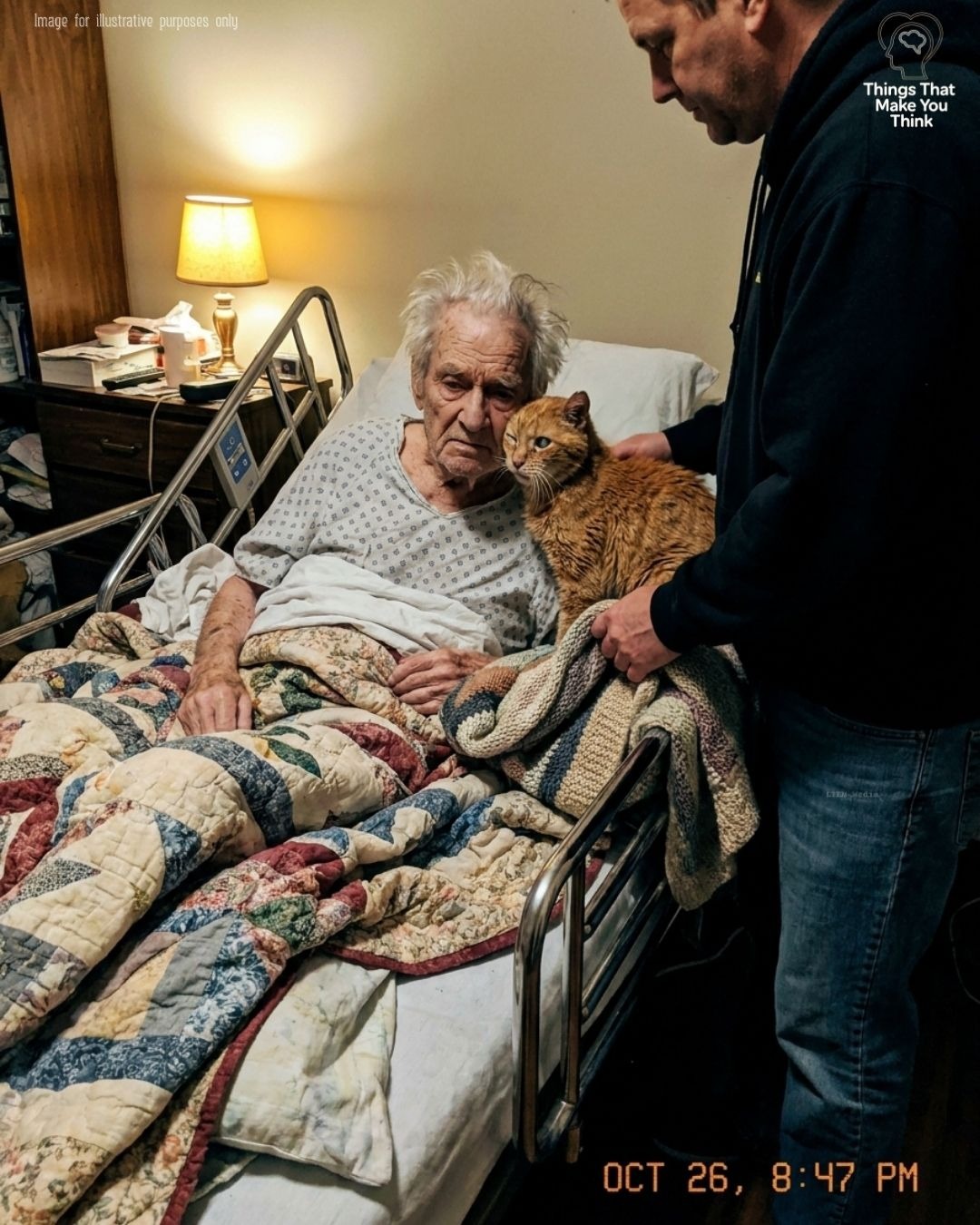
But when my father reached the last room of his life, Copper walked in after him.
No fear.
No complaint.
No need to understand the whole mystery.
He just pressed his small body against a dying man and stayed.
Some people will still say, “It was just a cat.”
Let them.
Some people need love to look a certain way before they respect it.
But I saw what I saw.
I saw my father leave this world with one hand on the creature that helped him survive it.
I saw Copper wait until Dad was gone before he let himself rest.
And I learned something I wish I had learned earlier.
Family is not always the person with your last name.
Comfort is not always loud enough for others to respect.
And love does not become small just because it comes on four tired legs.
Sometimes the holiest thing in a room is not a speech.
Not a prayer.
Not a perfect goodbye.
Sometimes it is an old orange cat, purring softly under a dying man’s hand.
Sometimes it is a sister finally saying, “He was not just a cat.”
Sometimes it is a son taping a note to a door because he never wants to forget again.
Check twice.
Sit longer.
Don’t mock what keeps someone going.
Because one day, the thing you almost dismissed may turn out to be the very thing that helped someone stay.