Nora saw it.
Her voice softened by half an inch.
“That doesn’t make what happened less meaningful. It means he gets boundaries too.”
That sentence became the rule the whole barn was built on.
He gets boundaries too.
So did the kids.
So did I.
The barn program started the next Monday.
We called it Second Gate.
Emma named it.
She said everyone talks about doors closing, but nobody talks about the second gate you find after you think you’re trapped.
I pretended not to care for the name.
Then I painted it on a plain wooden sign and hung it by the driveway.
No logos.
No slogans.
No promises.
Just two words.
Second Gate.
The first official afternoon, only six kids came.
That hurt more than I expected.
Some parents had said no.
Some kids were embarrassed by the attention.
Some didn’t want to sign forms.
Some didn’t want their pain to become a program with a clipboard.
I understood.
Still, when Emma walked in and saw the smaller group, her face fell.
“They scared everyone off.”
“No,” I said. “The ones who came are here.”
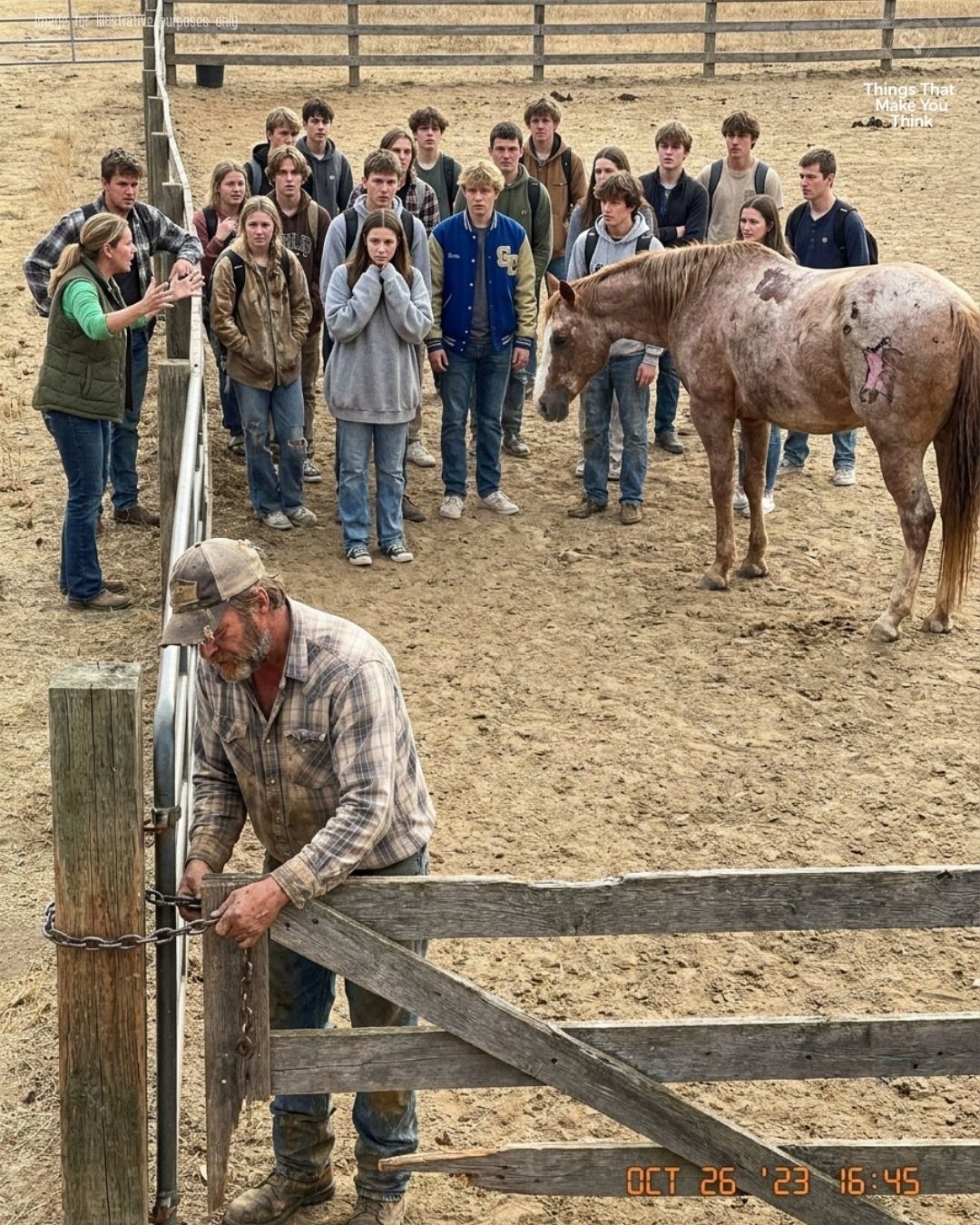
She looked toward Buster’s stall.
He was dozing with one hind foot cocked.
“He doesn’t know the difference?”
“He knows who shows up.”
That afternoon, we trained.
How to put on a halter.
How to read ears.
How to wrap a lead rope properly.
How to say no without being cruel.
How to step back without calling it failure.
Ms. Lin sat on an overturned bucket near the tack room, knitting something blue and ugly.
The kids eyed her like she was a trap.
She didn’t force conversation.
She didn’t carry a clipboard.
She just knitted and occasionally asked practical questions.
“Who knows where the broom goes?”
“Who wants water?”
“Is that horse allowed to eat your jacket?”
By the end of the week, the kids stopped flinching when she spoke.
By the second week, three of them had sat beside her.
By the third, one had asked if she had a minute.
That was how trust worked in the barn.
Not grand.
Not instant.
Just one quiet minute, offered and accepted.
The controversy did not stop.
If anything, it grew.
A local talk show wanted me to come on.
I said no.
A regional lifestyle magazine wanted pictures of Buster.
I said no.
A man from a nonprofit with a name that sounded invented by a committee wanted to “partner” and “scale the model.”
I told him my manure pile was scalable if he wanted to start there.
Mr. Mercer told me I needed to be more diplomatic.
I told him diplomacy was his spiritual gift, not mine.
But the hardest push came from inside the group.
It happened on a cold afternoon in week four.
A new student showed up with his mother.
His name was Caleb.
He was seventeen, broad-shouldered, sharp-eyed, and angry enough to heat the barn.
I knew his type before he spoke.
Not because I judge kids.
Because I had been his type once.
Pain wrapped in barbed wire.
His mother looked worn down to the bone.
She kept apologizing before anyone accused her of anything.
“He said he doesn’t want to be here,” she told me.