But present.
That’s what they were.
Present.
Not vanished into those little glowing screens.
Not hiding behind sarcasm.
Not acting too bored to be alive.
They were just there.
Breathing.
Brushing.
Lifting.
Sweating.
Buster moved among them like some old priest of the pasture.
He was careful with Emma.
Patient with Mason.
Stern with a loud boy named Robbie who kept trying to act fearless because he was terrified of everything.
When Robbie stepped too quickly toward his head, Buster pinned one ear halfway back.
Robbie froze.
I said, “That’s a boundary.”
Robbie swallowed. “He hates me?”
“No,” I said. “He’s telling you how to be respectful before either one of you gets hurt.”
Robbie stared at the horse.
Then he nodded like Buster had just explained adulthood better than any grown person ever had.
At lunch, I handed out peanut butter sandwiches and apples from a paper sack.
Nothing fancy.
Nothing planned.
Just what I had in the kitchen.
They sat on overturned buckets and hay bales, eating in a rough little circle.
Emma tore her crust into tiny pieces and held one out toward Buster.
“He can’t eat that,” I said.
She pulled it back fast. “Sorry.”
“You didn’t know.”
She looked down at the bread in her palm. “I hate when adults say that.”
“Say what?”
“That I didn’t know. Usually they mean I should’ve.”
That one landed right under my ribs.
Mason stopped chewing.
The barn went quiet.
I leaned against the stall door and looked at all of them.
“Then I’ll say it different,” I told her. “You’re allowed to learn something without being ashamed you didn’t already know it.”
Nobody answered.
But three kids looked away.
And one girl started crying into her sandwich so silently that I almost didn’t notice.
That was the second thing I should have seen coming.
You give hurting kids a place where they don’t have to perform being okay, and sooner or later the truth starts leaking out of them.
Not in dramatic speeches.
Not all at once.
Just little drops.
One boy said he hated going home because everyone there was always angry.
One girl said she had not slept more than four hours in two nights.
Another kid said nobody at school knew his parents had split up because he kept wearing the same expensive jacket and making jokes.
Mason said nothing.
Emma said even less.
But Emma stayed closest to Buster.
And Mason kept cleaning long after the stalls were already clean.
That afternoon, when the others finally started leaving, I stood by the gate and made sure every one of them had a ride or a clear way home.
I’m not careless with kids.
No matter what people said later.
I wrote down names.
Phone numbers when they had them.
Parent names when they were willing to give them.
I told them the barn was not a hospital.
I told them I was not a counselor.
I told them if they were in real trouble, we were getting another adult involved whether they liked it or not.
They groaned at that.
Of course they did.
Teenagers act like adult help is a punishment because too many adults have made it feel that way.
But they still came back the next day.
And the next.
By the end of the week, my barn had a rhythm again.
Kids came before school.
Kids came after practice.
Kids came on days when the sky was low and gray and the whole county smelled like wet leaves and old manure.
They learned each horse by name.
Buster was the old scarred king.
Daisy was the round little mare who looked sweet and would steal anything from your pocket.
June Bug was blind in one eye and trusted only people who moved slowly.
Gospel was a tall gelding with a crooked blaze and the emotional stability of a thunderstorm.
The kids loved him anyway.
Maybe because most of them understood what it felt like to look calm from far away and come apart up close.
For five days, it was beautiful.
Messy.
Imperfect.
But beautiful.
Then the photo showed up.
Not on any big site.
Just one of those local community pages where people post about missing dogs, potholes, yard sales, and everybody else’s business.
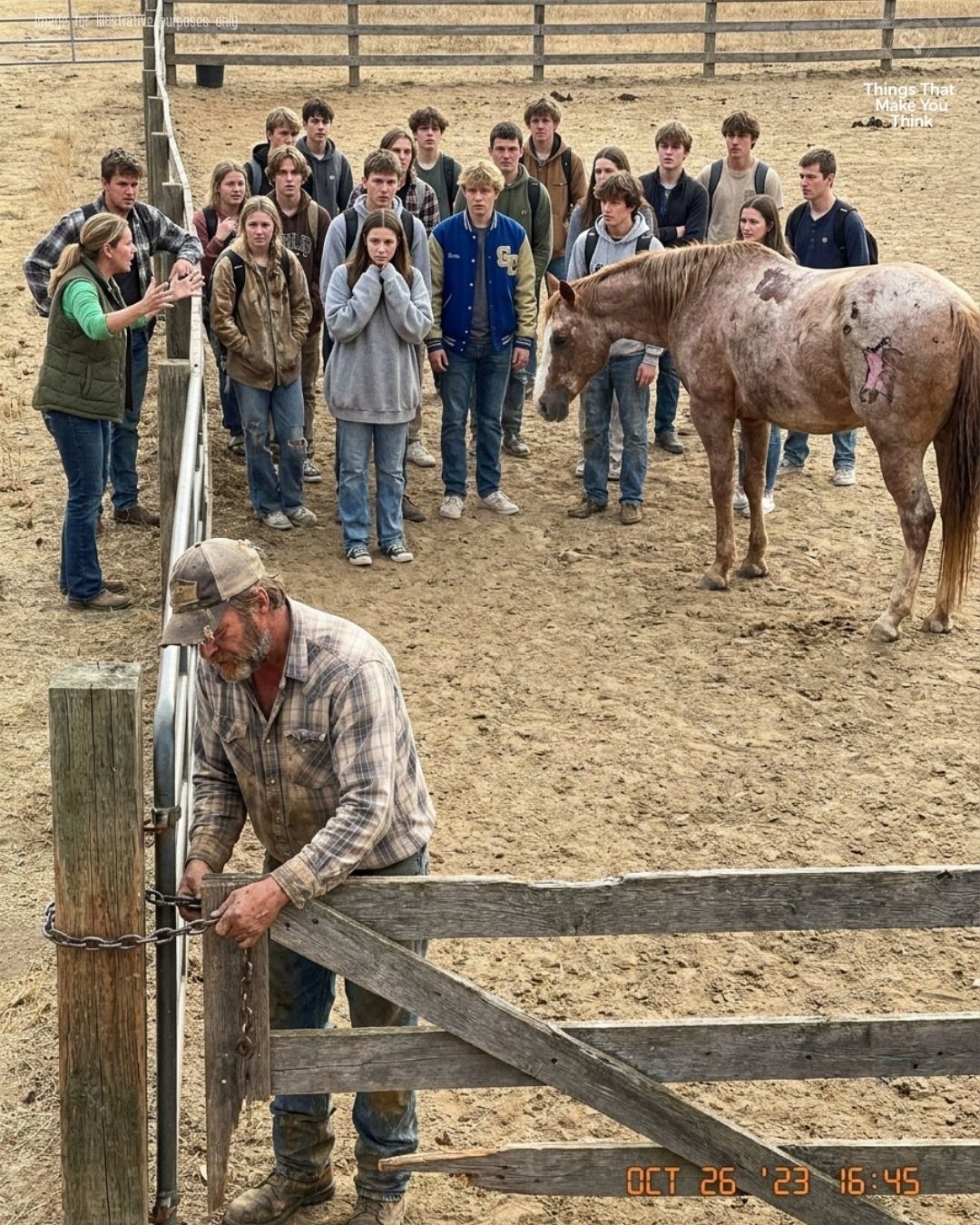
The picture showed sixteen kids standing around Buster in the schoolyard.
Hands on his scars.
Heads bowed.
Faces wet.
Someone had taken it from outside the fence during my demonstration.
The caption said:
“Why are students being locked inside a pen with a dangerous animal during class time?”
By the time I saw it, there were already hundreds of comments.
Some people called me a hero.
Some called me reckless.
Some said kids these days were too soft.
Some said adults had ignored kids for too long and were only angry because a horse noticed first.
Some said the school should be sued.
Some said the parents should be ashamed.
Some said I had no business talking about grief, pain, or survival in front of minors.
One comment just said:
“That horse looks safer than most people.”
I stared at that one longer than I should have.
Then my phone rang.
It was the agriculture teacher, Mrs. Avery.
Her voice sounded like paper being torn in half.
“The principal wants to speak with you,” she said. “Now.”
“I figured.”
“He’s upset.”
“I figured that too.”
She went quiet.
Then she said, “For what it’s worth, I think those kids needed what happened.”
“That and a dollar buys bad coffee at the gas station.”
“I know,” she whispered. “But I needed to say it.”
The principal arrived at my farm twenty minutes later in a clean gray coat and polished shoes that had no business stepping in barn mud.
His name was Daniel Mercer.
He was not a bad man.
That matters.
Stories are too easy when you make the person standing in your way a villain.
Mr. Mercer had tired eyes, a stiff jaw, and the expression of a man who had spent his whole career trying to keep children safe inside a system that punished him every time safety got complicated.
He stood outside my barn while Buster watched him over the stall door.
“That animal was described to me as dangerous,” he said.
“That animal has better manners than half the grown men I know.”
His mouth tightened. “Mr. Halden, this is serious.”
“I know it is.”
“You locked students inside an enclosure.”