The next morning, I asked Miguel if I could use my lunch break to speak at the residents’ advisory meeting.
He looked at me like I had asked to juggle chainsaws in the lobby.
“Danny,” he said, “be careful.”
“I’m just going to ask a question.”
“That’s usually how trouble starts.”
He wasn’t wrong.
The residents’ advisory meeting took place every other Thursday in the activity hall.
Usually, they discussed things like pool hours, menu changes, and whether the hallway thermostat was set too cold.
That day, the room was packed.
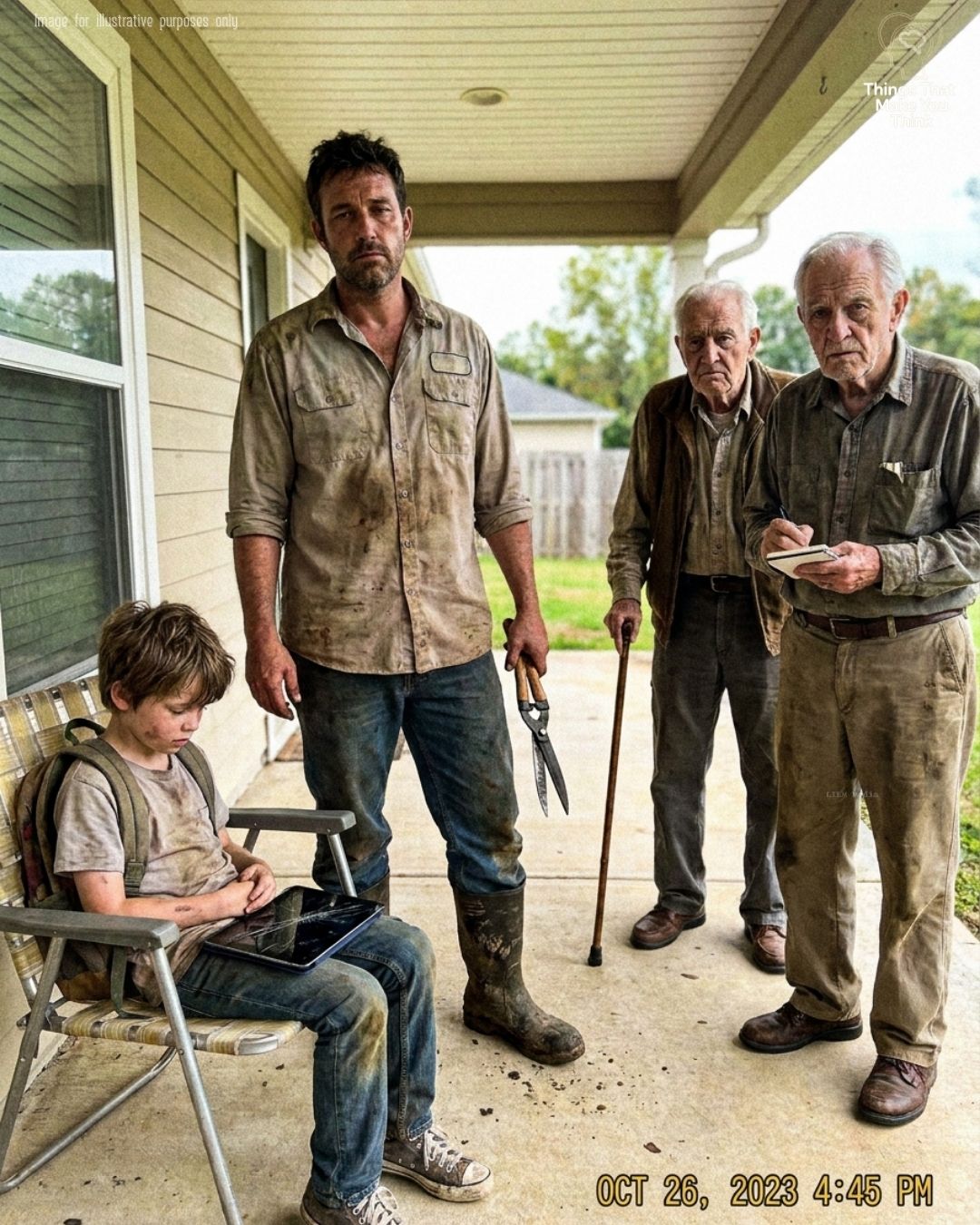
Arthur, Frank, and Thomas sat in the second row.
Not the back.
The second.
Like soldiers who had chosen their ground.
Ms. Bell stood at the front with a clipboard.
Beside her sat two members of the community board.
One was Mr. Pritchard, a retired accountant with a bow tie and a habit of clearing his throat before disagreeing.
The other was Mrs. Vale, who wore pearl earrings and always looked like she was trying not to smell something unpleasant.
I stood near the side wall in my work boots, still carrying bits of grass on my pants.
I had never felt more out of place.
Ms. Bell went through the agenda.
Pool resurfacing.
Guest parking.
New meal delivery times.
Then Arthur raised his hand.
Ms. Bell hesitated.
“Yes, Arthur?”
Arthur stood slowly.
Frank reached out like he might help him.
Arthur waved him off.
“I’d like to discuss the closure of the woodworking shop to young guests and the banning of supervised visits from Daniel’s son.”
The room stirred.
Ms. Bell’s jaw tightened.
“That matter concerns employee policy and resident safety,” she said.
“It concerns us,” Arthur replied. “We are residents.”
Mr. Pritchard cleared his throat.
“There are insurance matters that can’t be reduced to sentiment.”
Frank leaned forward.
“Funny. Everything good gets called sentiment right before somebody kills it.”
A few residents murmured.
Mrs. Vale folded her hands.
“With respect, Frank, this is a retirement community. Many of us moved here for peace and quiet. Not to have children running around.”
I wanted to defend Leo.
But Arthur spoke before I could.
“There was no running around.”
Mrs. Vale looked at him.
“That’s not the point.”
“What is the point?” Thomas asked.
His voice was soft.
But the room went quiet anyway.
Mrs. Vale looked uncomfortable.
“The point is boundaries,” she said. “We pay to live here. Employees work here. Residents live here. Children have schools and parks and camps. Not everything has to be blended together.”
There it was.
The controversy.
Not cruelty.
Not hatred.
Just a clean, polished belief that everyone belonged in their assigned place.
Workers on one side.
Residents on another.
Children somewhere else.
Neat lines.
Safe lines.
Lonely lines.
A woman near the back raised her hand.
Her name was Mrs. Alvarez.
She had once brought Leo a lemonade on a day so hot the pavement looked wet.
“I liked seeing the boy,” she said. “This place has been livelier since he came.”
Mrs. Vale turned slightly.
“You may feel that way. Others do not.”
“Others can close their doors,” Frank muttered.
Arthur shot him a look.
Frank sat back, but his cane kept tapping.
Mr. Pritchard spoke next.
“There is also a fairness issue. If one employee brings a child, others may request the same. If one resident mentors one child, others may want to invite grandchildren. Soon we have a situation that is impossible to manage.”
A few heads nodded.
I hated that his argument made sense.
That was the worst part.
It wasn’t ridiculous.
It wasn’t cartoon villain nonsense.
It was the kind of argument that wins because it sounds calm.
Ms. Bell looked at me.
“Daniel, since your family is being discussed, do you wish to say anything?”
Every face turned.
I wanted to disappear.
I wanted to keep my head down and protect my paycheck.
I thought of Leo sitting at our kitchen table, pushing away his lunch.
I thought of Arthur holding the knight.
I thought of Thomas tracing that newsletter sentence with one finger.
And I thought of what Arthur had said.
Feeding a child and raising a child are not always the same work.
So I stepped forward.
“My son was here because I didn’t have any other option,” I said.
My voice shook at first.
I hated that.
But I kept going.
“I know that wasn’t ideal. I know this is not a daycare. I know rules matter.”
Ms. Bell’s expression softened just a fraction.
“But my son did not come here looking for trouble. He sat in a chair because his dad was trying not to lose a job.”
Nobody moved.
“And three men noticed him.”
I looked at Arthur, Frank, and Thomas.
“They could have ignored him. They could have complained. They could have told me I was failing.”
My throat tightened.
“They didn’t.”
Arthur looked down.
Frank’s face turned red.
Thomas closed his eyes for a second.
“They gave him something I couldn’t buy,” I said. “Not because I didn’t want to. Because I couldn’t. They gave him time. Skill. discipline. stories. They made him feel seen.”
Mrs. Vale’s eyes dropped to her lap.
I wasn’t done.
“I understand safety. I understand liability. But I also know loneliness has a cost too.”
That sentence changed the room.
I could feel it.
Because everyone in that room knew loneliness.
Some had buried spouses.
Some had children who called on holidays.
Some had grandchildren they saw through holiday cards and tiny phone screens.
Some had outlived nearly everyone who remembered who they used to be.
I looked at Ms. Bell.
“I’m not asking you to throw out rules. I’m asking you to make better ones.”
Frank whispered, “That’s right.”
“I’m asking if there is a way for residents who want to mentor kids to do it safely. With permission. With supervision. With boundaries. Not hidden. Not improvised. Not because a desperate dad has no childcare. But because this place is full of people who still have something to give.”
The silence after that felt enormous.
Then Thomas stood.
He was slower than Arthur.