Not just for me.
For everyone.
Margaret asked me to help her make a video.
At first, I thought she meant video call her daughter.
“No,” she said. “A video for the message group.”
I blinked.
“You want to post a video?”
“Yes.”
“You hate the message group.”
“I hate gossip,” she corrected. “This is different.”
I set her phone on a stack of old hardcover books on the coffee table.
She sat in Arthur’s recliner.
Behind her, the afternoon light came through lace curtains.
Her hands were folded in her lap.
She wore a pale yellow cardigan.
Her hair was neatly pinned.
She looked small.
But not weak.
“Ready?” I asked.
She nodded.
I pressed record.
For a second, she just looked at the camera.
Then she began.
“My name is Margaret Whitaker. I have lived on Rosebend Lane for forty-seven years.”
Her voice trembled, but she kept going.
“Some of you have been discussing me today. I know you believe you are concerned. Perhaps some of you are. But I would like to say something plainly.”
She lifted her chin.
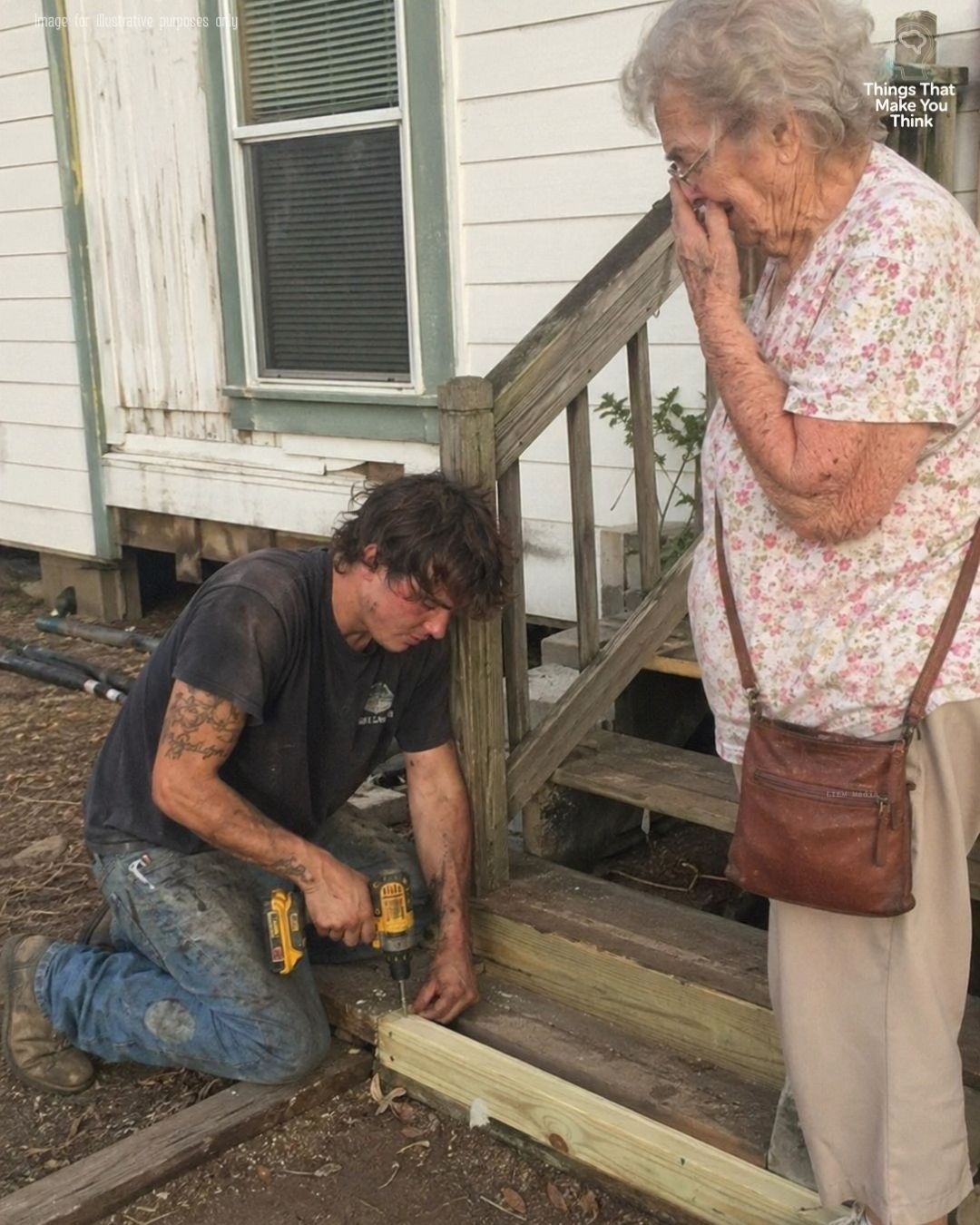
“Leo did not take advantage of me. He helped me when I was embarrassed, frightened, and too proud to ask anyone for help.”
I stood behind the phone, frozen.
“He paid for the correct wood for my porch step with his own money. He repaired it so I would not fall. Since then, he has carried my groceries, mended nothing because I do the mending, taught me how to see my grandchildren on my phone, and listened to stories about my husband that many people got tired of hearing years ago.”
Her eyes shone.
“He is nineteen. He has tattoos. His car is loud enough to wake the dead. And he has shown me more respect than many people who know exactly which fork to use at dinner.”
I covered my mouth with my hand.
Margaret kept going.
“If your concern is real, you are welcome to help. If your concern is only suspicion dressed up as kindness, please leave me and my friend in peace.”
Then she leaned closer to the camera.
“And if anyone would like to discuss my porch, my mailbox, my shrubs, or my faded railing, I will be outside Saturday morning at eight o’clock. Bring gloves.”
She looked at me.
“Did I do it right?”
I laughed.
I couldn’t help it.
“Margaret,” I said, “you just declared war.”
She smiled.
“No. I invited witnesses.”
We posted it.
Within an hour, it had more comments than any lost-cat post the neighborhood had ever seen.
People argued.
A lot.
Some apologized.
Some doubled down.
Some said Margaret was brave.
Some said the video made them uncomfortable.
Some said young people like me needed more chances.
Some said elderly homeowners still needed protection.
Some said the neighborhood rules existed for a reason.
Some said rules without compassion were just decorated cruelty.
And there it was.
The moral dilemma.
The thing that split the street right down the middle.
Was everyone wrong for questioning a tattooed teenager spending time with an elderly widow?
Or were they wrong for assuming danger before they saw kindness?
I didn’t know the perfect answer.
I still don’t.
Because both fear and love can wear the same face from far away.
But I knew this.
Not one person had asked Margaret what she wanted until she forced them to listen.
Saturday morning came hot and bright.
At 7:45, I pulled up to Margaret’s house expecting maybe four people.
There were thirty.
Thirty people.