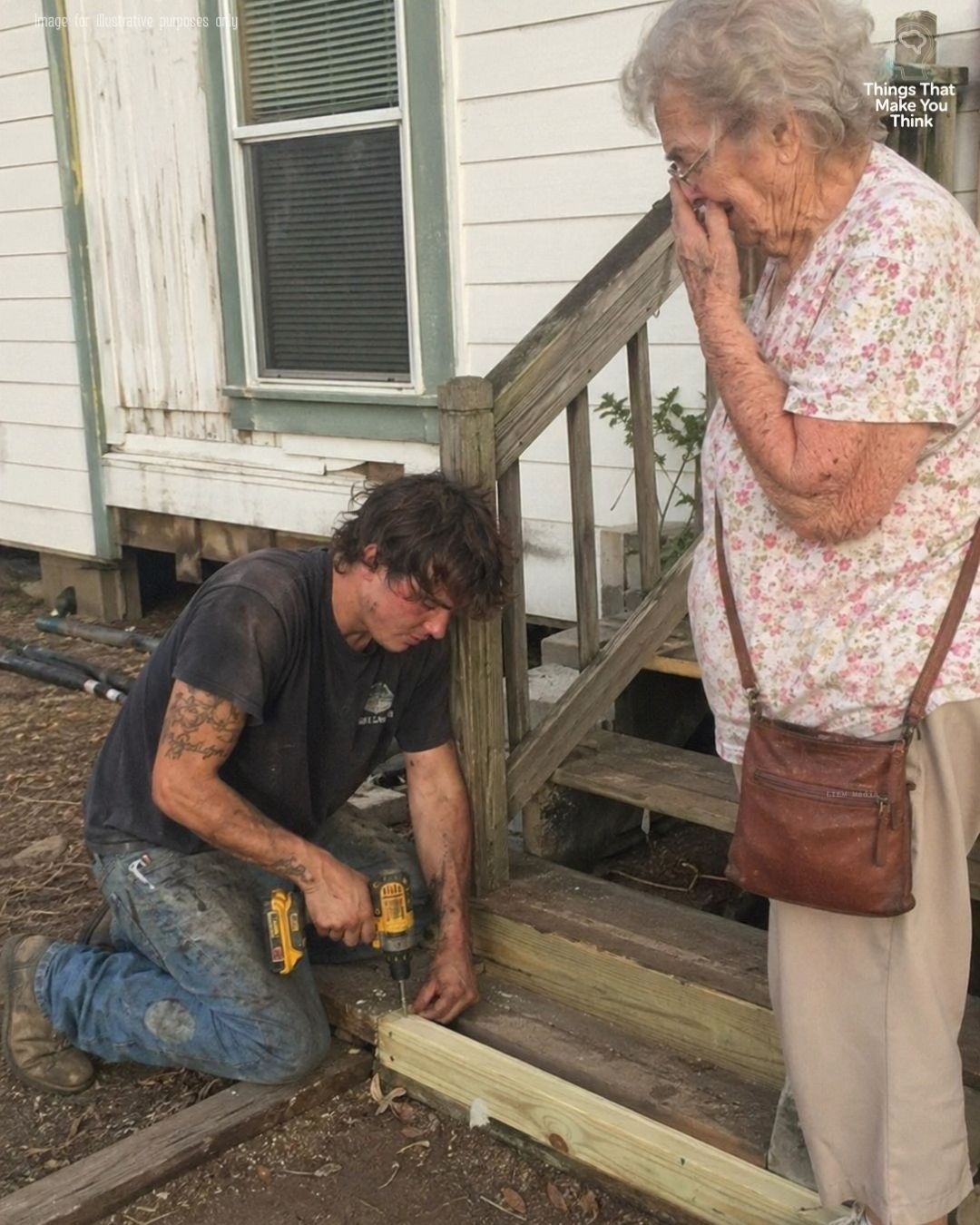
Things Margaret had probably stared at every day, feeling the house slipping out of her hands one inch at a time.
“I can fix all of that,” I said.
The woman studied me.
“Again, any exterior repairs must be approved.”
“Then approve them.”
“That is not how the process works.”
“Then how does it work?”
Clipboard Man smiled thinly.
“Submit the forms. Wait for review. Use approved vendors when required. Pay any outstanding balance.”
Margaret whispered my name.
“Leo.”
I turned.
Her face was pale.
“I can’t pay four hundred dollars,” she said.
She didn’t say it to them.
She said it to me.
Like I was the only safe person standing there.
Something in my chest cracked open.
The board members started walking away.
I followed them to the sidewalk.
“You can’t do this,” I said.
Clipboard Man didn’t stop.
“We already have.”
The woman paused and looked back.
For one second, I thought she might say something kind.
Instead, she said, “Sometimes help causes more trouble when people don’t understand the rules.”
Then they walked away.
Margaret stood on her porch, one hand pressed to her chest.
I walked back slowly.
I didn’t know what to say.
I had tried to help.
Now I had made it worse.
“I’m sorry,” I said.
She looked at the yellow notice by her flower pot.
Then at me.
“No,” she said.
Her voice was soft, but there was steel underneath it.
“No, Leo. I am tired of being sorry for needing help.”
That was the first time I saw Margaret Whitaker get angry.
Not bitter angry.
Not frightened angry.
Righteous angry.
The kind that rises up when a person has been quiet for too long.
She reached down, picked up the yellow notice, and held it like it was a dirty rag.
“Arthur and I bought this house when the street still had empty lots,” she said. “We planted those oak trees when they were shorter than you. I brought casseroles to half the people on this block when their babies were born.”
Her hand shook.
“But now I’m a violation.”
I didn’t say anything.
Because sometimes the truth doesn’t need help.
It just needs room.
She folded the notice once.
Then again.
Then held it out to me.
“What do we do?”
We.
That one word nearly knocked me over.
Until that moment, I hadn’t realized how alone I felt most of the time.
I had my mom, yes.
But my mom worked double shifts at a senior care center.
I had coworkers.
I had classmates I barely talked to anymore.
I had people who knew my face.
But not many who said we.
I took the notice.
“We fix everything,” I said. “The right way. The approved way. And we make them watch.”
Margaret smiled through her tears.
It was small.
But it was there.
The next fourteen days became the strangest two weeks of my life.
Every morning, before work, I stopped by Margaret’s house.
Every evening, after work, I came back.
We measured the railing.
We scraped old paint.
We trimmed shrubs.
We replaced the mailbox post.
We tightened the gutter.