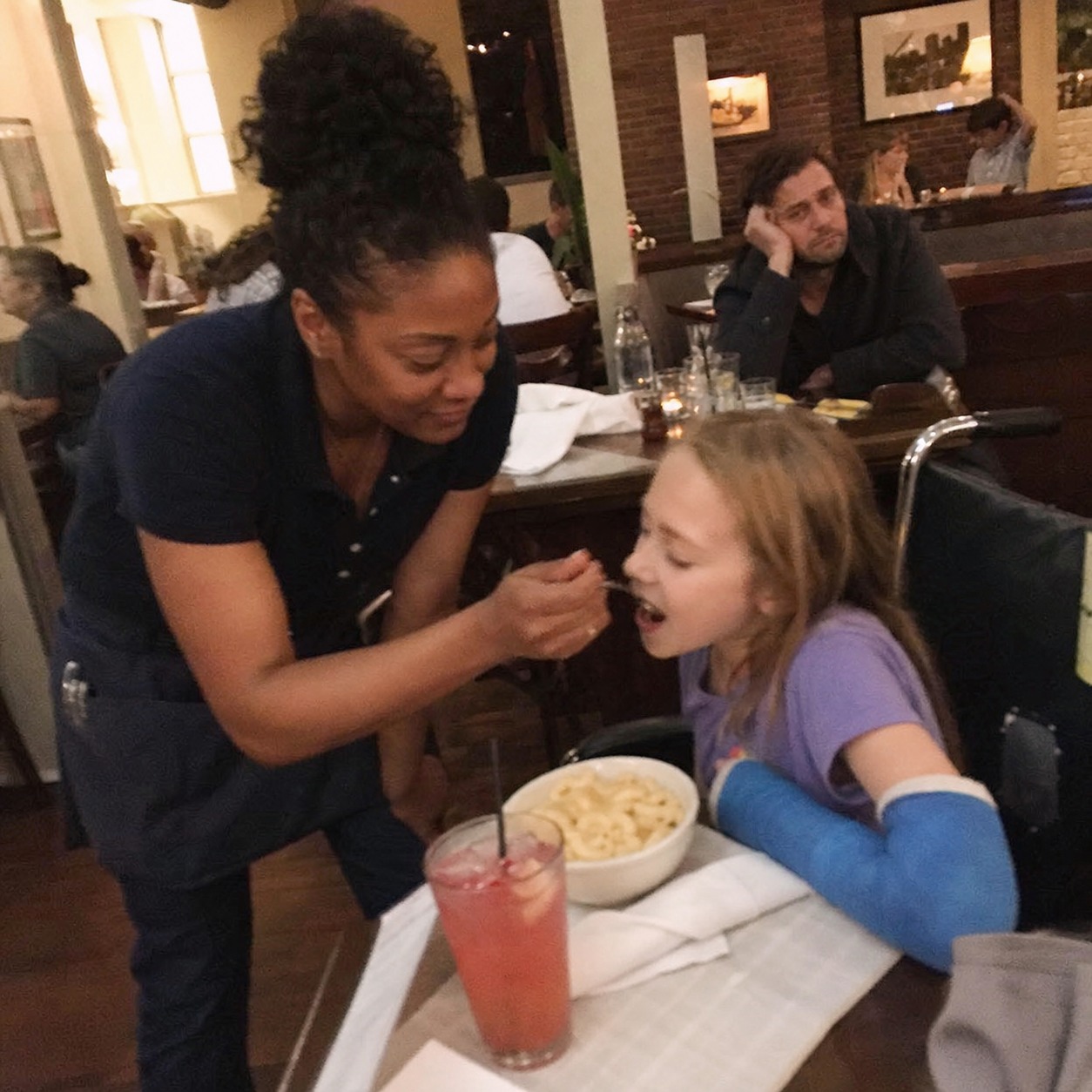
Beside him stood three figures.
A girl with a blue cast.
A tired waitress with kind eyes.
A cat who looked odd and brave.
Underneath, in Lila’s handwriting, were the words:
She did not fix me.
She saw me.
That was where healing started.
Tiana read it twice.
Her throat tightened.
Lila rolled her eyes.
“Don’t cry. It makes Dad cry, and then he gets weird.”
“I do not get weird,” Miles said.
“You absolutely do.”
Dorothy leaned toward Mrs. Chen.
“He does.”
Miles placed a hand over his heart like he had been betrayed by an entire jury.
Tiana laughed.
A year ago, she had stood in a parking lot holding forty-three dollars after ten hours of work.
A year ago, her dream had felt like a locked door.
A year ago, she thought the best she could do was survive one more shift.
Now she stood in a building designed for children who needed time, patience, dignity, and someone willing to look them in the eye.
She was still tired.
Still busy.
Still carrying more than people could see.
But she was no longer shrinking herself to fit inside someone else’s low expectations.
Later that afternoon, after the guests had eaten small sandwiches and too many cookies, Lila tugged Tiana toward the art room.
“I have something for you.”
On the table sat a new drawing.
This one was cleaner.
More confident.
Crash the Cat stood at the edge of a road split into three paths.
One path led to a restaurant.
One to a medical school.
One to a small apartment balcony full of plants.
Crash was walking down the middle, carrying a tray in one paw and a stethoscope in the other.
Tiana laughed softly.
“Crash is multitasking.”
“He learned from you.”
Tiana looked at the drawing for a long moment.
Then she looked at Lila.
“You know, you helped me too.”
Lila frowned.
“I didn’t do anything.”
“Yes, you did.”
“What?”
“You reminded me I was still in there.”
Lila’s face softened.
For once, she had no quick answer.
She leaned against the table and looked down at Crash.
“Dad says people sometimes meet at the exact wrong time, but it turns out to be the exact right time.”
“Your dad says things like that?”
“Only when he’s trying not to cry.”
Tiana smiled.
“Then he may be right.”
That evening, after the center emptied, Tiana drove Dorothy back to their apartment.
The sun was low over the city.
Dorothy sat in the passenger seat, quiet for several blocks.
Then she said, “I was afraid I had taken your life from you.”
Tiana’s hands tightened on the wheel.
“Mama.”
“I was. Don’t tell me not to say it. Mothers have fears too.”
Tiana pulled into a small overlook near the river and parked.
For a moment, neither of them spoke.
The water caught the last light.
People walked dogs along the path.
A little boy in a red hoodie tried to race his father and nearly tripped over his own feet.
Dorothy looked straight ahead.
“When I got sick, you stopped everything.”
“I did what I had to do.”
“I know. But I still saw it. The white coat went into the box. Your books went quiet. You smiled, but not all the way.”
Tiana’s eyes filled.
“I was angry sometimes,” she admitted.
Dorothy nodded.
“I know.”
“Not at you.”
“I know that too.”
“I was angry that love could cost so much.”
Dorothy reached over slowly and placed her hand over Tiana’s.
Her fingers were thin now.
Still warm.
“Love costs,” she said. “But it should not bury you.”
Tiana looked at her mother then.
Really looked.
At the woman who had raised her alone.
Who had packed lunches when money was thin.
Who had stayed up sewing patches onto school uniforms.
Who had shouted loudest at graduations.
Who had become fragile without ever becoming weak.
“You didn’t bury me,” Tiana said. “You kept me human.”