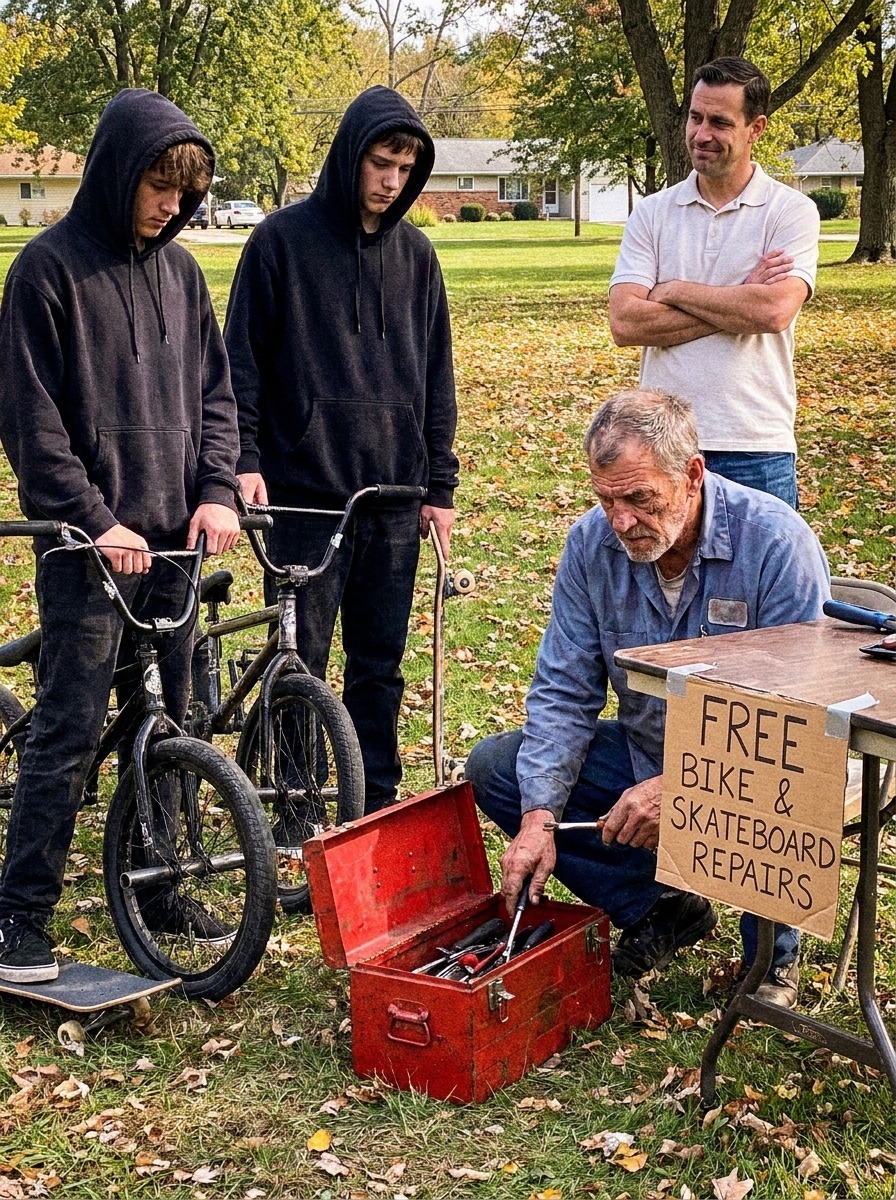
He touched nothing.
“He worked at the rail yard. Fixed everything himself. Cars. Sinks. Lawn mowers. Didn’t trust anyone else to do it right.”
I waited.
Preston looked at my toolbox.
“When Leo asked if I had a bike…”
He stopped.
A car passed.
Crickets started up somewhere near the fence.
“I did,” he said. “Blue one. My father rebuilt it from junk parts. I hated it.”
That surprised me.
“Why?”
“Because other kids had new bikes. Mine had mismatched tires and a seat with duct tape on it. I was ashamed of it.”
He laughed once, without humor.
“My father was proud. I was embarrassed.”
I leaned against the workbench.
“What happened to it?”
“I left it outside in the rain until it rusted. Then told him someone stole it.”
There was no pride in his voice now.
Just memory.
“He knew,” Preston said. “Never said so. Just stopped fixing things for me.”
I looked at him for a long time.
“So now nobody gets a patched-up bike?”
His mouth tightened.
“I’m not here for therapy.”
“No. You came to my garage at night to talk about your father’s blue bicycle. Happens all the time.”
For the first time, Preston almost smiled.
Almost.
Then it vanished.
“I was wrong about some things,” he said.
Some things.
A politician’s apology from a man who claimed not to be political.
I let him sit with the smallness of it.
He cleared his throat.
“I still believe safety matters.”
“It does.”
“And structure.”
“It can.”
“But I…” He looked toward the street. “I may have let my personal discomfort influence my approach.”
There it was.
The most expensive way possible to say, I judged them.
“Preston,” I said, “those kids heard every word you said about them. They’ll carry it longer than you think.”
He nodded once.
“I know.”
“No,” I said. “You don’t. Not yet.”
His eyes came back to mine.
“Then tell me.”
That was the first decent thing he had said.
So I told him.
I told him about Leo offering to disappear.
About Tasha being followed by store clerks when she bought school supplies.
About Maya taking two buses to get to the park because her little brother’s bike was the only transportation he had.
About Rico sleeping on a couch in his uncle’s apartment and still showing up early to sort tools.
About kids who had learned to make themselves hard because softness got laughed at.
About how adults loved redemption stories as long as the redeemed stayed grateful and quiet.
Preston didn’t interrupt.
That also mattered.
When I finished, his face looked different.
Not transformed.
Real life rarely works that fast.
But cracked.
Sometimes cracked is enough to let light in.
He reached into his pocket and pulled out an envelope.
“I can cover the insurance for the year.”
I looked at it.
Then at him.
“No.”
He blinked.
“No?”
“No.”
His pride flashed.
“You’d refuse help?”
“I’d refuse a purchase.”
“That’s not what this is.”
“Then don’t make it look like one.”
He held the envelope tighter.
“I’m trying to make this right.”
“Then do it in the daylight.”
He stared at me.
I stepped closer.
“Come to the park. Say you were wrong where the kids can hear it. Put the money in the jar like everyone else. No grand speech. No ownership. No naming rights. No board control.”
His face hardened again.
“That’s humiliating.”
“So was watching police shut down my table.”
Silence.
He looked away.
I softened my voice.
“Humility won’t kill you, Preston. It might even fix something.”
He didn’t answer.
After a moment, he put the envelope back in his pocket.
“I’ll think about it.”
“That’s all any of us can do.”
He left.
I didn’t know whether he’d come back.
People like Preston often prefer private guilt to public repair.
But the next Tuesday, five minutes before the repair stand opened, his SUV pulled up.
The kids noticed immediately.
Leo’s whole body went still.
Tasha muttered, “Here we go.”
Preston stepped out.
Evan got out after him, carrying the blue-and-silver bike from the fundraiser.
The chain had been repaired.
Badly.
By a proper shop, I guessed.
The derailleur still clicked wrong.
Preston walked across the grass with that same stiff posture.
But there was no folder under his arm.
No board members behind him.
No sneer.
Just a man, his son, and a bike that still didn’t shift right.