“No.”
She watched Mr. Alvarez showing a group of students how the service hallway connected to the old boiler room.
“He knew more than half the administrators.”
“Probably.”
“And nobody invited him to speak.”
“No.”
She was quiet for a long time.
Then she said, “I think I’ve been chasing the wrong kind of prestige.”
That sentence hurt.
Not because it was wrong.
Because it was expensive.
Young people pay so much for prestige.
Money.
Time.
Sleep.
Confidence.
Sometimes their own instincts.
I nudged her shoulder with mine.
“Prestige isn’t evil.”
“I know.”
“It just makes a lousy compass.”
She leaned her head against the wall.
“What should be the compass?”
“Usefulness,” I said. “Integrity. Who benefits when you succeed. Who gets hurt if you fail. Those are better questions.”
She looked at me.
“Did you always know that?”
I snorted.
“No. I learned it the hard way.”
Across the hall, the tech executive was sitting with Jonah.
Not standing over him.
Not posing.
Sitting.
His suit pants were probably ruined from the dusty floor.
He didn’t seem to care.
Jonah was explaining what it felt like to panic in the elevator.
The executive was listening with his full face.
That mattered.
Listening is not redemption by itself.
But it is often the first honest step toward it.
When power finally returned, it came slowly.
First one hallway.
Then another.
Then the main lobby lights flickered back on.
A cheer rose through the building.
Not huge.
Not cinematic.
Just tired, relieved people grateful for fluorescent bulbs.
I watched the students look up.
Some laughed.
Some clapped.
Some wiped their eyes.
And I wondered how many of them would ever again flip a switch without thinking of the hands behind it.
Maybe not all.
But some.
Some is enough to start with.
The dean asked me to return to the auditorium before everyone left.
I almost said no.
I was exhausted.
My back hurt.
My feet were sore.
And emotionally, I felt like I had been turned inside out.
But Maya squeezed my hand.
So I went.
The auditorium was dim but functional.
Students filled the seats again, though nobody sat quite the same way.
The mood had changed.
Earlier, they had been an audience.
Now they were witnesses.
The dean walked to the microphone.
No folder this time.
No polished introduction.
“I owe this community an apology,” she said.
The room quieted instantly.
“Today exposed failures in our emergency readiness, our maintenance response, and our institutional listening. Those failures will be reviewed publicly. Not privately. Publicly.”
A murmur moved through the room.
“We are grateful to emergency responders, campus staff, utility crews, student volunteers, and Ms. Elena Ramirez, whose knowledge and judgment helped keep this situation from becoming much worse.”
People turned toward me.
I hated that part.
Praise always feels heavier than criticism to me.
The dean continued.
“But gratitude is not enough. We cannot celebrate essential workers on a stage and ignore essential systems in our budgets. We cannot invite people here as symbols and then fail to give their expertise authority.”
Maya looked at me.
Her eyes were shining again.
The dean took a breath.
“Beginning this semester, this university will create a new infrastructure resilience fellowship, including paid placements with skilled trades, public utilities, emergency management teams, accessibility advocates, and campus operations staff. We will also conduct an independent safety and maintenance audit, with findings shared with our community.”
The applause began slowly.
Then grew.
Not everyone clapped.
I noticed that.
Some administrators looked tense.
Some donors in suits whispered to each other.
Some students looked skeptical, as they should.
Promises are easy under bright lights.
Harder when invoices arrive.
Then the tech executive stood.
He did not go to the stage.
He stayed in the aisle.
“I’d like to add something,” he said.
The dean hesitated.
Then nodded.
He turned to face the students.
“My earlier remarks today were about innovation. I still believe in innovation. But I confused innovation with importance.”
The room went still.
He looked directly at me.
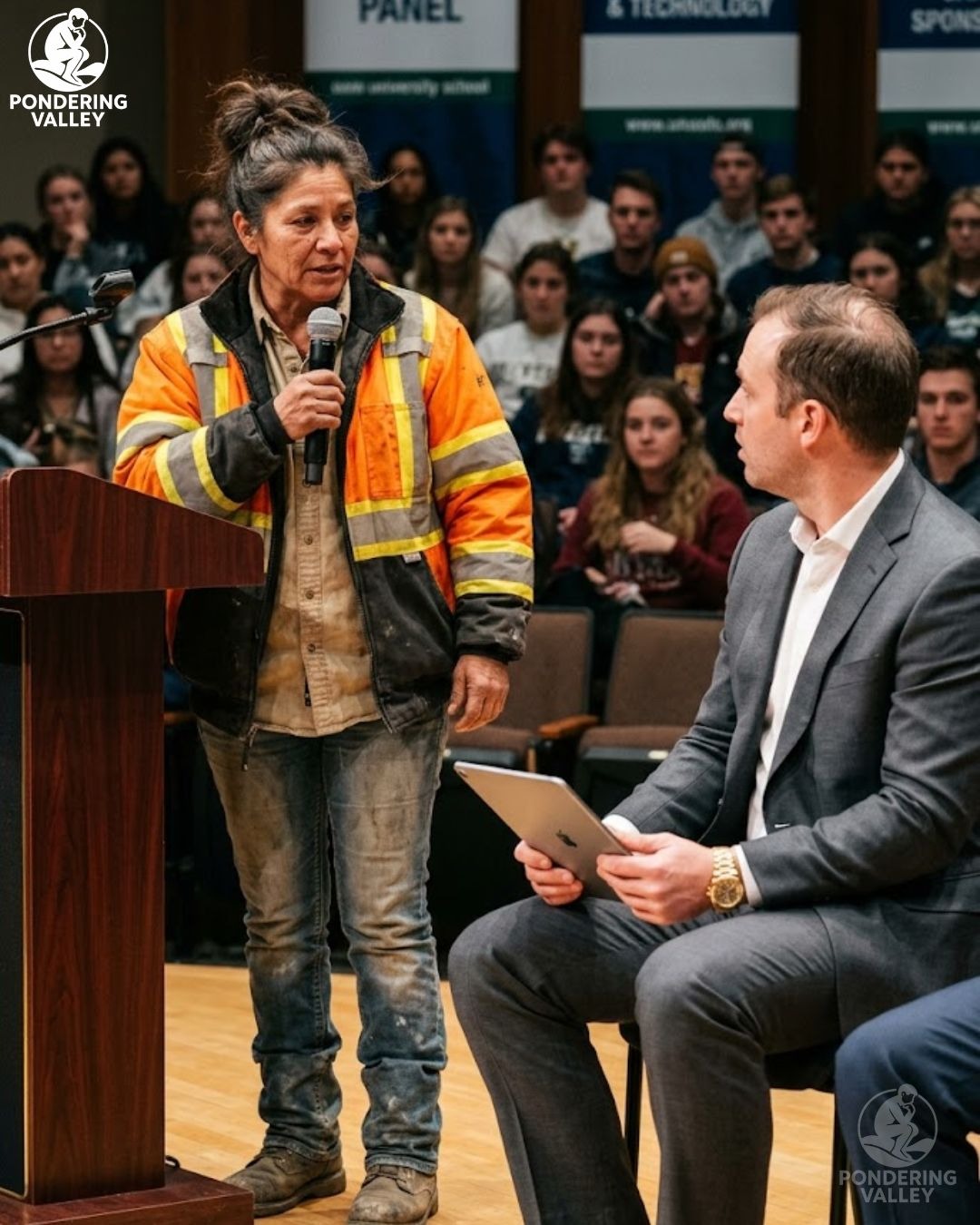
“And before the panel, I treated Ms. Ramirez with disrespect because I made assumptions based on clothing, class signals, and my own arrogance.”
A few students shifted.
He kept going.
“That was wrong. Not because she later proved impressive. It was wrong before I knew anything about her.”
That sentence mattered.
I felt it in my chest.
Because respect that depends on someone proving usefulness is not respect.
It is a transaction.
He turned back to the room.
“My company will contribute to the university’s infrastructure fellowship, but Ms. Ramirez challenged me not to use software as a substitute for physical maintenance. She was right.”
A faint smile tugged at my mouth.
He continued.
“So our contribution will not be branded. It will not be a product launch. It will not require the university to adopt our platform. It will go first toward the audit, radio systems, accessibility response upgrades, and paid student placements in essential infrastructure work.”
Now the applause came stronger.
Still not everyone.
Good.
Healthy skepticism keeps institutions honest.
Then Bethany raised her hand from the front row.
The dean noticed immediately.
“Yes?”
Bethany’s voice carried.
“Will students with disabilities be included in that audit?”
The dean nodded.
“Yes.”
Bethany didn’t smile.
“And not just surveyed after decisions are made?”
The dean looked at her for a long second.
Then said, “Included before decisions are made.”
Bethany nodded once.
That was enough.
Then Mr. Alvarez, the custodian, raised his hand from the side aisle.
People turned.
He looked startled by the attention, like he had only raised his hand halfway and somehow the whole room had caught him.
The dean smiled gently.
“Mr. Alvarez?”
He cleared his throat.
“I just want to say, some of us have been reporting that east corridor emergency lighting for months.”
The room went silent again.
The facilities supervisor looked like he wanted to disappear through the floor.
Mr. Alvarez continued.
“We put in tickets. Sometimes they get closed before the work is done. I’m not saying that to blame one person. I’m saying the system makes it easy for warnings to become paperwork.”
Warnings becoming paperwork.
That line hit harder than anything I had said.
Because it was the whole problem in four words.
The dean nodded slowly.
“Thank you,” she said. “That will be part of the review.”
Mr. Alvarez sat down.
And this time, the applause was different.
It wasn’t loud.
It was respectful.
The kind of applause that says, we see you now.