There were still lines of grief in her face.
Mine too, probably.
But we were alive.
The boy was laughing.
The sky was clear.
That was not nothing.
Three months later, I received another call from St. Agnes Medical Center.
For one second, my body returned to the first call.
My hand went cold.
My heart forgot the years.
But this time, the voice on the line said, “Ms. Ellison? This is Maribel from St. Agnes. I don’t know if you remember me.”
“I remember.”
“I’m calling because a young man is here asking for you.”
My breath stopped.
Then she laughed softly.
“He’s not hurt. He’s volunteering.”
I closed my eyes.
Oliver.
“He wanted me to tell you he listed you as his emergency contact on his volunteer paperwork, but this time he thought he should warn you.”
I sat down and laughed until I cried.
That evening, I drove to St. Agnes.
Oliver was in the children’s ward wearing a volunteer badge, helping a little girl in a cast choose between dinosaur stickers.
He saw me and waved.
The same hospital.
The same hallway.
A different ending.
Maribel stood beside me.
“He’s good with scared kids,” she said.
“He knows the territory.”
Oliver came over, taller than me now, all elbows and sincerity.
“You came,” he said.
“You warned me.”
“I’m learning.”
He hugged me.
Teenagers do not always hug in public, so I treated it with the respect of a sacred event and did not make a sound.
Over his shoulder, I saw room twelve.
Empty now.
Clean.
Waiting for another child, another story.
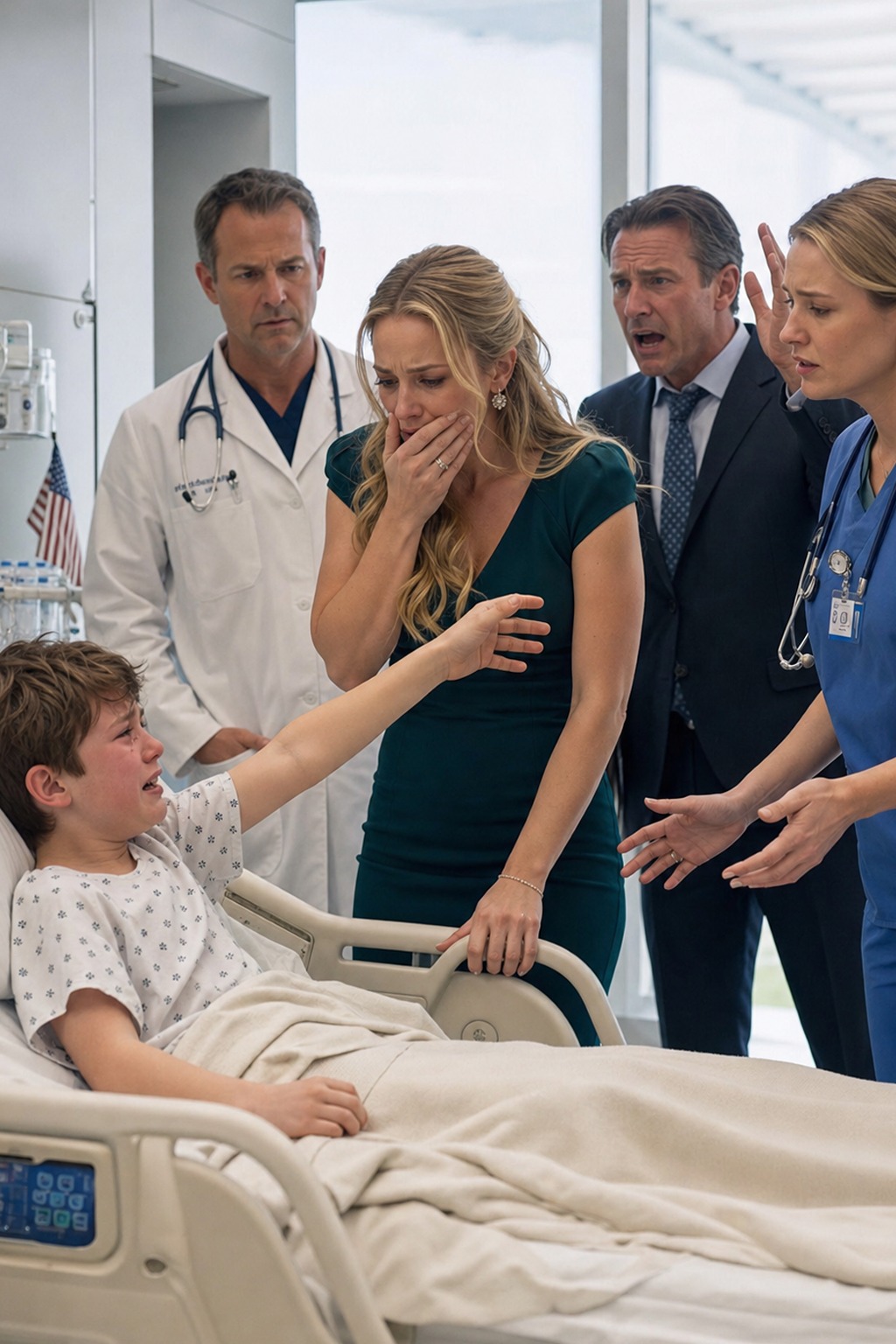
I thought of the night I first walked in with wet hair and mismatched socks, telling myself I had no son, no reason, no obligation.
Then a boy whispered my name.
Then the past opened.
Then everything changed.
Oliver pulled back.
“I put something in your car,” he said.
“That sounds illegal.”
“It’s not. Probably.”
In my passenger seat was a small framed card.
The original emergency card from his backpack.
NORA ELLISON
PHONE
ADDRESS
LADY WITH TWO EYES
Under it, Oliver had added a new note:
Found her.
She came.
I sat in the parking lot holding the frame for a long time.
When I got home, Rachel was waiting on my porch.
She had a key now.
Not to my house.
To the side gate, because Oliver kept forgetting his astronomy books in my shed.
She saw the frame in my hand and smiled.
“He wanted you to have it.”
“I don’t know what to say.”
Rachel looked out at the quiet street.
“Neither did I, for twelve years. That was the problem.”
We sat on the porch steps.
The old silence came to sit with us, but it no longer had teeth.
After a while, Rachel said, “Do you ever wish you hadn’t answered the phone?”
I looked at her.
The honest answer was complicated.
I wished none of it had happened.
I wished Rachel had told the truth at twenty-one.
I wished Elias had been stopped before Oliver was born into fear.
I wished no child had ever needed my name written on an emergency card.
But regret is not the same as wishing away the person who came through the door.
“No,” I said.
Rachel nodded.
“I’m glad.”
Across the street, a porch light flicked on.
Somewhere down the block, a dog barked.
My phone buzzed.
Oliver had sent a photo through the family group chat Rachel had made and I pretended to hate.
It was a blurry picture of the moon through his telescope.
Caption:
Still not your roof.
Rachel laughed.
I laughed too.
And there it was.
The perfect ending was not that Elias went to prison, though he did.
It was not that Margot Vance lost Blackridge House, though she did.
It was not that Halewick apologized, the old case was corrected, or the blue scarf finally told the truth.
Those things mattered.
They mattered deeply.
But the perfect ending was smaller.
A boy who once arrived at a hospital with my name hidden in his backpack now used that same hospital to help other frightened children.
A woman who once betrayed me now told the truth even when silence would have been easier.
And I, Nora Ellison, thirty-four, single, no children of my own, had somehow become Aunt Nora to a boy who believed I was worth finding on the worst day of his life.
That night, I hung the framed emergency card on the wall beside the tin box.
Rachel stood behind me.
Oliver came in carrying the telescope lens he had promised to clean and definitely had not.
He looked at the wall, then at me.
“Too dramatic?” he asked.
I looked at the card.
Found her.
She came.
Then I looked at the boy.
“No,” I said. “Exactly dramatic enough.”
He grinned.
Rachel put one hand over her mouth, smiling through tears.
The house was warm.
The past was still real.
But it no longer owned the room.
And when my phone rang later that night, I did not flinch.
I answered.
Because sometimes a call is not the past coming to hurt you again.
Sometimes it is a child reaching through the dark with your name in his hand.
And sometimes, if you are brave enough to pick up, it gives you back a family you never knew you were allowed to have.