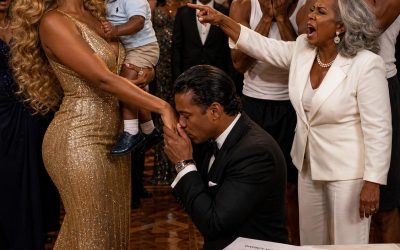
Ask Nora what happens when women bury evidence and call it courage.
The key opens the east room.
Blackridge House still remembers.
Your father
I read it once.
Then again.
The name struck nothing in my memory.
Evelyn Hart.
Unknown.
But the second sentence knew where to cut.
Ask Nora what happens when women bury evidence and call it courage.
I had buried the blue scarf.
I had dug it up.
That truth had sent Elias Vance to prison for forty-two years.
And now, from behind bars, he had found a way to put a shovel in his son’s hand.
I looked at Oliver.
“Did you call your mother?”
He shook his head.
“Why not?”
“Because I wanted to ask you first.”
That hurt.
Not because I did not understand.
Because I did.
“What does the photo show?”
He handed it to me.
Blackridge House.
Not the white-columned facade from the press conferences.
Not the staircase where Margot Vance had once stood beside her son pretending sorrow was a family virtue.
This photograph showed a hallway I did not recognize.
Dark wood.
A runner rug.
A narrow green door at the end.
No windows.
On the back, in the same typed font:
THE EAST ROOM.
I felt the old coldness spread through me.
Houses like Blackridge do not run out of rooms.
They only run out of witnesses.
Oliver watched my face.
“You don’t know?”
“No.”
“Don’t lie because you’re trying to be careful.”
“I’m not lying.”
“Do you think Mom will?”
The question was too fast.
Too sharp.
Too ready.
Elias had not sent a key.
He had sent suspicion.
That was always how he began.
Not by breaking the room.
By teaching people to doubt who had built it.
I set the envelope on the table.
“Oliver, listen to me. Whatever this is, it came from a man who kidnapped you through his brother, had your mother locked in a facility under a false name, erased evidence, hurt women, and spent years making other people sound unstable so he could stay clean.”
“I know.”
“Do you?”
His jaw tightened.
“I was there.”
The words snapped between us.
I deserved them.
Not because I had done wrong.
Because adults sometimes forget that surviving a story does not mean a child has stopped living inside it.
I softened my voice.
“I know you were.”
He looked away.
For a moment, I saw him at eleven again, barefoot in a hospital doorway asking Elias where the blue scarf was.
Then he was seventeen.
Almost eighteen.
Old enough to hate being protected.
Young enough to still need it.
“What if he’s telling the truth about something?” Oliver asked.
“Then we find out.”
“And if Mom hid something?”
“Then we find out.”
He looked at me.
“No matter what?”
I heard his own younger voice from the sycamore tree at Halewick.
We don’t hide important stuff anymore.
Children say things cleanly because they do not yet know how expensive clean truths become.
“No matter what,” I said.
Only then did he sit down.
The garlic bread was charcoal.
Oliver ate it anyway.
That is how I knew he was terrified.
Rachel arrived twelve minutes after I called her.
She came through the front door without knocking, hair half pinned, bag still on her shoulder, face already braced for disaster.
“Is he hurt?”
“No,” I said.
Oliver stood from the couch.
Rachel crossed to him, then stopped short when she saw his expression.
Mothers learn their children’s faces the way soldiers learn terrain.
Every danger has a shape.
“What happened?” she asked.
Oliver handed her the note.
I watched her read it.
Her face emptied.
Not confusion.
Not surprise.
Recognition.
My stomach sank.
“Mom,” Oliver said.
Rachel’s fingers closed around the paper.
“Where did this come from?”
“Don’t do that,” he said.
She looked up.
“What?”
“Don’t ask questions you know aren’t the point.”
Her mouth parted slightly.
The boy had learned too much from too many wounded adults.
Rachel sat down slowly.
“Nora,” she said, and in my name I heard warning.
No.
Plea.
Maybe both.
I folded my arms.
“Who is Evelyn Hart?”
Rachel closed her eyes.
Oliver made a small sound.
Not pain.
Worse.
Confirmation.
“She was someone I knew before Oliver was born,” Rachel said.
“That’s not an answer,” Oliver said.
“I know.”
He laughed once, sharp and humorless.
“You all say that right before not answering.”
Rachel flinched.
I sat across from her.
“Rachel.”
She opened her eyes.
For a second I saw the girl at Halewick again. Mascara streaked, bruised, terrified, begging me to hide the scarf where we hid everything that mattered.
Then I saw the woman at trial, standing under oath and saying what she had done.
Truth had made Rachel stronger.
But not fearless.
No one becomes fearless.
They only become tired of fear choosing for them.
“Evelyn Hart was a Vance Foundation intern,” Rachel said. “Twenty-three. Smart. From Ohio. Scholarship student. She worked under Margot first, then Elias.”