One of his sisters leaned against her arm.
“I’m not saying rules are stupid,” Leo said. “I used to think that. I don’t anymore.”
He looked at Ms. Bellamy.
“Some rules keep people alive.”
Then he looked at Mr. Carver.
“But some rules tell kids, in a quiet way, that being complicated makes them a problem.”
No one moved.
Leo’s voice grew steadier.
“Arthur didn’t start cocoa because he wanted to run a program. He started it because he noticed us.”
He turned to the crowd.
“That’s the part you can’t put on a form.”
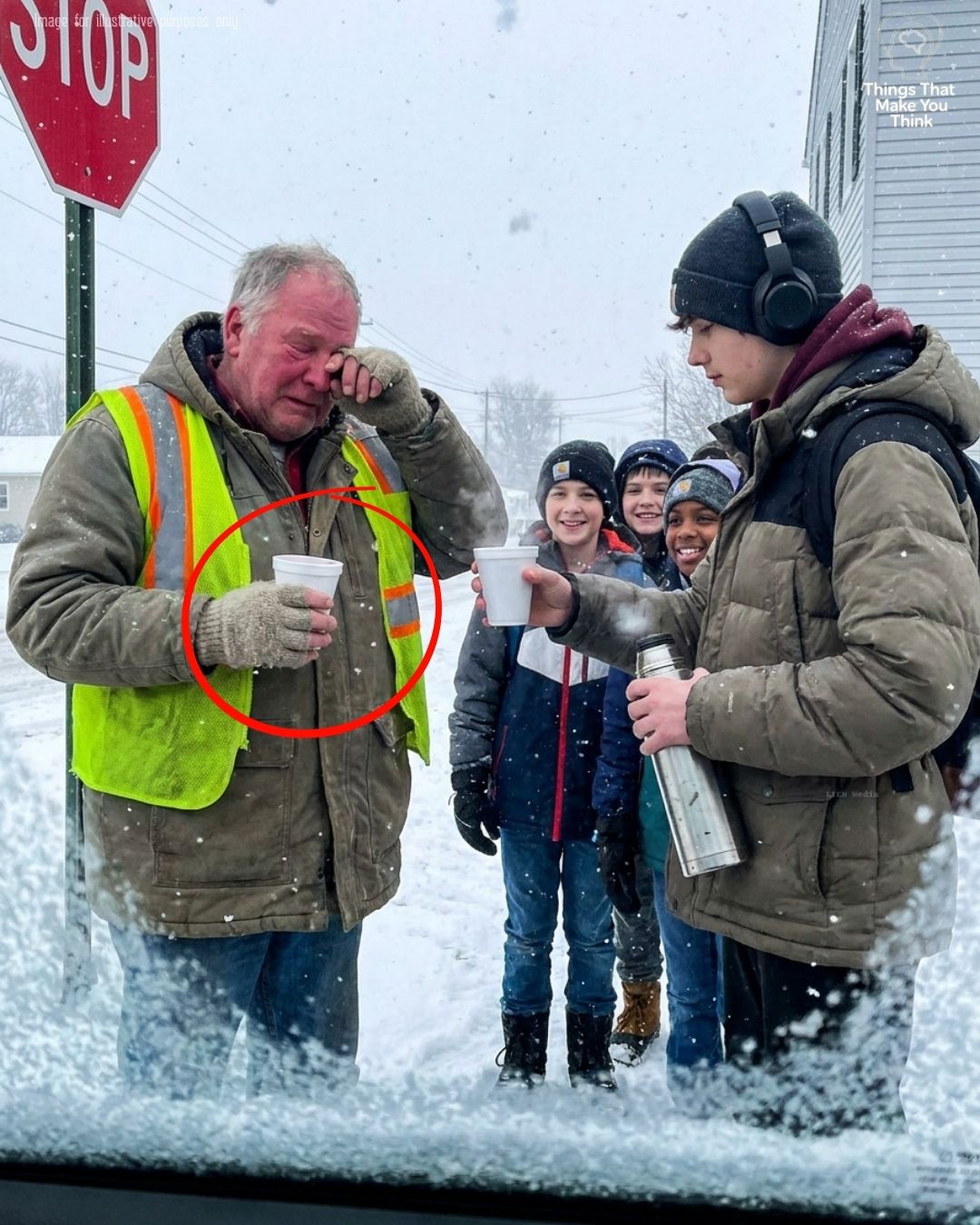
Arthur wiped his eyes before anyone could see.
Leo took one breath.
“So here’s what I think. Make the cocoa safe. List the ingredients. Use sealed cups. Let parents opt out if they need to. Train volunteers. Whatever.”
He paused.
“But don’t make the default answer no.”
The gym stayed silent.
Leo looked down at his paper, then back up.
“Because some kids already hear no all day.”
That was when the first clap came.
It came from the cafeteria worker.
Then from a teacher.
Then from the bleachers.
Soon, the whole gym was clapping.
Not everyone.
But enough.
Leo stepped back like the sound embarrassed him.
Arthur stood before he realized he had moved.
Leo saw him.
For one second, the boy looked like he might cry.
Then he shrugged, because fourteen-year-old boys would rather face winter barefoot than let a gymnasium see their tears.
The meeting did not end neatly.
Real life rarely did.
There was no sudden vote that solved everything.
No single speech erased medical concerns.
No applause rewrote municipal policy.
But something shifted.
The room stopped talking about the cocoa as a program.
They started talking about the children as people.
By the end of the night, Mrs. Harlan proposed a temporary compromise.
The diner would provide a full ingredient list.
The cups would be pre-filled by trained staff and sealed with lids.
A large sign would be posted at the corner.
Parents could submit an opt-out form if their child should not receive cocoa.
Students with known restrictions could choose a sealed cup of hot water instead.
No wristbands.
No public sorting.
No child pulled out of line because an adult forgot a form.
Mr. Carver hated it.
You could see it in his face.
But he also saw the room.
And sometimes policy changes not because someone’s heart grows three sizes, but because the room becomes impossible to ignore.
The temporary plan passed for thirty days.
A pilot program.
Arthur almost laughed when he heard the phrase.
Somewhere in government, even mercy needed a trial period.
After the meeting, Leo tried to leave quickly.
Arthur caught him near the gym doors.
“Hey.”
Leo turned.
“What?”
Arthur smiled.
“You did good, son.”
Leo looked away.
“Just talked.”
“No,” Arthur said. “You told the truth without making enemies. That’s harder than shouting.”
Leo’s mother stepped closer.
Up close, Arthur could see how tired she was.
But he could also see pride fighting through that exhaustion.
“You Arthur?” she asked.
“Yes, ma’am.”
She held out her hand.
“Nina.”
He shook it.
Her grip was firm.
“Leo talks about you.”
Leo groaned.
“Mom.”
Nina ignored him.
“He acts like he doesn’t. But he does.”
Arthur smiled.
“He talks about you too.”
That made her pause.
Leo looked alarmed.
Arthur continued gently.
“He says you work hard.”
Nina’s mouth tightened.
For a second, she seemed ready to defend herself against an accusation that had not been made.
Then she saw Arthur’s face.
No judgment.
Just recognition.
Her eyes softened.
“I’m trying,” she said.
Arthur nodded.
“I know.”
Two words.
That was all.
But Nina looked at him like nobody had said them to her in a very long time.
The next morning, the wristband table was gone.
In its place stood a large laminated sign.
HOT COCOA PROVIDED BY MAPLE STREET DINER.
INGREDIENTS LISTED BELOW.
PARENTS MAY OPT OUT THROUGH THE SCHOOL OFFICE.
HOT WATER AVAILABLE UPON REQUEST.
NO STUDENT PHOTOS WITHOUT PERMISSION.
NO QUESTIONS ASKED.
Arthur read the last line three times.
No questions asked.
He did not know who added it.
Mrs. Harlan denied it.
Ms. Bellamy denied it.