Leo didn’t look up.
“So are you.”
“I’m always early.”
“Then I’m learning from a bad influence.”
Arthur smiled.
They worked in comfortable silence until Leo suddenly said, “My mom slept eight hours last night.”
Arthur stopped.
Leo kept sweeping.
“First time in months.”
Arthur’s voice was careful.
“That’s good.”
“Yeah.”
Leo brushed salt into the street.
“She made pancakes this morning.”
Arthur looked at him.
Leo tried to hide his smile.
Failed.
“They were kind of burned.”
“Best kind,” Arthur said.
Leo nodded.
“Yeah.”
The walk signal clicked.
The first group of students appeared at the corner.
Arthur stepped into the road and lifted his sign.
His neon vest flashed in the pale morning sun.
The children crossed.
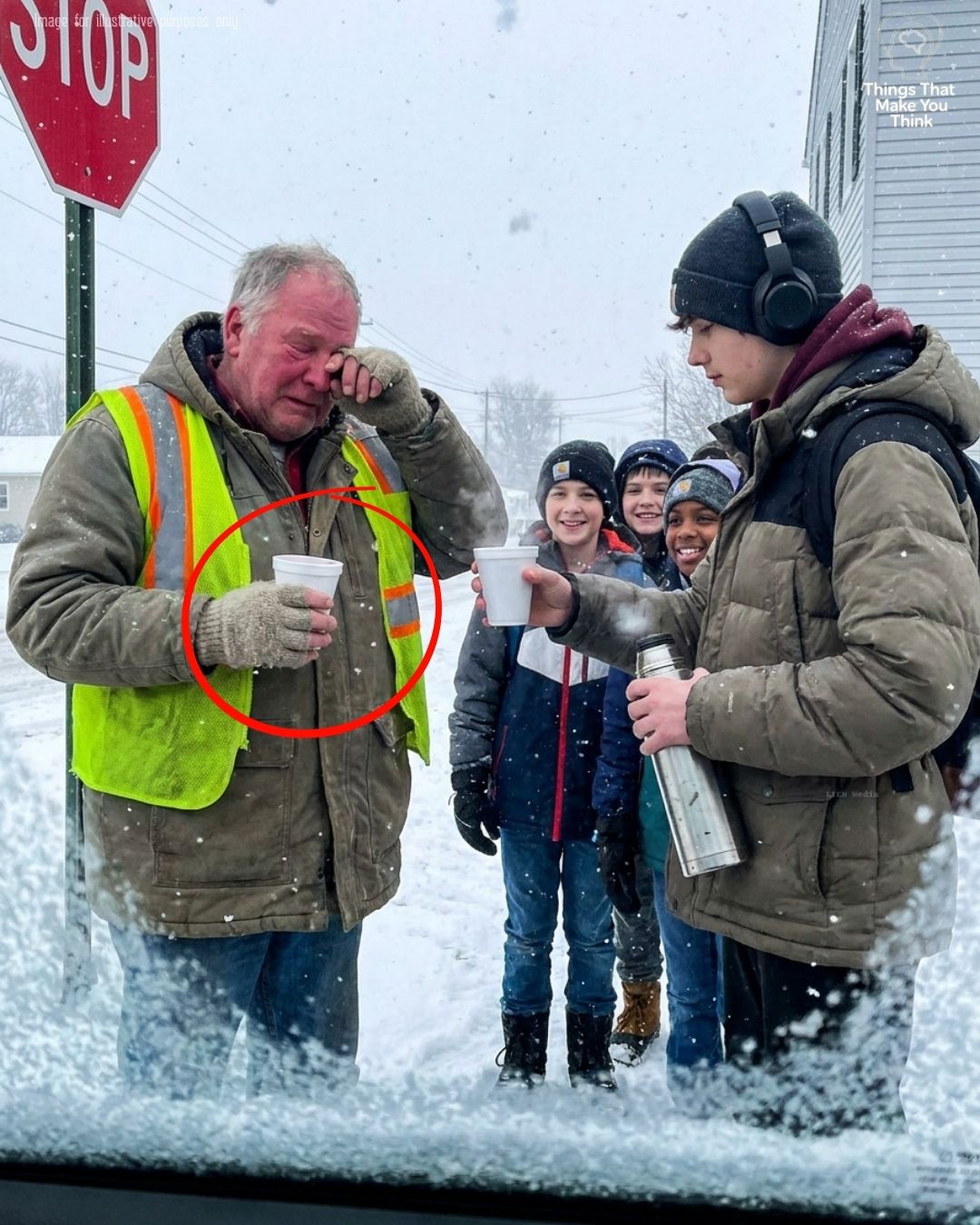
Cocoa steamed.
Gloves disappeared from the bin.
A town that had argued itself raw kept showing up anyway.
That was the part Arthur loved most.
Not that they solved everything.
They hadn’t.
There were still families struggling.
Still forms.
Still policies.
Still adults who cared more about control than connection.
Still people who thought Leo was disrespectful.
Still people who thought Arthur had become too soft.
But every morning, the corner proved something stubborn.
A community did not have to be perfect to be good.
It only had to keep choosing people over pride.
The last snow of the season came in March.
Wet, heavy flakes that clung to coats and melted in eyelashes.
Arthur was packing up the cocoa table when Mr. Carver walked over.
Arthur braced himself.
Old habits.
Mr. Carver stood awkwardly beside the curb.
“I wanted to inform you,” he said, “that the thirty-day pilot has been extended through the end of the school year.”
Arthur blinked.
“Is that so?”
“Yes.”
Mr. Carver looked at the Green Thermos sign.
“The data was favorable.”
Arthur almost smiled.
“Data.”
“Attendance improved slightly on severe weather mornings. Tardiness decreased. Nurse visits for cold-related complaints went down.”
Arthur nodded seriously.
“Well. Can’t argue with data.”
Mr. Carver glanced at him, perhaps suspecting humor and choosing not to confront it.
Then he cleared his throat.
“My office will also be recommending a version of this model for other crossing locations next winter.”
Arthur’s smile faded.
“Other corners?”
“Yes.”
“That’s good.”
Mr. Carver shifted again.
“And Mr. Whitaker?”
“Yes?”
The supervisor looked at the empty sidewalk where the children had stood with signs weeks earlier.
“I may have handled the initial situation poorly.”
Arthur waited.
Mr. Carver seemed to struggle with the size of his own sentence.
“I was focused on preventing problems.”
Arthur nodded.
“That’s your job.”
“Yes. But I failed to notice I had become one.”
Arthur studied him.
There were many things Arthur could have said.
He could have been sharp.
He could have been triumphant.
He could have reminded Mr. Carver of the clipboard, the warning, the cold morning when the table vanished.
Instead, Arthur thought of Leo at the microphone.
Truth without enemies.
“It’s easy to miss people when you’re looking at procedures,” Arthur said.
Mr. Carver nodded slowly.
“Yes. It is.”
Then he reached into his coat pocket and pulled out something folded.
A blue paper wristband.
Arthur recognized it immediately.
Mr. Carver looked embarrassed.
“I found it in my file. From that first morning.”
Arthur stared at it.
“I kept it as a reminder,” Mr. Carver said. “Not a comfortable one.”
He handed it to Arthur.
Arthur took it.
The paper was flimsy.