Almost weightless.
Strange, how something so small had carried so much shame.
“What should I do with it?” Arthur asked.
Mr. Carver looked toward the school.
“Maybe ask Leo.”
So Arthur did.
The next morning, he handed the wristband to Leo without explanation.
Leo turned it over in his fingers.
His face changed when he realized what it was.
“Where’d you get this?”
“Mr. Carver.”
Leo looked suspicious.
“Why?”
“He said it reminded him of a mistake.”
Leo stared down at the blue strip of paper.
For a long time, he said nothing.
Then he walked to the Green Thermos bin, took a pushpin from the little corkboard where ingredient lists were posted, and pinned the wristband in the corner.
Under it, he wrote four words on an index card.
REMEMBER WHO GETS LEFT OUT.
Arthur read it.
Then read it again.
“That’s good,” he said.
Leo shrugged.
“It’s not for them.”
Arthur looked at him.
Leo nodded toward the adults arriving with donations.
“It’s for us too.”
Arthur felt that one deep.
Because Leo was right.
Every system, no matter how kind at the start, could harden.
Every program could forget the person it was built for.
Every good deed could become a gate if nobody kept watch.
Spring came slowly.
The cocoa became less necessary.
Some mornings, kids chose water.
Some wanted nothing at all.
The big dispenser was replaced by a smaller one.
The glove bin became a snack-and-supplies bin.
Arthur wondered if the corner would lose its magic when the cold left.
It didn’t.
Because by then, the cocoa had never really been the point.
The point was that kids walked to school through a world that often expected them to be tougher than they should have to be.
And one old man had noticed.
Then one angry boy had refused to let that noticing become another system that forgot the quiet ones.
On the last day before spring break, the students surprised Arthur.
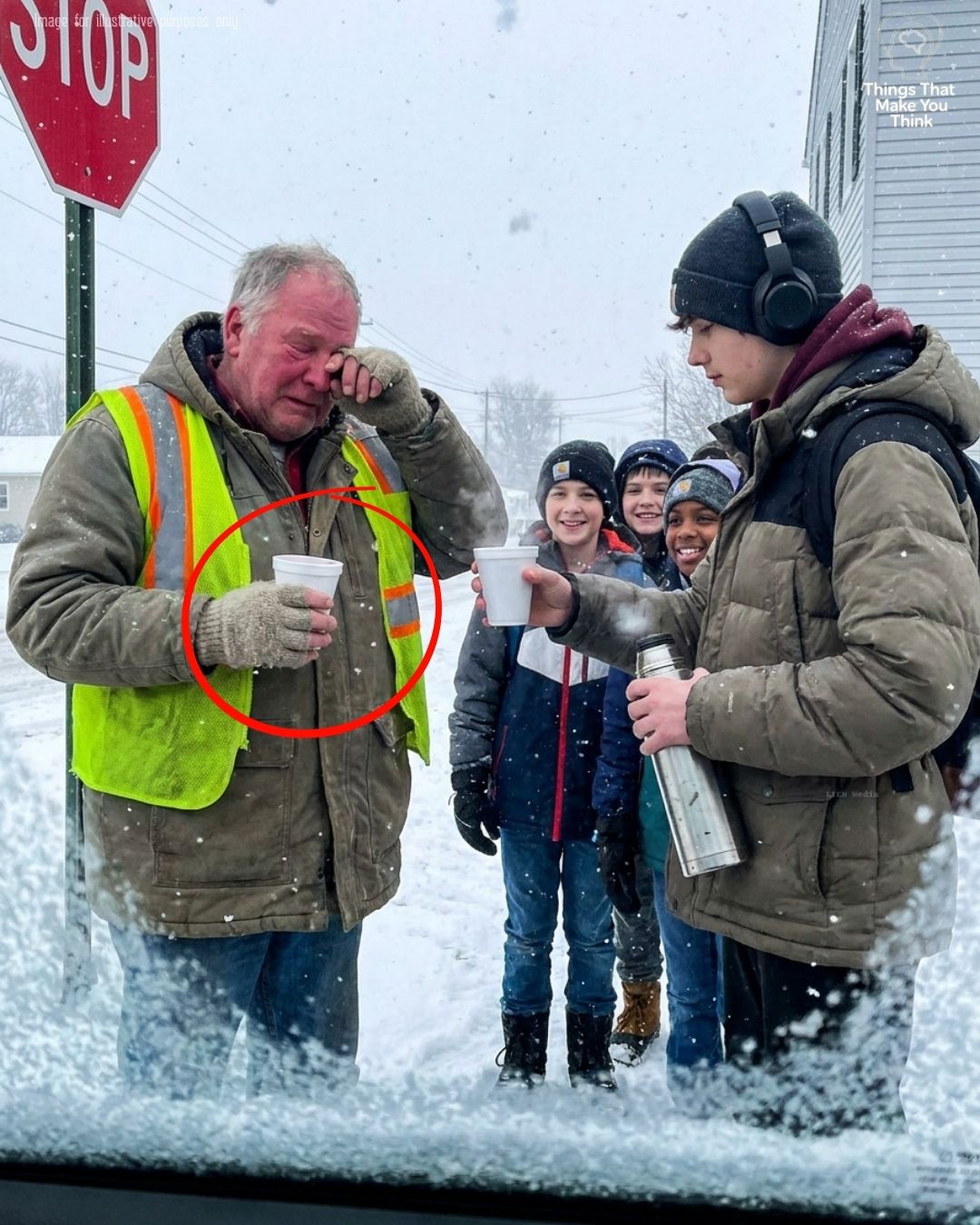
He arrived at Elm and 4th to find nearly fifty kids waiting on the sidewalk.
For one terrifying second, he thought something was wrong.
Then they parted.
Leo stepped forward holding the green thermos.
Arthur’s green thermos.
His wife’s green thermos.
Arthur stared.
“Where did you get that?”
Leo suddenly looked nervous.
“Your daughter mailed it.”
Arthur’s breath caught.
“My daughter?”
Leo nodded toward Mrs. Harlan, who stood nearby with a guilty smile.
“We might have found her number.”
Arthur pressed a hand to his chest.
His daughter lived two states away.
They spoke on holidays.
Sometimes birthdays.
Grief had made Arthur smaller, and distance had done the rest.
He had never told her how lonely the house became.
He had never told her that her mother’s thermos had become a kind of altar.
Mrs. Harlan stepped forward.
“She wanted to be here, but she couldn’t travel this week. She sent a letter.”
Arthur took the envelope with trembling hands.
He opened it slowly.
The paper shook.
Dad,
Mrs. Harlan told me what happened at your corner.
She told me about the kids.
She told me about Leo.
She told me Mom’s thermos helped start something beautiful.
I cried when I heard that.
For a long time, I thought we lost both of you when Mom died.
Maybe I was wrong.
Maybe you were still there, just waiting for someone to need you again.
Mom would be so proud of you.