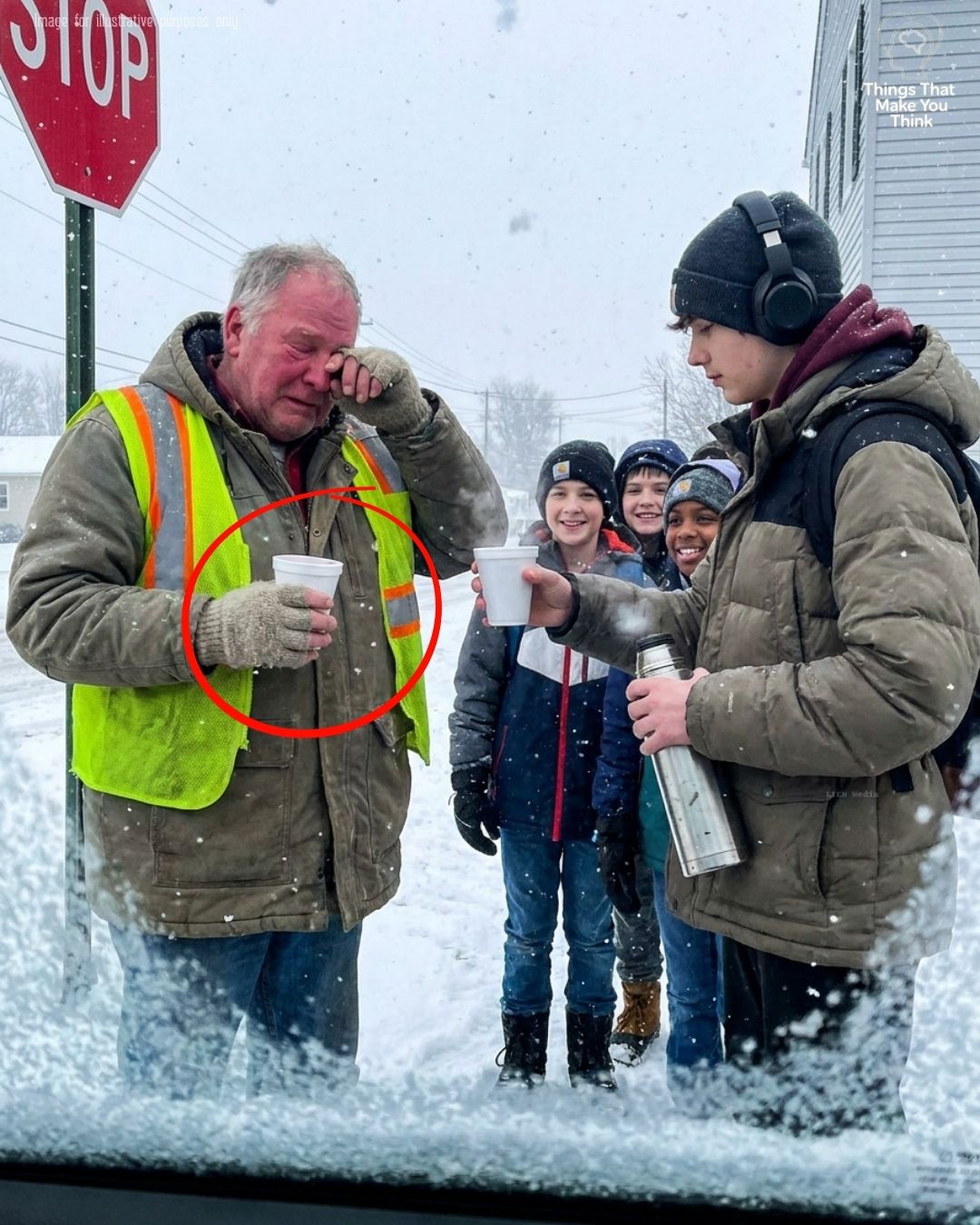
A hush fell over the corner.
Leo’s mouth opened a little.
Mr. Carver stepped closer.
“You are a city employee on duty.”
“I am.”
“Then you are expected to maintain order.”
Arthur nodded.
“And I will. I’ll keep them out of the road. I’ll make sure they cross safely. That’s my job.”
He looked at the cardboard signs.
“That is not disorder.”
Mr. Carver’s face reddened.
The first car horn sounded.
Not angry.
Supportive.
Then another.
A mother rolled down her window and called, “Let them ask!”
Another parent shouted, “What about allergies?”
Someone else yelled, “What about kids going without?”
The corner became a storm of competing truths.
And Arthur stood in the middle of it, holding a stop sign, realizing that sometimes a community did not become stronger because everyone agreed.
Sometimes it became stronger because people finally admitted what they were afraid of.
The school principal arrived ten minutes later.
Mrs. Harlan was a small woman with silver hair, snow boots, and the exhausted eyes of someone who had broken up three hallway arguments before breakfast.
She did not yell.
She did not threaten.
She simply walked to the center of the sidewalk and said, “All right. Everyone breathe.”
Strangely, they did.
Even Mr. Carver.
Mrs. Harlan turned to Leo.
“Did you make these signs?”
Leo lifted his chin.
“Some of them.”
“Did you block traffic?”
“No.”
“Did you insult anyone?”
“No.”
“Did you keep students from getting to school?”
“No.”
She looked at Mr. Carver.
“Then I’m not treating this like misconduct.”
Mr. Carver’s jaw tightened.
“We have policy.”
“We also have children,” Mrs. Harlan said.
The words landed hard.
Not because they were clever.
Because they were simple.
Mr. Carver looked like he had swallowed ice.
Mrs. Harlan turned to the students.
“You have five minutes. Then you go to class.”
Leo nodded.
Mrs. Harlan looked at Arthur.
“And you, Mr. Whitaker, keep doing your crossing guard work.”
Arthur nodded.
“Yes, ma’am.”
For five minutes, the kids stood silently with their signs.
Some with wristbands.
Some without.
That mattered.
A boy with a blue wristband stood beside Mateo.
A girl sipping cocoa stood beside Riley.
They were not protesting the kids who got cups.
They were protesting the idea that care had to come with public sorting.
When the bell rang in the distance, Leo lowered his sign.
The students crossed together.
Arthur watched them go.
His heart was pounding so hard he could feel it in his ears.
Ms. Bellamy came up beside him.
“I’m sorry,” she whispered.
Arthur looked at her.
She seemed close to tears.
“I know you didn’t make the rule,” he said.
“My nephew has a severe allergy,” she said. “That’s why I agreed to help. I thought… I thought we were protecting kids.”
Arthur’s expression softened.
“You were.”
She looked at the empty sidewalk.
“Then why did it feel so awful?”
Arthur had no answer.
That afternoon, the town’s community page exploded again.
Only this time, it was not just anger.
It was argument.
Long, painful, personal argument.
Parents told stories about children with allergies.
Grandparents told stories about poverty.
Teachers explained that forms often punished the very families most overwhelmed.
Nurses explained why food safety mattered.
A father wrote that his son had once been excluded from a field trip because a permission slip got lost.
A mother wrote that her daughter could not risk unknown ingredients.
For once, nobody could easily claim the other side was heartless.
That made the fight harder.
And more honest.
By evening, someone created a poll.
Should the cocoa program require signed consent before serving students?
The vote split almost perfectly in half.
The town was not divided between good people and bad people.
It was divided between two kinds of fear.
Fear of harm.
And fear of abandonment.
Arthur sat in his kitchen reading the comments until the words blurred.
Then he closed the laptop.
He pulled Ellen’s thermos closer.
And for the first time since she died, he spoke to her out loud without feeling foolish.
“What would you do?”
The house gave no answer.