“Pressure and release,” she said.
“Sounds like parenting.”
She snorted.
“Sounds like life.”
Buster learned slowly.
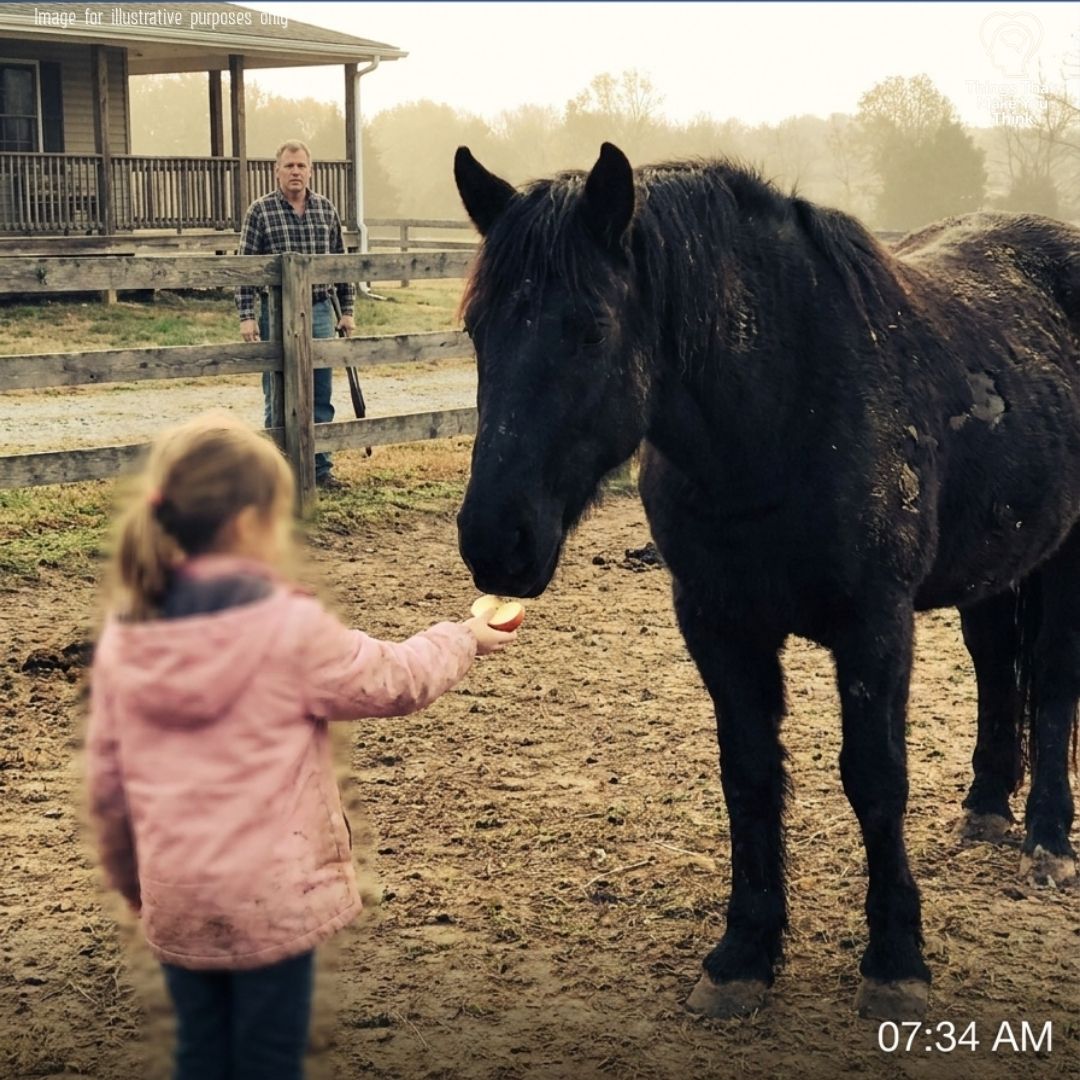
Some days he let me touch his shoulder.
Some days he swung away before I got within ten feet.
Some mornings a backfiring truck on the county road sent him galloping circles around the pasture, eyes wild, sweat darkening his neck.
But he recovered faster.
That was what Mara told me to watch.
Not whether he was never scared.
Whether he could come back.
Humans were the same, I suppose.
Lily came back in small ways.
She spoke more at home.
Not much at school yet.
But at home, words began appearing like wildflowers after a hard winter.
“Pancakes.”
“Too much salt.”
“Buster hates your singing.”
That one made me laugh so hard I had to sit down.
At night, she sometimes asked about Emily.
Not the accident.
Not yet.
But little things.
“What was Mom’s favorite cereal?”
“Did Mom like storms?”
“Did Mom ever get mad at you?”
“Yes,” I said.
Lily looked shocked.
“What did you do?”
“I folded towels wrong.”
“There’s a wrong way?”
“According to your mother, there were many wrong ways.”
Lily smiled into her sleeve.
Those moments saved me.
But healing has a cruel habit of opening doors you thought were walls.
One night, near the end of the first month, I heard Lily crying in her room.
Not the quiet kind.
The kind she had swallowed for eight months.
I found her on the floor beside her bed, clutching Emily’s old gray sweater.
Her whole body shook.
“I forgot her voice,” she gasped.
I dropped beside her.
“No, baby.”
“I did. I forgot it. I can see her mouth moving, but I can’t hear it.”
I pulled her into my lap.
She fought me for a second, then collapsed against my chest.
“I talked for Buster,” she sobbed. “Why couldn’t I talk for Mom?”
The question tore through me.
Because grief is not fair.
It makes children think love is measured by what they were able to do in the worst moment of their lives.
“You were ten,” I said.
“I was there.”
“You were a child.”
“I didn’t say goodbye.”
My own tears came then.
I had tried not to cry too much in front of her after the funeral.
Another mistake adults make.
We think our tears add weight.
Sometimes they give permission.
“I didn’t either,” I whispered.
She looked up at me.
“You didn’t?”
I shook my head.
“The last thing I said to your mom was that we were out of milk.”
Lily stared.
A tiny, broken laugh came out through her tears.
“That’s dumb.”
“I know.”
“She probably rolled her eyes.”
“She definitely did.”
Lily cried harder then.
But differently.
Not like drowning.
Like melting.
I held her until the moon moved across the window.
Outside, Buster stood near the fence under the stars.
As if keeping watch over every creature in that house still learning how to survive.
The second hearing came after thirty days.
This time, we brought photographs.
New fencing.
Double gates.
Training logs.
Vet reports.
Mara’s evaluation.
No incidents.
No loose escapes.
No aggressive contact.
Daniel Price came too.
He walked better now, though the cane remained.
When the board asked for public comment, he stood.
My stomach tightened.
Daniel cleared his throat.
“I still don’t like that horse,” he said.
A few people laughed nervously.
“I still think folks need to be careful. And I still think Mr. Reeves has taken on something most people wouldn’t have the patience for.”
He looked back at me.
“But he did what he said he’d do.”
The room shifted.
Not dramatically.
Just enough.
Sometimes trust returns as a teaspoon, not a flood.
Daniel continued.
“My son helped with that fence. He told me Mr. Reeves didn’t make excuses for what happened to me. That matters.”
He leaned on his cane.
“So I’m not here to object today. I’m here to say keep the rules tight. But let the man keep doing the work.”
I could barely breathe.
After the meeting, Daniel walked past me.
He didn’t stop.
But he tapped two fingers against the back of a chair.
A small gesture.
Not forgiveness.
Maybe respect.
At that stage, respect felt like a miracle too.
By spring, Buster had gained weight.
His coat started shining blue-black in the sun.
His ribs disappeared beneath muscle.
His mane, once tangled with burrs, fell thick and uneven along his neck.
He still carried scars.
They didn’t vanish.
I was learning that healing didn’t always mean becoming unmarked.
Sometimes it meant the scars stopped being the first thing people saw.
Lily turned eleven in April.
She asked for no party.
Just three people.
Me.
Doc Briggs.
Mrs. Alvarez.
And Buster, though she said he did not count as people because “he is better.”
We hung paper lanterns from the porch.
I baked a lopsided cake.
Mrs. Alvarez brought tamales because she said cake alone was not dinner.
Doc gave Lily a grooming kit with her name burned into the wooden box.
Buster gave her nothing, because he was a horse.
Then he rested his chin on top of her head and nearly knocked her party hat off.
She laughed so loudly that Gus, who had pretended not to come but was fixing a gate hinge nearby, wiped his eyes with the back of his sleeve.
That night, Lily made a wish before blowing out her candles.
I didn’t ask what it was.
Two weeks later, I found out.
She wanted to visit Arthur’s grave.
The cemetery sat on a hill behind a small white chapel that no longer held regular services.