Arthur’s stone was simple.
His full name.
His dates.
A small engraved horseshoe.
The nurses from the medical facility had pooled money for it, along with half the valley once they heard the story.
I brought wildflowers.
Lily brought one black ribbon from Buster’s mane brush.
She tied it gently around the base of the stone.
For a while, we stood in silence.
Then Lily said, “Thank you for loving him first.”
The wind moved through the grass.
I looked away because some moments are too private even for a father.
As we turned to leave, I saw a woman standing near the cemetery gate.
She was maybe in her fifties.
Well-dressed in a careful, city way.
Her hair was smooth.
Her eyes were red.
A man stood beside her, arms folded tightly.
I knew before she spoke.
Arthur’s children.
The woman stepped forward.
“Mr. Reeves?”
I placed myself slightly in front of Lily.
“Yes.”
“My name is Carolyn Whitcomb. This is my brother, Nathan.”
Lily’s hand found mine.
Carolyn looked at the grave.
Then at the ribbon.
“We heard what you did. Bringing Buster to Dad.”
Her voice cracked on the word Dad.
I had prepared myself to dislike them.
That was easier.
I had built them into villains in my mind.
The children who abandoned a horse.
The city people who sold the farm.
The ones who drove away and left loyalty starving in the woods.
But Carolyn didn’t look like a villain.
She looked like someone who had made a terrible choice and been forced to live long enough to understand it.
Nathan looked defensive.
Defense is often shame wearing work boots.
Carolyn continued.
“The nurse sent us a photograph. Of Dad with Buster.”
I said nothing.
“She said he smiled at the end.”
“He did,” I said.
Carolyn covered her mouth.
Nathan looked toward the road.
Then Carolyn said something I didn’t expect.
“We want to see him.”
Lily’s fingers dug into my palm.
Nathan added quickly, “Just see him. We’re not trying to take him.”
Not trying.
Those words left a crack big enough for fear.
I didn’t answer immediately.
Carolyn noticed.
“I know what you must think of us.”
I kept my voice even.
“I don’t know you.”
“No,” she said. “But you know what we did.”
Nathan’s face hardened.
“You don’t know what it was like.”
Carolyn turned on him.
“Nate.”
“No,” he said. “I’m tired of being the monster in this story.”
There it was again.
Another person refusing to fit the role I had assigned.
Nathan looked at me.
“Our father couldn’t live alone. He kept leaving burners on. He fell twice. He refused help. He refused to sell. He refused to move. He refused everything.”
His voice rose.
“That horse was fifteen hundred pounds of panic every time we tried to get near him. We had jobs. Kids. Bills. Dad’s care cost more than the house was worth after repairs.”
Carolyn whispered, “Stop.”
But Nathan kept going.
“You think we drove off laughing? You think we didn’t sit in that truck while Dad begged without words from a wheelchair and that horse screamed from the pasture?”
The cemetery felt suddenly too small.
Nathan’s eyes shone.
“We failed him. Fine. Say it. But don’t pretend we were choosing between good and evil. We were choosing between impossible and impossible.”
I had no reply.
Because he was right about one thing.
It is easy to judge people at the end of their rope when you never saw the rope fraying.
Carolyn wiped her face.
“We should have done better,” she said. “That’s still true.”
Nathan looked away.
She turned to Lily.
“I’m sorry.”
Lily stared at her.
Carolyn’s voice trembled.
“I’m sorry Buster waited alone.”
Lily did not forgive her.
Children are not vending machines for absolution.
But she nodded once.
That afternoon, Arthur’s children came to the farm.
Buster knew them.
I saw it immediately.
Not joy.
Not rage.
Recognition.
His body went stiff at the far end of the pasture.
Carolyn burst into tears the second she saw him.
Nathan stood silent, his face gray.
“He looks better,” Carolyn whispered.
Lily held Buster’s lead rope inside the paddock.
Mara stood near the gate.
I had called her before allowing the visit.
No surprises.
No emotional reunions without boundaries.
That was the rule.
Carolyn asked if she could touch him.
Lily looked at Buster.
Buster’s ears flicked back.
“No,” Lily said.
Carolyn flinched.
Then nodded.
“Okay.”
It was the most mature answer in the whole pasture.
Nathan stepped closer to the fence.
Buster snorted.
Not violently.
But enough.
Nathan froze.
“I’m sorry, old man,” he said.
His voice broke on the last word.
Buster did not come to him.
Sometimes apologies are seeds, not keys.
You don’t get to unlock what you broke just because you finally found the right words.
But after a long moment, Buster lowered his head and began grazing.
Mara whispered, “That’s more forgiveness than a lot of humans offer.”
The visit changed something in me.
Not all at once.
I didn’t suddenly feel warm toward Arthur’s children.
I didn’t excuse what happened.
But I stopped needing them to be monsters.
That mattered.
Because once you decide someone is only one thing, you stop being curious.
And without curiosity, compassion dies early.
By summer, the county board lifted the strictest conditions.
Buster remained under supervision, but the monthly hearings ended.
The farm settled into a rhythm.
Mornings belonged to feed, coffee, and Lily reading out loud on the porch.
She had started reading again after months of refusing books.
At first, she read to Buster because she said he did not interrupt.
Then she read to me.
Then, one afternoon, she asked if Ryan could come listen too.
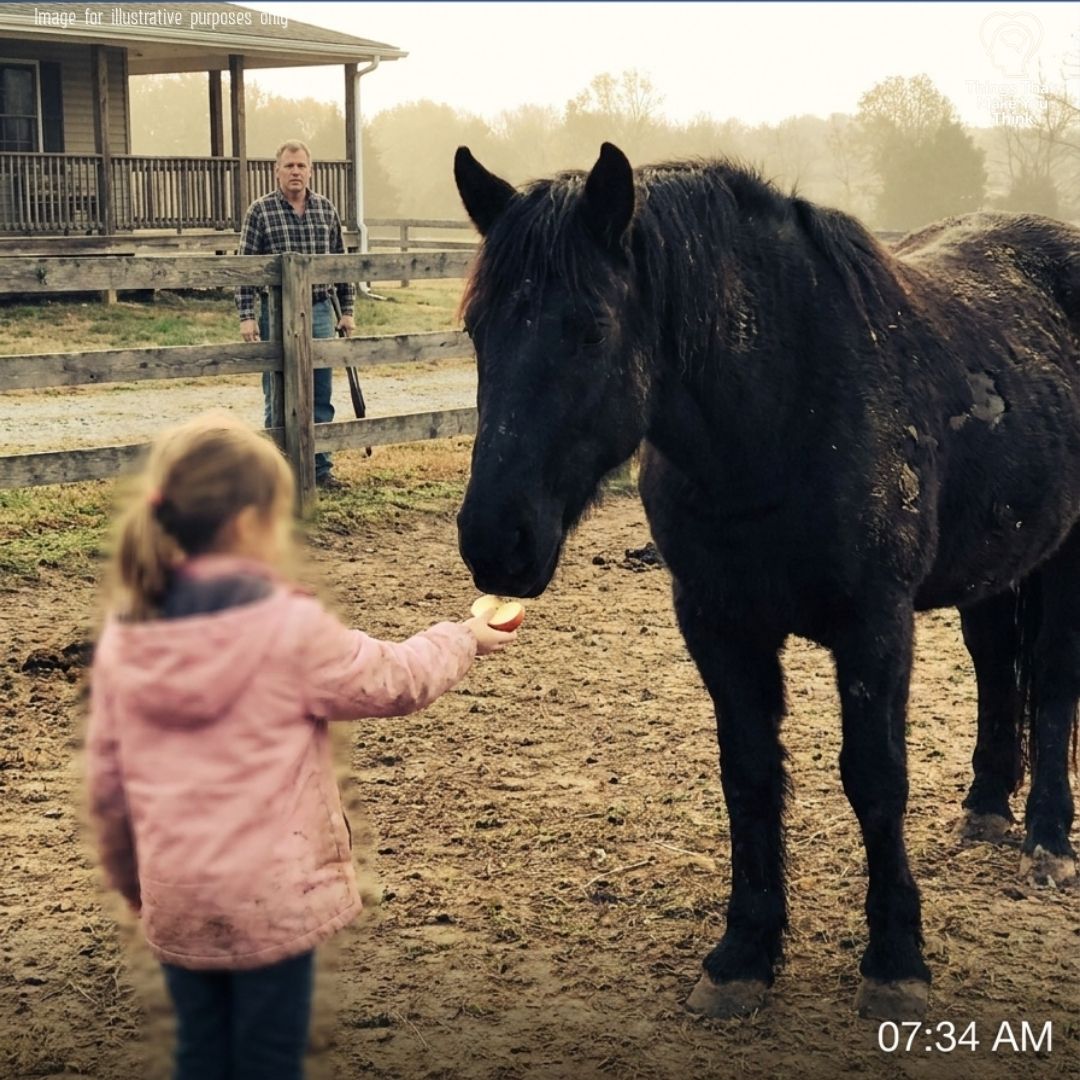
Ryan Price arrived on his bike with a library book, a bag of apples, and the awkward posture of a boy trying to apologize without using the word.
Buster watched him carefully.
Ryan stayed outside the fence.
He did everything right.
Turned sideways.
Kept his voice low.
No sudden movements.
After twenty minutes, Buster approached.
Ryan held out an apple slice with a trembling hand.
Buster took it gently.
Ryan’s eyes filled with tears so fast he looked embarrassed by his own face.