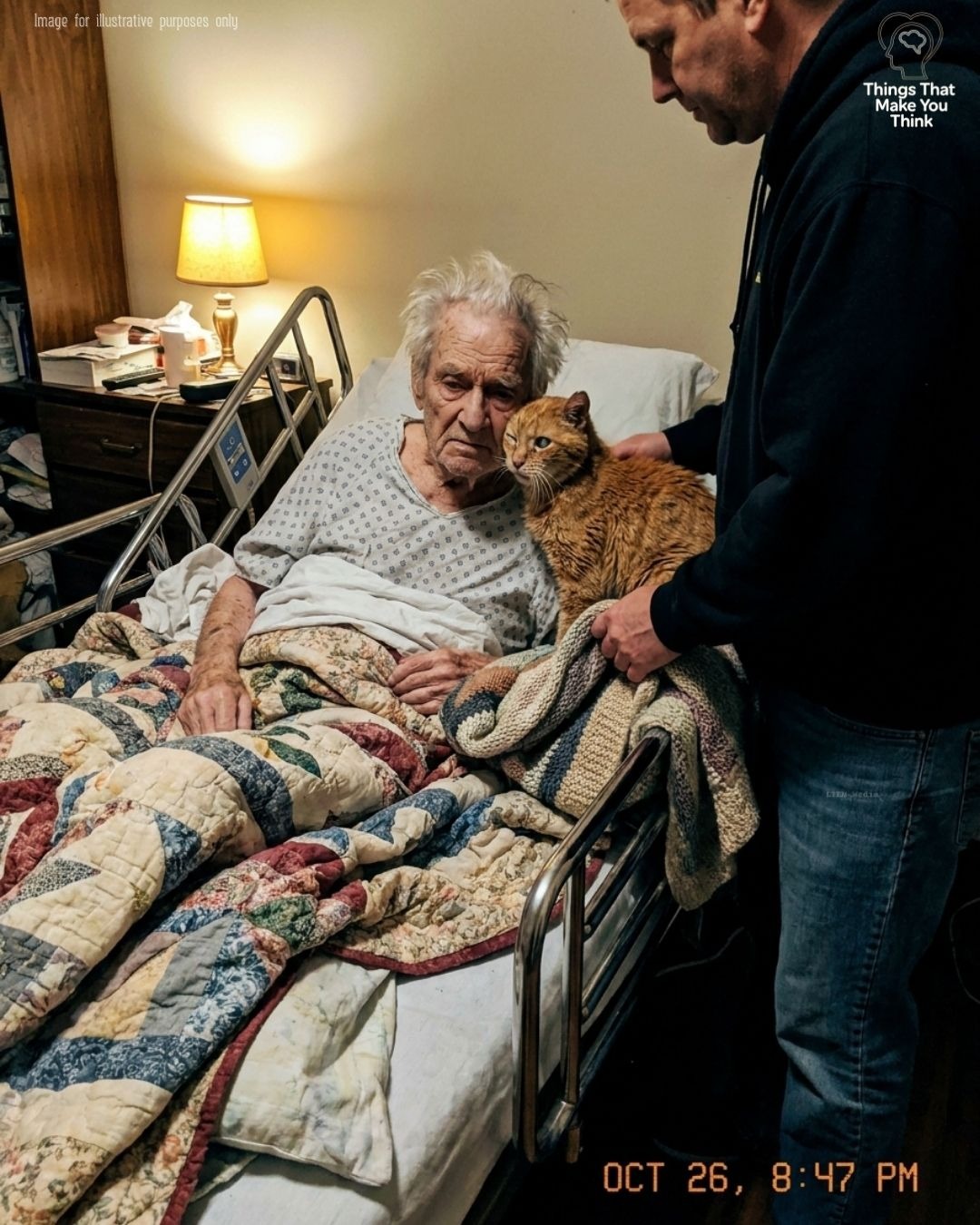
Copper did not look uncomfortable when he cried during old songs.
Copper just climbed onto his chest and stayed.
That kind of love can feel unfair to the people who have words.
Especially when we use those words badly.
That afternoon, I called a small animal clinic on the edge of town.
I asked what people did in situations like this.
My voice broke halfway through the question.
The woman on the phone did not rush me.
She said, “You would be surprised how often pets go right after their person.”
I closed my eyes.
“Really?”
“Yes,” she said. “Some hearts are attached in ways we don’t measure.”
Rachel stood across the kitchen, listening.
She pretended not to.
The woman explained the options.
Private cremation.
A simple wooden box.
A clay paw print.
No pressure.
No sales voice.
Just kindness.
I asked how soon.
She said we could bring Copper that day, or the next morning.
I looked toward the living room.
The recliner sat empty.
The blanket on the back of it still had orange hairs on it.
“Tomorrow,” I said.
I couldn’t let him leave the house twice in one day.
That evening, Rachel and I made funeral arrangements at Dad’s kitchen table.
It was the same table where he had taught me how to count change.
The same table where Mom had rolled pie dough.
The same table where Dad had sat alone for years, sharing toast crusts with a cat.
Rachel had a notebook.
Of course she did.
She wrote down flowers, service time, burial clothes, music.
Then she said, “Obituary.”
I nodded.
She started drafting.
“Beloved father of Ethan and Rachel. Grandfather of three. Preceded in death by his wife, Marianne.”
She paused.
Her pen hovered.
I said nothing.
She knew.
She looked up slowly.
“No.”
“I didn’t say anything.”
“You were about to.”
“Copper mattered.”
“Not in the obituary.”
“Why not?”
“Because people will think it’s strange.”
“There’s that word again.”
Rachel put the pen down.
“Obituaries are for people.”
“Obituaries are for telling the truth about a life.”
“Copper was not a relative.”
“He was family.”
Rachel stood up so fast the chair scraped.
“Do you hear yourself?”
“Yes.”
“No, I don’t think you do. Dad died. Our father died. And you are arguing over whether to name a cat in the newspaper.”
“I’m arguing over whether we are allowed to tell the truth.”
“The truth is Dad had children.”
“The truth is Dad had children who were busy.”
Her face changed.
I regretted it immediately.
But the words were already alive.
Rachel’s voice dropped.
“Say it.”
I looked away.
“Say what you mean.”
“I don’t want to.”
“Yes, you do.”
So I said it.
“We left him lonely.”
Rachel went still.
Even the kitchen seemed to stop breathing.
Mark, who had been sitting in the living room pretending not to hear, turned his head.
Rachel’s eyes filled again.