This time she did not wipe them.
“You left too,” she said.
“I know.”
“No, you don’t get to make this about me.”
“I’m not.”
“You live twenty minutes away.”
“I know.”
“I live two hours away with three kids and a job that eats me alive.”
“I know.”
“Do you?”
Her voice cracked.
“Because every time I called, he said he was fine. Every time I offered to come, he said not to fuss. Every holiday, he said he didn’t want a big thing. What was I supposed to do, break down his door?”
I had no answer.
That was the terrible part.
We had both failed him.
And we had both been given reasons that sounded acceptable at the time.
That is how neglect often works.
Not as cruelty.
As delay.
As later.
As next week.
As “he said he was fine.”
I sat back down.
My anger had drained out, leaving only shame.
“I’m not saying you didn’t love him,” I said.
Rachel whispered, “Then don’t say I left him.”
I nodded.
“You’re right.”
She sat down again.
The pen lay between us like a tiny weapon.
After a long silence, Mark spoke from the living room.
His voice was careful.
“What if it said something simple?”
Rachel looked at him.
He cleared his throat.
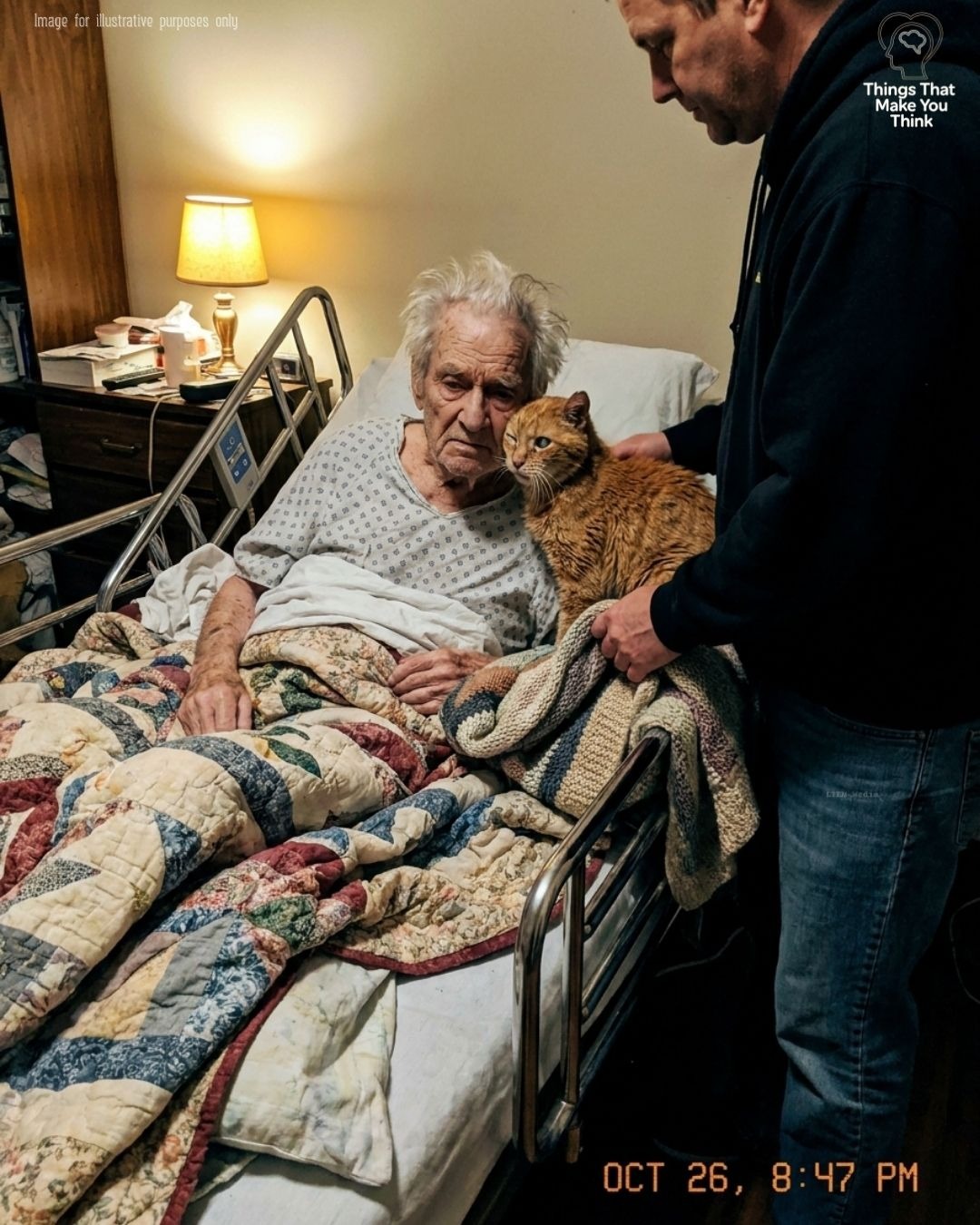
“Like, ‘He found great comfort in the companionship of his cat, Copper.’”
Nobody spoke.
Mark raised both hands a little.
“I’m just saying. It’s true. And it doesn’t make the whole thing about the cat.”
Rachel stared at the notebook.
I stared at Mark.
In fifteen years, that might have been the most useful thing he had ever said in our family.
Rachel picked up the pen.
Her hand shook.
She wrote it down.
Slowly.
“He found great comfort in the companionship of his cat, Copper.”
Then she looked at me.
“There. Happy?”
“No,” I said.
And I meant it.
None of this was happiness.
It was just a small mercy.
The next morning, I drove Copper to the animal clinic.
I went alone.
Rachel offered to come, but I told her I needed to do it myself.
Not because she didn’t deserve to.
Because Copper had come out from under the recliner for me.
I owed him the last ride.
I placed him in a small cardboard carrier lined with Dad’s flannel.
Not shoved.
Not trapped.
Talked to.
Just like Dad had asked.
I drove slow.
At every red light, I looked over.
“I’m sorry, buddy,” I said.
The carrier did not move.
Of course it didn’t.
But I kept talking.
I told him Dad was proud of him.
I told him he had done his job.
I told him I was sorry for every time I had called him “just a cat.”
When I arrived, a woman with gray-streaked hair met me at the side door.
She did not make me stand in a waiting room with people holding leashes and laughing children.
She brought me to a quiet room with a faded couch and a box of tissues.
There was a small lamp on.
No bright ceiling lights.
I appreciated that more than I could say.
She asked if I wanted time.
I nodded.
Then she left.
I opened the carrier.
Copper looked like he was sleeping.
I touched the torn ear.
“I need you to look after him,” I whispered.
Then I laughed, because it was a ridiculous thing to say.
Then I cried, because it was exactly what I meant.
The woman came back in.
She asked if I wanted the collar.
Copper’s collar was old brown leather with a tiny copper-colored tag.
Dad had punched extra holes in it over the years as Copper got thinner.
I held it in my palm.
It smelled faintly of dust and Dad’s house.
“Yes,” I said.
Then I asked, “Can I put something with him?”
She nodded.
I had brought a note.
Just one sentence.
Written on Dad’s old grocery pad.
You stayed with him. Now rest.
I folded it and tucked it beside Copper.
The woman’s eyes got wet.
She did not make a show of it.
She simply said, “That’s beautiful.”
When I got back to Dad’s house, Rachel was in the living room.
She had not cleaned.
She had not packed.
She was sitting in Dad’s recliner with Copper’s old blanket on her lap.
At first, I thought she was cold.
Then I saw the photo in her hand.
It was an old picture of Dad asleep on the couch.
Copper was stretched across his chest, one paw on Dad’s chin.
Dad’s mouth was open.
Copper looked annoyed.
Rachel was crying so quietly I almost backed out of the room.
But she saw me.
She held up the photo.
“I took this,” she said.
“I remember.”
“Thanksgiving. Four years ago.”
“Dad burned the rolls.”
She laughed through her tears.
“He said Copper distracted him.”
“He did.”
Rachel wiped her face.
“I forgot I took it.”
She looked down at the photo again.
“I forgot he smiled like this.”
I sat on the couch across from her.
The room felt different without Copper.
Even his absence had weight.
Rachel said, “I found a box.”
“What box?”
She pointed toward the hallway.
“In the closet. It has your name on it.”
I followed her.
Dad’s hall closet smelled like old coats and cedar blocks.
On the top shelf was a shoebox.
My name was written on it in Dad’s handwriting.
ETHAN — WHEN YOU’RE READY