Her face changed.
“Ethan.”
“What?”
“You can’t carry him around all day.”
“I know.”
“I’m serious.”
“So am I.”
She rubbed her forehead.
“I know Dad loved him. I do. But please don’t turn this into some strange thing.”
That was the first sentence that cracked something open in me.
“Strange?”
“You know what I mean.”
“No, Rachel. I really don’t.”
She looked at Dad again.
Her eyes filled, but she blinked the tears back fast.
That was Rachel.
She cleaned before she cried.
She organized before she felt.
She made lists because lists did not ask questions.
“I mean,” she said carefully, “Dad was a man. A father. A husband. A veteran of hard years. A person. Copper was a cat.”
I stood up slowly.
Copper’s body was light against my chest.
“So?”
“So we need to keep some perspective.”
That word.
Perspective.
People use it when they want your grief to stand in a smaller room.
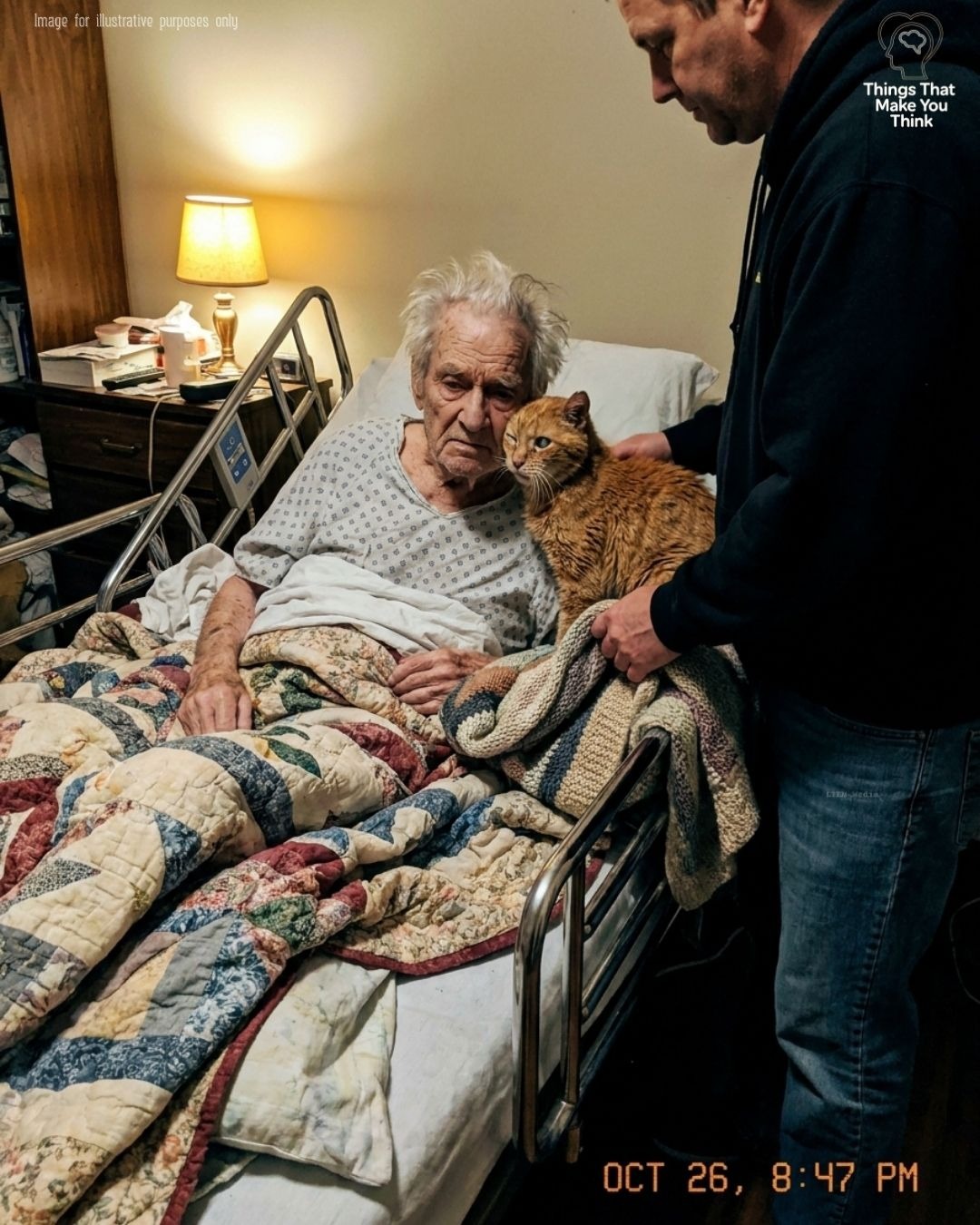
I looked at my father’s hand lying on the blanket.
The hand I had held until dawn.
The hand Copper had purred under until the last breath.
“Dad asked for him,” I said.
“I know.”
“No, you don’t.”
Her face hardened.
“I lost him too.”
“I’m not saying you didn’t.”
“You think because you were here at the end, you understand him better?”
That one landed.
Because it was partly true.
And partly unfair.
And grief loves anything unfair.
“I think Copper was here when we weren’t,” I said.
Rachel stared at me.
Mark looked down at his shoes.
The room went cold.
Then Rachel said the words that would follow me for days.
“Maybe that’s the problem.”
I did not answer.
Because I understood what she meant.
And I hated her for meaning it.
She meant the cat had become an accusation.
A small orange witness.
A creature who had sat beside Dad through all the quiet years when his children called less, visited less, told themselves he was fine because he always said he was fine.
Copper had seen the truth.
We had not.
That made him hard to look at.
The funeral home workers came near noon.
Two kind men in dark coats stepped softly through the house.
One was older, with silver hair and tired eyes.
The other was young and kept swallowing like he was trying not to feel too much.
They handled Dad with a gentleness that nearly undid me.
Rachel stood in the hall with her arms folded.
Mark signed something at the kitchen table.
I stood near the bedroom door, still holding Copper.
The older funeral director noticed.
He did not flinch.
He did not smile.
He just said, “That his cat?”
I nodded.
“Name?”
“Copper.”
The man looked toward Dad.
Then back at the bundle in my arms.
“Good cat,” he said.
Two words.
That was all.
But they gave Copper more dignity than my sister had managed all morning.
Rachel heard him.
Her jaw tightened.
After they took Dad, the house seemed to collapse inward.
The bed looked wrong without him.
The quilt had a dent where Copper had stayed pressed to his chest.
I sat on the floor beside it.
I finally laid Copper on Dad’s flannel shirt and wrapped him carefully.
The shirt still smelled like cedar, soap, and the faint old-man sweetness of cough drops.
Copper deserved that.
Rachel came in with a trash bag.
I looked at it.
She looked at Copper.
“Not him,” she said quickly. “I’m not a monster.”
I didn’t say anything.
She set the bag down.
“I thought I’d start with medical supplies. Empty bottles. Things like that.”
“Not today.”
“We can’t leave everything.”
“Yes, we can.”
“Ethan.”
“Today, we can.”
She breathed out hard.
“You always do this.”
“What?”
“Make me the bad guy because I’m the one who handles things.”
I almost laughed.
Not because it was funny.
Because it was exactly the kind of fight we had been rehearsing for years.
Rachel was the responsible one.
I was the emotional one.
That was the family story.
The problem was, family stories are often written by whoever talks first.
“I’m not making you the bad guy,” I said.
“You are. You’re looking at me like I came here with a shovel.”
“You came in with a trash bag.”
Her mouth opened.
Then shut.
For the first time that day, she looked ashamed.
She lowered herself onto the chair beside the bed.
The same chair where Dad used to sit to put on his socks.
“I don’t know what to do,” she whispered.
That softened me.
Because the truth was, neither did I.
We were two grown children standing in the ruins of a man who had raised us and then quietly disappeared inside himself.
We had jobs.
Mortgages.
Appointments.
Group texts.
Calendars full of things that felt urgent until death stepped into the room and made them all look foolish.
Rachel stared at Copper.
“He really stayed all night?”
“Yes.”
“Did Dad know?”
“Yes.”
She covered her mouth.
“He must have been so scared.”
I shook my head.
“No. I think he was less scared because Copper was there.”
Rachel looked away.
A tear slipped down her cheek.
She wiped it fast, almost angrily.
“I hated that cat sometimes,” she said.
I looked at her.
She gave a broken little laugh.
“Isn’t that awful?”
“Yes,” I said.
Then I added, “But honest.”
She nodded.
“I’d call Dad, and he’d say, ‘Copper’s on my lap, can I call you later?’ Or I’d come over, and he’d talk to Copper like he was a person, then barely ask about my kids.”
“He asked about them.”
“Not like before.”
I had no defense for that.
Because Dad had changed after Mom died.
He loved us.
But grief had moved into his throat and locked some doors.
Rachel wiped her cheek again.
“I think I was jealous of a cat.”
She laughed once more.
This time, it sounded like pain.
“I am forty-six years old, and I was jealous of an old cat with one good eye.”
I sat beside her.
For a while, we just looked at Copper.
Then Rachel whispered, “That’s pathetic.”
“No,” I said.
“It is.”
“It’s human.”
She leaned forward, elbows on knees.
“I wanted Dad back.”
“I know.”
“And he gave all the soft parts to Copper.”
That sentence stayed in the room.
Because it was true in a way neither of us wanted.
Dad had not stopped loving us.
But he had stopped knowing how to reach us.
Copper did not require explanations.
Copper did not ask why he missed Mom so much after five years.
Copper did not say, “You should get out more.”
Copper did not tell him to join a group.
Copper did not look uncomfortable when he cried during old songs.
Copper just climbed onto his chest and stayed.
That kind of love can feel unfair to the people who have words.
Especially when we use those words badly.
That afternoon, I called a small animal clinic on the edge of town.
I asked what people did in situations like this.
My voice broke halfway through the question.
The woman on the phone did not rush me.
She said, “You would be surprised how often pets go right after their person.”
I closed my eyes.
“Really?”
“Yes,” she said. “Some hearts are attached in ways we don’t measure.”
Rachel stood across the kitchen, listening.
She pretended not to.
The woman explained the options.
Private cremation.
A simple wooden box.
A clay paw print.
No pressure.
No sales voice.
Just kindness.
I asked how soon.
She said we could bring Copper that day, or the next morning.
I looked toward the living room.
The recliner sat empty.
The blanket on the back of it still had orange hairs on it.
“Tomorrow,” I said.
I couldn’t let him leave the house twice in one day.
That evening, Rachel and I made funeral arrangements at Dad’s kitchen table.
It was the same table where he had taught me how to count change.
The same table where Mom had rolled pie dough.
The same table where Dad had sat alone for years, sharing toast crusts with a cat.
Rachel had a notebook.
Of course she did.
She wrote down flowers, service time, burial clothes, music.
Then she said, “Obituary.”
I nodded.
She started drafting.
“Beloved father of Ethan and Rachel. Grandfather of three. Preceded in death by his wife, Marianne.”
She paused.
Her pen hovered.
I said nothing.
She knew.
She looked up slowly.
“No.”
“I didn’t say anything.”
“You were about to.”
“Copper mattered.”
“Not in the obituary.”
“Why not?”
“Because people will think it’s strange.”
“There’s that word again.”
Rachel put the pen down.
“Obituaries are for people.”
“Obituaries are for telling the truth about a life.”
“Copper was not a relative.”
“He was family.”
Rachel stood up so fast the chair scraped.
“Do you hear yourself?”
“Yes.”
“No, I don’t think you do. Dad died. Our father died. And you are arguing over whether to name a cat in the newspaper.”
“I’m arguing over whether we are allowed to tell the truth.”
“The truth is Dad had children.”
“The truth is Dad had children who were busy.”
Her face changed.
I regretted it immediately.
But the words were already alive.
Rachel’s voice dropped.
“Say it.”
I looked away.
“Say what you mean.”
“I don’t want to.”
“Yes, you do.”
So I said it.
“We left him lonely.”
Rachel went still.
Even the kitchen seemed to stop breathing.
Mark, who had been sitting in the living room pretending not to hear, turned his head.
Rachel’s eyes filled again.
This time she did not wipe them.
“You left too,” she said.
“I know.”
“No, you don’t get to make this about me.”
“I’m not.”
“You live twenty minutes away.”
“I know.”
“I live two hours away with three kids and a job that eats me alive.”
“I know.”
“Do you?”
Her voice cracked.
“Because every time I called, he said he was fine. Every time I offered to come, he said not to fuss. Every holiday, he said he didn’t want a big thing. What was I supposed to do, break down his door?”
I had no answer.
That was the terrible part.
We had both failed him.
And we had both been given reasons that sounded acceptable at the time.
That is how neglect often works.
Not as cruelty.
As delay.
As later.
As next week.
As “he said he was fine.”
I sat back down.
My anger had drained out, leaving only shame.
“I’m not saying you didn’t love him,” I said.
Rachel whispered, “Then don’t say I left him.”
I nodded.
“You’re right.”
She sat down again.
The pen lay between us like a tiny weapon.
After a long silence, Mark spoke from the living room.
His voice was careful.
“What if it said something simple?”
Rachel looked at him.
He cleared his throat.