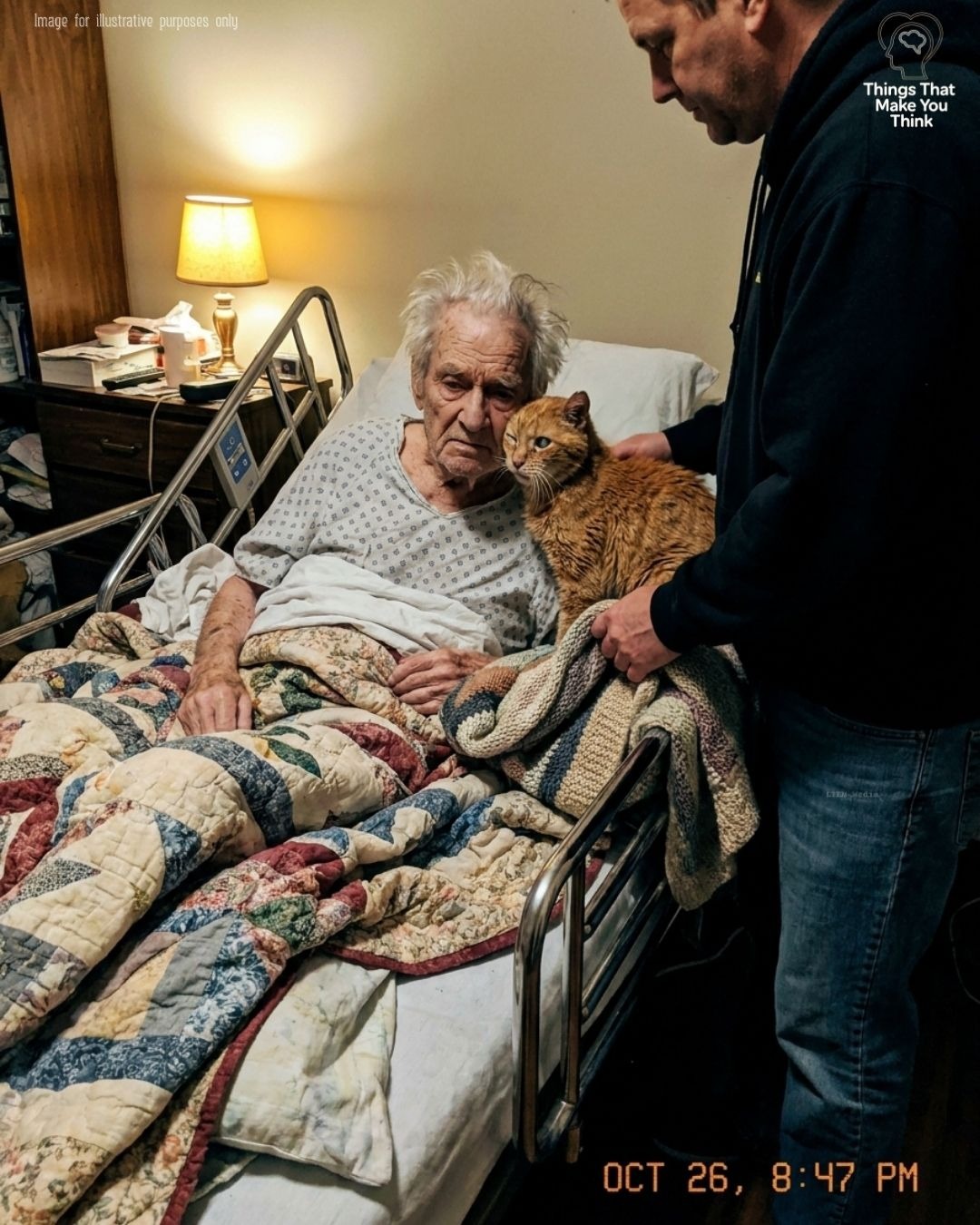
“Like, ‘He found great comfort in the companionship of his cat, Copper.’”
Nobody spoke.
Mark raised both hands a little.
“I’m just saying. It’s true. And it doesn’t make the whole thing about the cat.”
Rachel stared at the notebook.
I stared at Mark.
In fifteen years, that might have been the most useful thing he had ever said in our family.
Rachel picked up the pen.
Her hand shook.
She wrote it down.
Slowly.
“He found great comfort in the companionship of his cat, Copper.”
Then she looked at me.
“There. Happy?”
“No,” I said.
And I meant it.
None of this was happiness.
It was just a small mercy.
The next morning, I drove Copper to the animal clinic.
I went alone.
Rachel offered to come, but I told her I needed to do it myself.
Not because she didn’t deserve to.
Because Copper had come out from under the recliner for me.
I owed him the last ride.
I placed him in a small cardboard carrier lined with Dad’s flannel.
Not shoved.
Not trapped.
Talked to.
Just like Dad had asked.
I drove slow.
At every red light, I looked over.
“I’m sorry, buddy,” I said.
The carrier did not move.
Of course it didn’t.
But I kept talking.
I told him Dad was proud of him.
I told him he had done his job.
I told him I was sorry for every time I had called him “just a cat.”
When I arrived, a woman with gray-streaked hair met me at the side door.
She did not make me stand in a waiting room with people holding leashes and laughing children.
She brought me to a quiet room with a faded couch and a box of tissues.
There was a small lamp on.
No bright ceiling lights.
I appreciated that more than I could say.
She asked if I wanted time.
I nodded.
Then she left.
I opened the carrier.
Copper looked like he was sleeping.
I touched the torn ear.
“I need you to look after him,” I whispered.
Then I laughed, because it was a ridiculous thing to say.
Then I cried, because it was exactly what I meant.
The woman came back in.
She asked if I wanted the collar.
Copper’s collar was old brown leather with a tiny copper-colored tag.
Dad had punched extra holes in it over the years as Copper got thinner.
I held it in my palm.
It smelled faintly of dust and Dad’s house.
“Yes,” I said.
Then I asked, “Can I put something with him?”
She nodded.
I had brought a note.
Just one sentence.
Written on Dad’s old grocery pad.
You stayed with him. Now rest.
I folded it and tucked it beside Copper.
The woman’s eyes got wet.
She did not make a show of it.
She simply said, “That’s beautiful.”
When I got back to Dad’s house, Rachel was in the living room.
She had not cleaned.
She had not packed.
She was sitting in Dad’s recliner with Copper’s old blanket on her lap.
At first, I thought she was cold.
Then I saw the photo in her hand.
It was an old picture of Dad asleep on the couch.
Copper was stretched across his chest, one paw on Dad’s chin.
Dad’s mouth was open.
Copper looked annoyed.
Rachel was crying so quietly I almost backed out of the room.
But she saw me.
She held up the photo.
“I took this,” she said.
“I remember.”
“Thanksgiving. Four years ago.”
“Dad burned the rolls.”
She laughed through her tears.
“He said Copper distracted him.”
“He did.”
Rachel wiped her face.
“I forgot I took it.”
She looked down at the photo again.
“I forgot he smiled like this.”
I sat on the couch across from her.
The room felt different without Copper.
Even his absence had weight.
Rachel said, “I found a box.”
“What box?”
She pointed toward the hallway.
“In the closet. It has your name on it.”
I followed her.
Dad’s hall closet smelled like old coats and cedar blocks.
On the top shelf was a shoebox.
My name was written on it in Dad’s handwriting.
ETHAN — WHEN YOU’RE READY
My chest tightened.
I took it down.
Rachel stood behind me.
“You should open it,” she said.
“At the kitchen table.”
We sat where we had sat the night before.
I lifted the lid.
Inside were photos.
Copper in the sink.
Copper in a laundry basket.
Copper sitting on Dad’s newspaper.
Copper on the porch rail, looking furious at snow.
There were vet receipts.
Handwritten notes.
A little orange toy shaped like a fish.
And at the bottom, an envelope.
My name was on it.
I did not want to open it.
That sounds strange.
But grief makes cowards of us in little ways.
A letter from the dead is not paper.
It is a voice with no body.
Rachel put her hand on the table.
“Do you want me to leave?”
“No.”
I opened it.
Dad’s handwriting was shaky.
Not from the very end.
Maybe a year old.
Maybe two.
The first line nearly knocked the air out of me.
Son, if you’re reading this, I probably got quiet again.
I stopped.
Rachel covered her mouth.
I kept reading.
I know I did that after your mother passed.
I know it hurt you.
I know it hurt Rachel too.
I didn’t mean to make you feel shut out. I just didn’t know how to be half of myself in front of people who remembered me whole.
I pressed my fist to my mouth.
Rachel whispered, “Oh, Dad.”
I read on.
Copper did not remember me before.
He did not know the man I was when your mother was alive.
He only knew the man who sat in the chair and forgot to turn on lights.
That made it easier.
I had to stop again.
Because there are sentences that explain years in one blow.
Rachel got up and brought water.
Neither of us drank it.
I kept reading.
You used to tease me and say he was just a cat. You stopped after I told you he noticed when I came home. I was grateful for that.
But I never told you the whole truth.
There were nights when I only came home because he was waiting.
Rachel made a sound like someone had touched a bruise.
I looked at her.
Her face had gone white.
I kept reading, but slower.
Not because I wanted to leave this world. Don’t put that on yourself.
I mean there were nights when the house felt so empty I drove around longer than I needed to.
I sat in parking lots. I sat by the river. I sat outside the diner with coffee I didn’t want.
Then I would picture that ugly orange face in the window.
And I would go home.
The letter blurred.
I wiped my eyes with the back of my hand.
Rachel was shaking.
People say animals don’t understand. Maybe they don’t.
But Copper understood enough to sit beside me when words felt like heavy furniture I couldn’t move.
That was enough.
I smiled through tears at that.
Heavy furniture.
That was Dad.
Plain words carrying more than they showed.
If he outlives me, please don’t let anyone treat him like an old object left behind.
Talk to him first. He understands more than people think.
I stopped reading.
I looked at Rachel.
She looked at me.
We both remembered Dad’s last words about the carrier.
He had not been rambling.
He had been quoting himself.
He had been making sure I knew.
My hands shook as I finished.
And if he goes before me, bury his collar with me if the rules allow it.
If they don’t, keep it somewhere warm.
No fuss.
No big speech.
Just don’t let anyone say he was only a cat.
He was the little life that helped me stay with mine.
The letter ended with Dad’s name.
Not “Dad.”
His name.
Thomas.
As if he wanted me to remember he had been a man before he was our father.
Rachel stood up and walked to the sink.
She gripped the counter with both hands.