Her shoulders shook.
I did not go to her right away.
Sometimes grief needs privacy even in the same room.
Finally she whispered, “I said it.”
“What?”
“I said he was just a cat.”
I folded the letter carefully.
“You didn’t know.”
“I should have.”
“We all should have.”
She turned around.
Her face was wet and open in a way I had not seen since we were kids.
“I don’t want to be the person who made Dad’s last comfort feel embarrassing.”
“You’re not.”
“I was.”
“You were scared.”
“That’s not the same as right.”
I had no argument.
She came back to the table and picked up Copper’s collar.
The tiny tag caught the kitchen light.
She rubbed it with her thumb.
“I think it should go with Dad.”
I looked up.
“You do?”
She nodded.
“If they’ll allow it.”
The funeral director said yes.
Not the ashes.
Not Copper’s body.
But the collar could be placed with Dad.
A small personal item.
A memory.
A promise.
Rachel was the one who asked.
I watched her stand in that quiet office, shoulders straight, voice shaking, and say, “Our father wanted his cat’s collar with him.”
The funeral director did not blink.
He said, “Then that’s what we’ll do.”
Rachel cried in the parking lot afterward.
Not loud.
Not dramatic.
Just standing beside her car with one hand over her eyes.
“I hate that I understand it too late,” she said.
I leaned against the door beside her.
“I think everybody understands something too late.”
She nodded.
“That should be on a sympathy card.”
“It would be the only honest one.”
She laughed.
Then cried again.
The funeral was three days later.
The sky was the color of dishwater.
Cold rain tapped against the stained-glass windows of the little chapel.
People came in with wet coats and careful voices.
Neighbors.
Old coworkers.
A man from Dad’s hardware days.
Two women from Mom’s old quilting group.
A boy who was no longer a boy, who said Dad once fixed his bike chain without charging him.
Rachel’s children sat in the front row.
They looked uncomfortable in dress clothes.
Kids at funerals always look like they are trying to behave inside a room that makes no sense.
Dad’s casket was closed.
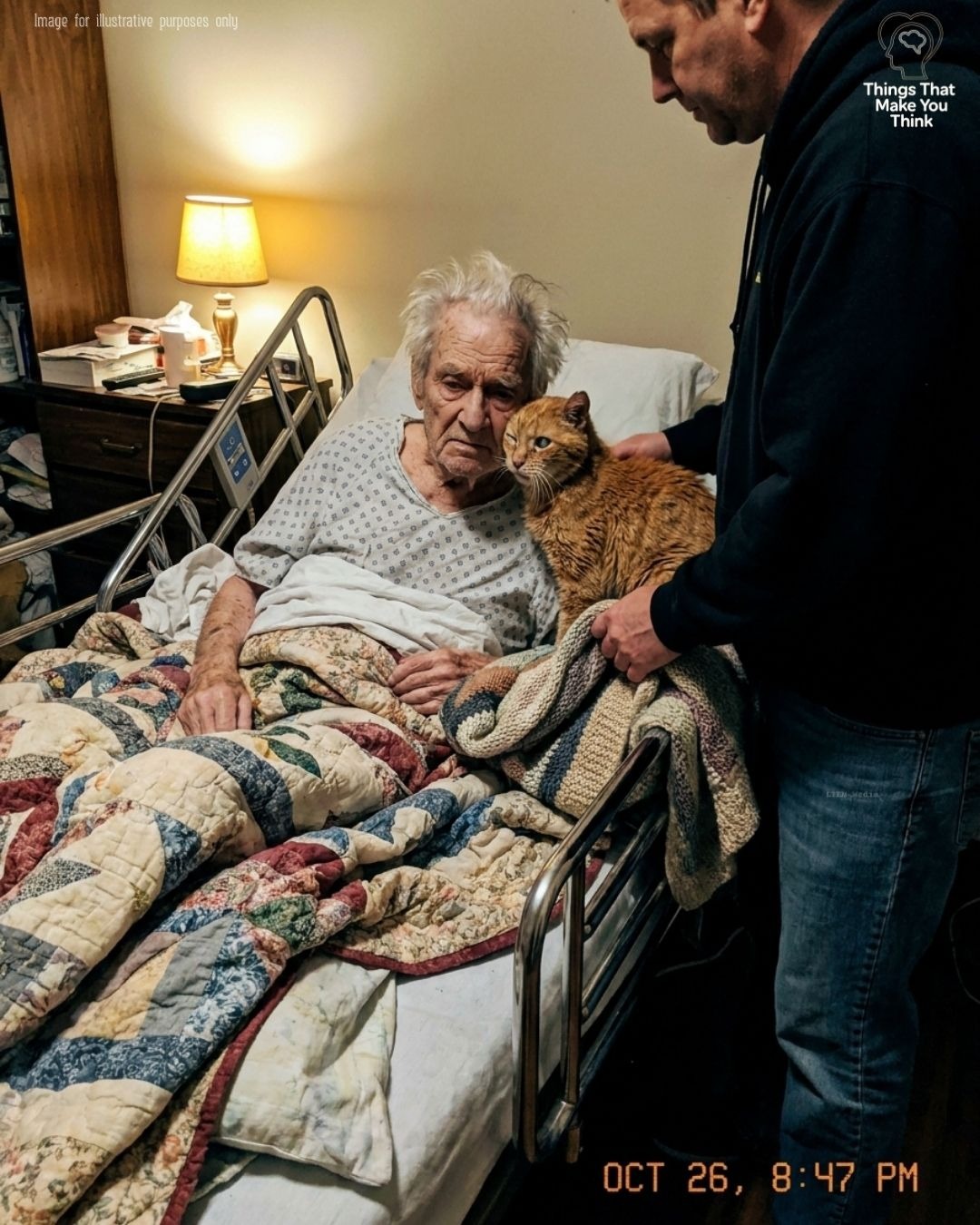
On top was a framed photo.
Not the stiff portrait Rachel wanted.
Not the one from his retirement party where he looked trapped in a tie.
It was the Thanksgiving picture.
Dad asleep on the couch.
Copper stretched across his chest.
One paw on his chin.
Rachel chose it.
When I saw it near the flowers, I nearly lost my footing.
Some people smiled when they saw it.
Some looked confused.
One older woman leaned close and whispered, “Oh, that cat.”
Like Copper had been a town resident.
Maybe he had.
Rachel stood beside me.
“Are you okay?”
“No.”
“Me neither.”
The service began.
There was music.
A prayer.
A reading.
Then the man leading the service invited me to speak.
I walked to the front with Dad’s letter folded in my jacket pocket.
I had planned to read from it.
But when I looked out at the room, I saw something I had not expected.
A lot of people were lonely.
You can see it sometimes.
Not because they look sad.
Because they hold themselves like they are used to taking up less space.
An older man sat alone in the back, twisting his hat.
A woman in a blue coat kept rubbing the empty chair beside her.
Dad’s neighbor, Mrs. Hanley, clutched a tissue like it was keeping her upright.
I looked at the photo of Dad and Copper.
Then I looked at Rachel.
She nodded.
So I spoke.
“My father was not an easy man to know after my mother died.”
The room went very still.
“He was kind. He was stubborn. He was proud. He would help you fix your fence before he would admit he needed help opening a jar.”
A few people laughed softly.
“He told us he was fine so often that we started believing him.”
My throat tightened.
“That is one of the things I will carry for the rest of my life.”
Rachel looked down.
I kept going.
“After Mom passed, Dad stopped going places. He stopped answering the phone sometimes. He stopped sitting on the porch.”
I looked at the photo.
“Then Copper showed up.”
A few smiles.
I heard someone whisper, “That old orange cat.”
“He was skinny. Half-wild. Bad-tempered. Missing pieces. Honestly, he looked like he had been assembled from spare parts.”
More laughter.
Gentle this time.
“Dad fed him. Copper hissed. Dad fed him again. Copper stayed.”
I paused.
“And for the next several years, that cat became the living thing that noticed when my father came home.”
The room blurred.
I took out Dad’s letter.
“My father wrote something I want to share.”
I unfolded the paper.
My hands shook badly enough that Rachel stood up.
For one second, I thought she was coming to stop me.
But she came to stand beside me.
Just beside me.
Like when we were kids at school Christmas programs and one of us forgot the words.
I read the line.
He was the little life that helped me stay with mine.
No one moved.
Then I heard a sound from the back.
The older man with the hat had covered his face.
His shoulders were shaking.
I folded the letter.
“I know some people will hear this and think, ‘It was just a cat.’”
I looked around the chapel.
“I used to think that too.”
I took a breath.
“But I don’t anymore.”
Rachel slipped her hand into mine.
I held it.
“Because sometimes the creature who saves a person is not the one with the right words. Sometimes it is the one who stays when words are gone.”
The room was silent.
Not empty silent.
Full silent.
“There are people in this room who called my father. There are people who visited. There are people who cared. I’m not here to blame anyone.”
I swallowed hard.
“I’m here to say we need to stop believing people every time they say they’re fine.”
A woman in the third row started crying.
“We need to check twice.”
A man nodded.
“We need to sit longer.”
Mrs. Hanley pressed a tissue to her mouth.
“We need to remember that loneliness does not always look like sadness. Sometimes it looks like a clean shirt, a mowed lawn, and a man who says, ‘Don’t fuss over me.’”
Rachel squeezed my hand.
“And we need to stop mocking the small comforts that keep people here.”
That was the line.
I did not know it would be.
But I felt it land.
Some people leaned forward.
Some looked away.
Some looked guilty.
Maybe I did too.
“Call it a pet. Call it family. Call it whatever makes you comfortable. But if an old orange cat helped my father survive his quietest years, then I will honor that cat in this room.”
I looked at Dad’s casket.
“Dad, Copper stayed.”
My voice broke.
“And we’re sorry we didn’t always understand what that meant.”
I could not say more.
Rachel wrapped her arm around mine and walked me back to the pew.
No one clapped.
Thank God.
Some moments do not need applause.
They need silence to do their work.
After the service, people came up to us.
Not all at once.
Slowly.
Like confession had formed a line.
Mrs. Hanley told us Dad used to leave Copper’s food bowl on the porch even during storms.
“He’d stand there in his slippers,” she said, “holding an umbrella over that cat like a fool.”
Rachel laughed through tears.
A retired mail carrier told me Copper used to follow Dad to the mailbox and swat at fallen leaves.
A woman from Mom’s quilting group said she had seen Dad at the grocery store buying tiny cans of cat food and pretending they were “for a neighbor.”
Then the older man with the hat came up.
He was tall but bent.
His eyes were red.
He shook my hand with both of his.
“My wife died two years ago,” he said.
“I’m sorry.”
He nodded.
“I got a little dog.”
He looked embarrassed saying it.
“A ridiculous thing. No teeth. Sleeps under my chair.”
I smiled.
He looked toward Dad’s photo.
“People laugh.”
My smile faded.
He swallowed.
“Your father would have understood.”
“Yes,” I said. “He would have.”
The man nodded once, put his hat back on, and walked out into the rain.
That moment alone would have been enough.
But grief was not done teaching us.
At the cemetery, the rain had stopped.
The ground was soft.
The air smelled like wet leaves and cold stone.
The funeral director approached us before the burial.
He held Copper’s collar in a small cloth pouch.
He looked at Rachel.
“You wanted to place it?”
Rachel looked at me.
I shook my head.
“No. You do it.”
Her lips trembled.
“Ethan.”
“He was your father too.”
She took the pouch.
For a second, she looked like a little girl holding something breakable.
The funeral director opened the casket just enough for the family.
No one else saw.
Rachel leaned in.
I stood beside her.
Dad looked peaceful in a way I didn’t trust.
People say that, but death does not look like sleep when you have sat beside it.
Still, his face was calm.
Rachel placed Copper’s collar beside Dad’s hand.
The copper tag rested against his sleeve.
She touched Dad’s fingers.
“I’m sorry,” she whispered.
Then she added, “He was not just a cat.”
I looked away.
Not because I didn’t want to hear it.
Because I did.
Too much.
When we stepped back, Rachel looked lighter.
Not healed.
Just lighter.
Sometimes doing the right small thing removes one stone from your pocket.