“Are they getting us out?”
“Yes.”
“Are you sure?”
I paused.
Then I told the truth.
“They’re getting the right people here. Until then, we’re going to be smart.”
There was a long silence.
Then Bethany said, “I like smart better than brave.”
I smiled despite myself.
“Me too.”
Behind me, students from the auditorium were being moved into interior hallways away from glass.
The polished career fair had transformed into something else.
The hedge fund tables became supply stations.
The software banners became makeshift signs.
The university tote bags were used to carry water.
The students who had spent the morning collecting business cards were now counting heads, guiding people with phone flashlights, and checking on anyone who seemed scared.
And the tech executive, the man who had waved me toward the service elevator, was standing in the center of the lobby repeating utility terminology into a phone like his life depended on getting every word right.
Maybe it did.
Maybe not his life.
But somebody’s.
After a few minutes, he covered the phone.
“They want to know if there’s a visible recloser near the pole.”
I walked to the window but stayed back from the glass.
“Tell them east side of science hall, pole-mounted equipment near the service drive. Line contact with large oak limb. Possible feeder damage. They need to isolate before anyone approaches.”
He repeated it.
Then listened.
Then looked at me.
“They’re asking who is giving the assessment.”
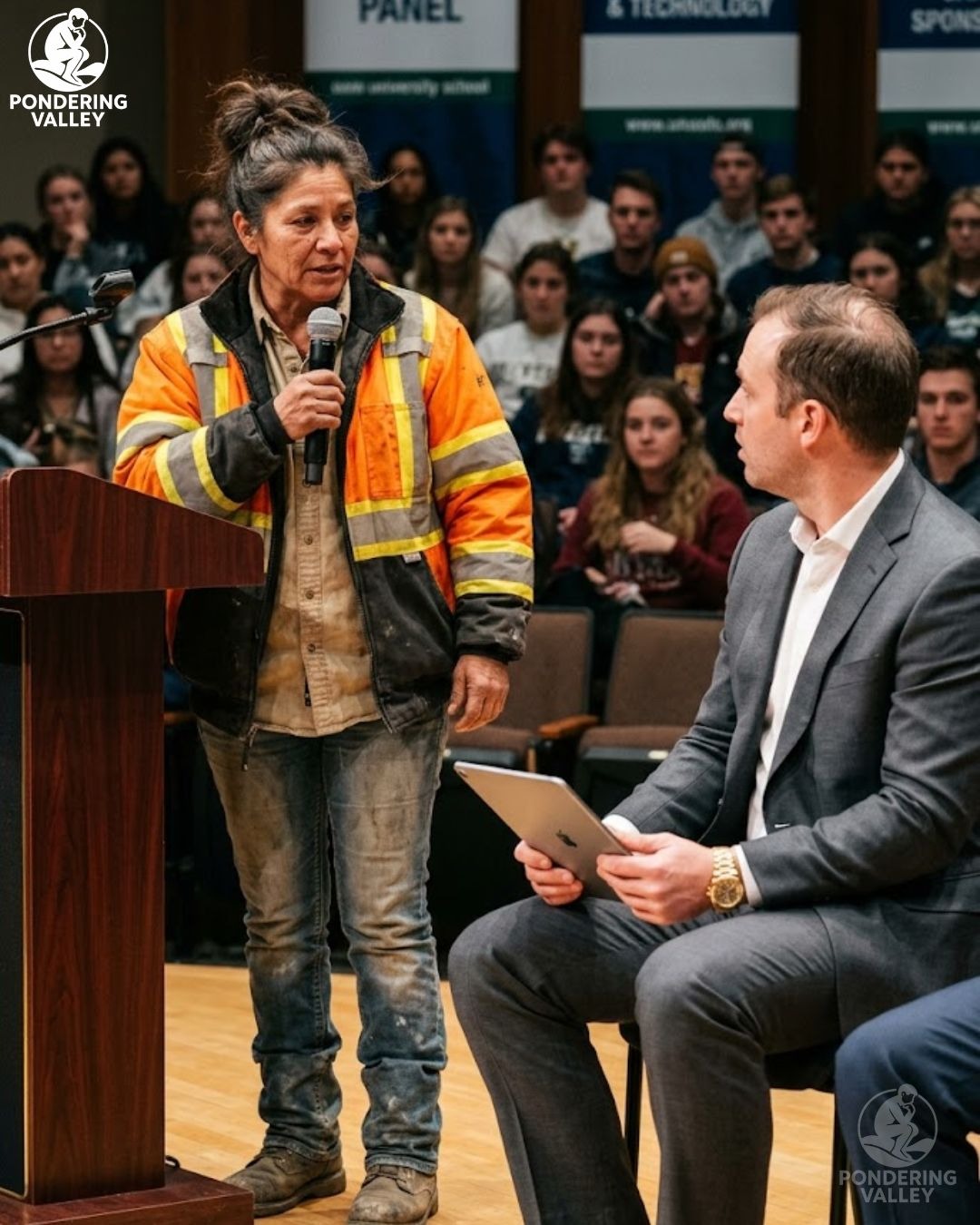
“Elena Ramirez. Journeyman lineman. Regional utility. Crew district seven.”
He repeated that too.
His eyebrows rose.
“They know your crew.”
“They should.”
He handed me the phone.
A woman’s voice came through, clipped and calm.
“Ramirez?”
“Speaking.”
“This is control. We’ve got your location. Your crew is tied up on a feeder fault two towns over, but we’ve got another crew rolling. Fifteen to twenty if roads hold.”
“Elevator entrapment, backup lighting failure, no building comms, students gathering outside.”
“Can you establish a safety perimeter?”
“Inside, yes. Outside, only through campus security.”
“Do not approach the line.”
“I wasn’t planning to.”
A tiny pause.
Then she said, “I know you weren’t. Had to say it.”
“I know.”
We understood each other.
That’s the thing about people who work dangerous jobs.
The rules are not suggestions.
They are memorials written by people who didn’t get second chances.
I handed the phone back.
The dean had heard enough to understand the timeline.
“Fifteen to twenty minutes,” she said.
“Maybe.”
Her face tightened.
“Maybe?”
“Roads. Wind. Other outages. Reality.”
She rubbed her forehead.
“This is going to be a disaster.”
I looked at the trapped elevator.
“It already is. The question is whether it becomes a tragedy.”
She looked at me sharply.
Good.
Sometimes people in charge need plain language.
Not cruelty.
Plainness.
Maya came back with water, granola bars, and a campus maintenance map she had ripped from a wall display.
“I found this,” she said.
I almost laughed.
“That’s my girl.”
Her cheeks flushed with pride.
The map showed service corridors, mechanical rooms, stairwells, and exits.
Nothing that would let us repair the elevator.
But plenty that would let us manage people.
I gathered a small group around me.
Maya.
The security guard.
The tech executive.
Two engineering students.
The dean.
“Listen carefully,” I said. “We’re not fixing the electrical system. We’re managing the human system.”
They stared at me.
“That means three things. Keep people away from danger. Keep people calm. Keep information moving.”
I pointed to the guard.
“You control doors. Nobody exits east. Use students to block hallways if needed.”
He nodded.
I pointed to the dean.
“You make announcements every three minutes. Calm. Specific. No vague reassurance. Tell them help is coming, what areas are safe, and what not to do.”
She nodded.
I pointed to the tech executive.
“You stay on comms. If that phone dies, find another with signal. You are the relay.”
He swallowed.
“Yes.”
I pointed to Maya.
“You coordinate volunteers. Water, headcounts, anyone with medical training, anyone who needs assistance moving.”
She stood taller.
“Got it.”
Then I went back to the elevator.
“Priya, I need you to do something for me.”
“I’m listening.”
“Keep everyone talking. No yelling. No pacing if there’s room. Sit if you can. Slow breaths. Tell me if anyone gets dizzy.”
“Okay.”
Jonah said weakly, “Can you tell us a story?”
I blinked.
“A story?”
“Anything. I just need not to think about the walls.”
I looked down at my boots.
Then at the tech executive.
Then at the dark lobby full of students.
“Alright,” I said.
I sat on the cold marble floor beside the elevator doors.
Expensive floor.
Old money floor.
The kind of floor that had probably never had a line worker sitting cross-legged on it with grease under her nails.
“I’ll tell you about my first pole climb,” I said.
The lobby quieted.
Not completely.
But enough.
“My first instructor was a man named Gus. Meanest old goat I ever met. Voice like gravel in a coffee can. He told me the pole didn’t care about my feelings, my plans, or my college transcripts. It only cared whether I respected gravity.”
A few students nearby laughed softly.