I heard another boom in the distance.
Smaller this time.
Campus was trying to reroute itself and failing.
The tech executive’s phone suddenly buzzed.
He stared at it like it had risen from the dead.
“I got one bar.”
“Call emergency dispatch,” I said. “Report a live wire hazard on the east campus loop, tree contact, transformer failures, trapped elevator occupants, backup lighting failure.”
He looked overwhelmed.
I grabbed his wrist, steadying the phone.
“Repeat it exactly.”
He nodded and made the call.
His voice shook at first.
Then it steadied.
Maybe because this was finally something he could do.
Maybe because someone had given him a task instead of a title.
The dean turned toward me.
“Ms. Ramirez, I need to ask…”
“No.”
“I haven’t asked yet.”
“You’re about to ask whether I can fix it.”
Her mouth closed.
“I can’t,” I said. “Not alone. Not without my crew. Not without proper clearance, gear, switching orders, and utility coordination.”
“But you know what’s wrong.”
“Knowing what’s wrong doesn’t give me permission to risk lives.”
That sentence sat between us.
Heavy.
Uncomfortable.
Useful.
Because that was the moral dilemma that would divide that campus for weeks afterward.
There were people trapped.
Buildings were dark.
A live wire was threatening the quad.
And I was the only person in sight who understood the danger.
But understanding danger is not the same as being allowed to play hero.
Hero stories are cute when someone else writes them.
In my world, shortcuts get people buried.
The dean’s eyes were wet.
“There are students in that elevator.”
“I know.”
“And if facilities can’t reach us?”
“Then we keep them alive until the right help does.”
She looked toward the dark auditorium full of frightened students.
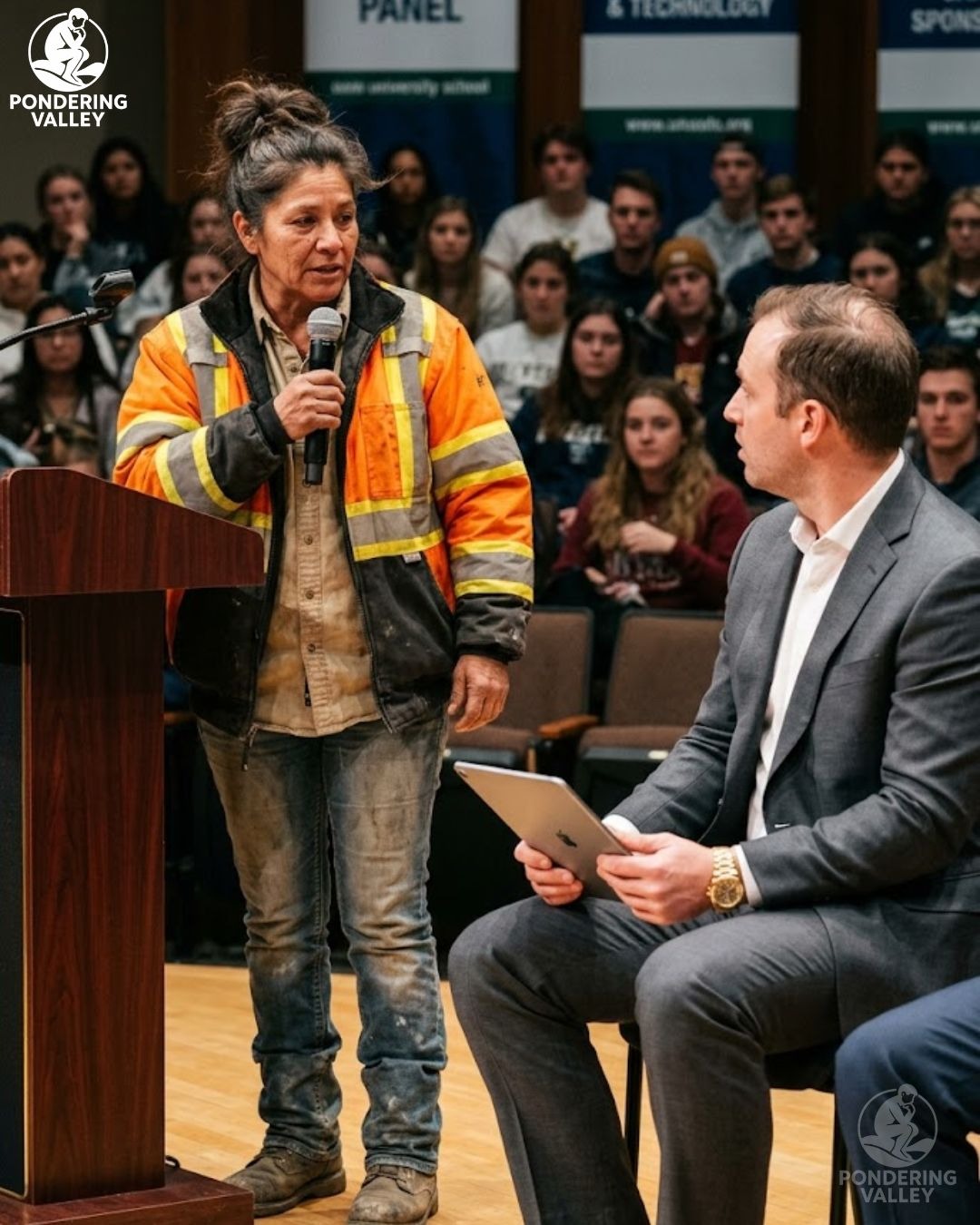
“You just told them tradespeople are the backbone of civilization.”
“I did.”
“Then help us.”
I stepped closer to her.
“I am helping you. I’m helping you by not making this worse.”
She flinched.
Not because I was cruel.
Because I was right.
The hardest thing in an emergency is not action.
It is disciplined restraint.
It is standing ten feet from something you know how to solve and not touching it because the missing piece might be the piece that kills a kid.
The tech executive returned.
“Dispatch is sending city fire and the utility company. They said severe wind damage is affecting multiple blocks.”
“Good,” I said. “Ask if they can patch you to the utility control center.”
He did.
While he waited, I turned to Maya.
“Find bottled water. Any cafeteria, green room, vending area. Bring it here. Take someone with you. Stay inside.”
She nodded.
“I’m on it.”
The security guard said, “I’ll go with her.”
“No,” I said. “You stay visible. People follow uniforms in a crisis. Even bad ones.”
His face changed when I said that.
Not insulted.
Straightened.
Like somebody had suddenly placed value on his shoulders.
“Yes, ma’am.”
Maya took two engineering students with her and disappeared down the hall.
I went back to the elevator doors.
“Priya?”
“I’m here.”
“Talk to me.”
“Jonah is breathing. Bethany is okay. She says her chair is locked and she’s stable.”
“Good. You’re doing great.”
Bethany’s voice came through next.